June 30, 2011

‘100,000,000 Guinea Pigs: Dangers in Everyday Foods, Drugs, and Cosmetics’ is a book written by Arthur Kallet and F.J. Schlink first released in 1933. Its central argument propounds that the American population is being used as guinea pigs in a giant experiment undertaken by the American producers of food stuffs and patent medicines and the like. Kallet and Schlink premise the book as being ‘written in the interest of the consumer, who does not yet realize that he is being used as a guinea pig…’
The book’s key proposition is that a great deal of products sold to the public – particularly pharmaceuticals and food products – are released with little regard or knowledge of how these products adversely impact the consumer. Corporations, often knowingly, release products which either do not do what they purport to, or have dangerous side effects or defects. Furthermore, many officials and government departments, namely the U.S. Food and Drug Administration, have fallen victim to regulatory capture (control by industry it is charged with regulating).
read more »
Posted in Health, Money, Politics |
Leave a Comment »
June 27, 2011

‘The Third Chimpanzee: The Evolution and Future of the Human Animal’ (1991) is a wide-ranging book by Jared Diamond, professor of geography and physiology at UCLA, which applies insights from biology, anthropology, and linguistics to questions such as why one species of big mammal (humans) came to dominate its closest relatives, such as chimpanzees, and why one group of humans (eurasians) came to dominate others (Indigenous peoples of the Americas).
It also examines how asymmetry in male and female mating behavior is resolved through differing social structures across cultures, and how first contact between unequal civilizations almost always results in genocide. The book ends by noting that technological progress may cause environmental degradation on a scale leading to extinction. Diamond expanded on these themes in subsequent books: ‘Guns, Germs and Steel’ (1997), ‘Why Is Sex Fun? (1997), and ‘Collapse’ (2005).
read more »
Posted in Science, Sex, War |
Leave a Comment »
June 27, 2011


Work is a book published by Crimethinc Far East, a decentralized anarchist publishing collective. It covers a wide range of economic, political, and philosophical issues, mostly relating to the ethical and utilitarian implications of Capitalism. Central to the book’s theme is that Capitalism is inherently immoral and inevitably causes massive wealth inequality and degradation of general human experience.
The book focuses specifically on the causes and effects crises suffered by capitalist economies, such as the 2008 financial crisis, and how the people can subvert global Capitalism to create a better future. The book features an ‘updated’ version of the Pyramid of the Capitalist System, designed by American artist, Packard Jennings, on the inside flap.
Posted in Money, Philosophy, Politics |
Leave a Comment »
June 12, 2011

‘The Black Swan: The Impact of the Highly Improbable’ is a book by Lebanese American, philosopher Nassim Nicholas Taleb. The book focuses on the extreme impact of certain kinds of rare and unpredictable events (outliers) and humans’ tendency to find simplistic explanations for these events retrospectively, after the fact. This theory has since become known as the black swan theory. The book also covers subjects relating to knowledge, aesthetics, and ways of life, and uses elements of fiction in making its points.
Taleb, bestselling author of ‘Fooled by Randomness,’ treats uncertainty and randomness as a single idea. The main idea in Taleb’s book is not to attempt to predict Black Swan Events, but to build robustness into negative ones that occur and being able to exploit positive ones. Taleb contends that banks and trading firms are very vulnerable to hazardous Black Swan Events and are exposed to losses beyond those that are predicted by their defective models.
read more »
Posted in Language, Philosophy, Science |
Leave a Comment »
June 3, 2011

Starship Troopers is a military science fiction novel by Robert A. Heinlein, first published (in abridged form) as a serial in ‘The Magazine of Fantasy & Science Fiction’ in 1959, published hardcover later that year. The first-person narrative is about a young soldier named Juan ‘Johnnie’ Rico and his exploits in the Mobile Infantry, a futuristic military unit equipped with powered armor.
Rico’s military career progresses from recruit to non-commissioned officer and finally to officer against the backdrop of an interstellar war between mankind and an arachnoid species known as ‘the Bugs.’ Through Rico’s eyes, Heinlein examines moral and philosophical aspects of suffrage, civic virtue, the necessities of war and capital punishment, and the nature of juvenile delinquency.
read more »
Posted in Art, Technology, War |
Leave a Comment »
June 3, 2011

Ender’s Game is a 1985 science fiction novel by American author Orson Scott Card that originated as the short story published in a 1977 issue of ‘Analog Science Fiction and Fact.’ Card released an updated version of Ender’s Game in 1991, changing some political facts to accurately reflect the times, including the decline of the Soviet Union. In his 1991 introduction, he discussed the influence of Isaac Asimov’s ‘Foundation’ series on the novel. Historian Bruce Catton’s work on the American Civil War also influenced him heavily. Set in Earth’s future, the novel presents an imperiled humankind who have barely survived two conflicts with the Formics (an insectoid alien race).
In preparation for an anticipated third invasion, an international fleet maintains a school to find and train future fleet commanders. The world’s most talented children, including the novel’s protagonist, Ender Wiggin, are taken at a very young age to a training center known as the Battle School. There, teachers train them in the arts of war through increasingly difficult games including ones undertaken in zero gravity in the Battle Room where Ender’s tactical genius is revealed. Reception to the book was generally positive, though some critics have denounced Card’s perceived justification of his characters’ violent actions. It has also become suggested reading for many military organizations, including the United States Marine Corps.
Posted in Art, Technology, War |
Leave a Comment »
June 3, 2011

The Forever War is a 1974 science fiction novel by American author Joe Haldeman, telling the contemplative story of soldiers fighting an interstellar war between humanity and the enigmatic Tauran species.
The pithy, insightful explorations of the inhumanity of war and of bureaucracy, and of the psychological effects resulting from time dilation space travel (a soldier returns home after centuries away), won acclaim immediately.
read more »
Posted in Art, Technology, War |
Leave a Comment »
May 25, 2011

The Shining is a 1977 horror novel by Stephen King. The title was inspired by the John Lennon song ‘Instant Karma!,’ which contained the line ‘We all shine on…’ It was King’s third published novel, and the success of the book firmly established him as a preeminent author in the horror genre. A film based upon the book, directed by Stanley Kubrick, was released in 1980.
After writing ‘Carrie’ and ‘Salem’s Lot,’ both of which are set in small towns in King’s home state of Maine, King was looking for a change of pace for the next book. He opened an atlas of the US on the kitchen table and randomly pointed to a location, which turned out to be Boulder, Colorado. So in early 1974, King and his wife, Tabitha, and their two children, Naomi and Joe, moved across the country to Colorado.
read more »
Posted in Art, Language |
Leave a Comment »
May 21, 2011

The Dragons of Eden: Speculations on the Evolution of Human Intelligence is a Pulitzer Prize winning 1977 book by Carl Sagan. In it, he combines the fields of anthropology, evolutionary biology, psychology, and computer science to give a perspective of how human intelligence evolved.
The opening quote is by Greek philosopher Plotinus: ‘Mankind is poised midway between the Gods and the Beasts.’
read more »
Posted in Language, Science |
Leave a Comment »
May 16, 2011
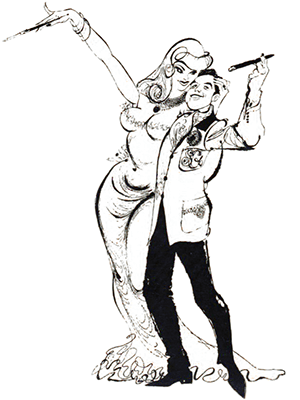
‘What Makes Sammy Run?‘ is a 1941 novel by Budd Schulberg. It is a rags to riches story chronicling the rise and fall of Sammy Glick, a Jewish boy born in New York’s Lower East Side who very early in his life makes up his mind to escape the ghetto and climb the ladder of success.
Reputedly, film mogul Samuel Goldwyn offered Schulberg money to not have the novel published, because Goldwyn felt that the author was perpetuating an anti-Semitic stereotype by making Glick so venal. It was later made into a long-running Broadway musical.
read more »
Posted in Art, Money |
Leave a Comment »
May 10, 2011

‘A Briefer History of Time‘ is a popular-science book published in 2005 from the English physicist Stephen Hawking and the American physicist Leonard Mlodinow. It is an update and rewrite of Hawking’s 1988 ‘A Brief History of Time.’
In this book Hawking and Mlodinow present quantum mechanics, string theory, the big bang theory, and other topics in a more accessible fashion to the general public. The book is updated with newly discovered topics, and informs of recurring subjects throughout the book in greater detail.
Posted in Education, Language, Science |
Leave a Comment »
May 10, 2011

‘A Brief History of Time: From the Big Bang to Black Holes’ is a 1988 popular science book written by English theoretical physicist Stephen Hawking, which attempts to explain a range of subjects in cosmology (e.g. the Big Bang, black holes, and light cones) to the nonspecialist reader.
Its main goal is to give an overview of the subject but, unusual for a popular science book, it also attempts to explain some complex mathematics. The author notes that an editor warned him that for every equation in the book the readership would be halved, hence it includes only a single equation: E=mc2.
read more »
Posted in Education, Language, Science |
Leave a Comment »



 The Daily Omnivore