Posts tagged ‘Book’

March 13, 2015

Why Zebras Don’t Get Ulcers

zebras

Why Zebras Don’t Get Ulcers‘ is a 1994 (2nd ed. 1998, 3rd ed. 2004) book by Stanford University biologist Robert M. Sapolsky. The book proclaims itself as a ‘Guide to Stress, Stress-Related Diseases, and Coping’ on the front cover of its third and most recent edition. The title derives from Sapolsky’s idea that for animals such as zebras, stress is generally episodic (e.g., running away from a lion), while for humans, stress is often chronic (e.g., worrying about financial burdens). Therefore, many wild animals are less susceptible than humans to chronic stress-related disorders such asulcers, hypertension, decreased neurogenesis and increased hippocampal neuronal atrophy. However, chronic stress occurs in some social primates (Sapolsky studies baboons) for individuals on the lower side of the social dominance hierarchy.

Sapolsky focuses on the effects of glucocorticoids (a class of steroid hormones) on the human body, stating that they may be useful to animals in the wild escaping their predators during the fight-or-flight response, but the effects on humans, when secreted at high quantities or over long periods of time, are much less desirable. He relates the history of endocrinology, how the field reacted at times of discovery, and how it has changed through the years. While most of the book focuses on the biological machinery of the body, the last chapter of the book focuses on self-help. He also explains how social phenomena such as child abuse and the chronic stress of poverty affect biological stress, leading to increased risk of disease and disability.

Tags: ,
January 30, 2015

A Course in Miracles

levels of the mind

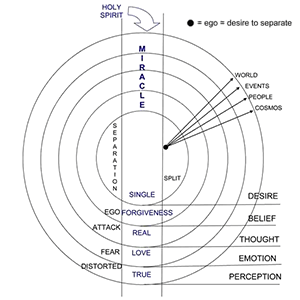
A Course in Miracles‘ (ACIM or simply the ‘Course’) is a book written and edited by psychologist Helen Schucman, with portions transcribed and edited by psychologist William Thetford, containing a self-study curriculum of spiritual transformation. It consists of three sections entitled ‘Text,’ ‘Workbook,’ and ‘Manual for Teachers.’ Written from 1965 to 1972, some distribution occurred via photocopies before a hardcover edition was published in 1976. The copyright and trademarks, which had been held by two foundations, were revoked in 2004 after a lengthy litigation because the earliest versions had been circulated without a copyright notice.

Schucman believed that an ‘inner voice,’ which she identified as Jesus, guided her writing. Throughout the 1980s annual sales of the book steadily increased each year, however the largest growth in sales occurred in 1992 after spiritual teacher Marianne Williamson discussed the book on ‘The Oprah Winfrey Show,’ with more than two million volumes sold. The book has been called everything from ‘a Satanic seduction’ to ‘The New Age Bible.’

read more »

Tags:
December 4, 2014

Metamagical Themas

Gebstadter

Douglas Hofstadter by Gilles Esposito-Farèse

Metamagical [met-uh-maj-i-kuhlThemas [thee-muhs] is an eclectic collection of articles that cognitive scientist Douglas Hofstadter wrote for ‘Scientific American’ during the early 1980s. The title is an anagram of Martin Gardner’s ‘Mathematical Games,’ the column that preceded Hofstadter’s. The anthology was published in 1985. Major themes include: self-reference in memes (ideas that spread within cultures), language, art and logic; discussions of philosophical issues important in cognitive science/AI; analogies and what makes something similar to something else (specifically what makes, for example, an uppercase letter ‘A’ recognizable as such); and lengthy discussions of the work of political scientist Robert Axelrod on the prisoner’s dilemma (a game theory problem).

There are three articles centered on the Lisp programming language, where Hofstadter first details the language itself, and then shows how it relates to Gödel’s incompleteness theorem. Two articles are devoted to Rubik’s Cube and other such puzzles. Many other topics are also mentioned, all in Hofstadter’s usual easy, approachable style. Many chapters open with an illustration of an extremely abstract alphabet, yet one which is still recognizable as such. The game of ‘Nomic’ (in which the rules of the game include mechanisms for the players to change those rules) was first introduced to the public in this column, in June 1982.

Tags: ,
November 10, 2014

Prometheus Rising

Sociobiology

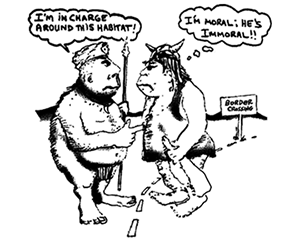
master slave morality

Prometheus Rising‘ is a book by Robert Anton Wilson first published in 1983. It is a guide book of ‘how to get from here to there,’ an amalgam of psychonaut Timothy Leary’s 8-circuit model of consciousness, spiritualist Georges Gurdjieff’s self-observation exercises, Polish semiotician Alfred Korzybski’s general semantics, occultist Aleister Crowley’s magical theorems, Sociobiology (the study of the evolutionary bases of behavior), Yoga, relativity, and quantum mechanics among other approaches to understanding the world around us. Wilson describes it as an ‘owner’s manual for the human brain.’

The book, which examines many aspects of social mind control and mental imprinting, provides mind exercises at the end of every chapter, with the goal of giving the reader more control over how one’s mind works. Wilson also discusses the effect of certain psychoactive substances and how these affect the brain, tantric breathing techniques, and other methods and holistic approaches to expanding consciousness. The book’s take on transactional analysis became the main seed thought for ‘The Sekhmet Hypothesis’ (suggesting a link between the emergence of youth culture archetypes in relation to the 11 year solar cycle), specifically the idea of applying the life scripts to pop cultural trends.

Tags:
November 9, 2014

The Sekhmet Hypothesis

okay

eight-circuit model

The Sekhmet Hypothesis was first published in 1995 by author Iain Spence. It suggested a possible link between the emergence of youth culture archetypes in relation to the 11 year solar cycles. The hypothesis was published again in 1997 in ‘Towards 2012’ and covered in 1999 in ‘Sleazenation’ magazine. Spence eventually abandoned the idea as not based in scientific fact, pointing to Strauss-Howe generational theory as a better model of social change.

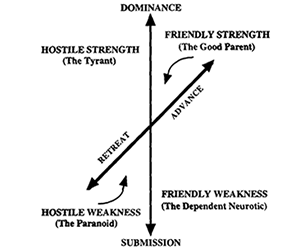
The origins of the hypothesis can be traced back to philosopher Robert Anton Wilson’s book, ‘Prometheus Rising,’ in which he makes a singular correlation between the archetype of the flower child with the mood of friendly weakness. Spence extended the comment into a study of various youth archetypes and linked in their behavior to transactional analysis (a theory of human interaction). The idea of linking pop culture to the solar cycles had been influenced from remarks made by modern occultist Peter J. Carroll, in his book, ‘Psychonaut.’ Sekhmet is the Egyptian goddess of the sun.

read more »

Tags:
November 9, 2014

The Caine Mutiny

mutiny

queeg

The Caine Mutiny‘ is a 1951 Pulitzer Prize-winning novel by American author Herman Wouk. The book grew out of Wouk’s personal experiences aboard a destroyer-minesweeper in the Pacific in World War II and deals with, among other things, the moral and ethical decisions made at sea by the captains of ships. The mutiny of the title is legalistic, not violent, and takes place during a historic typhoon in December 1944. The court-martial that results provides the dramatic climax to the plot.

The story is told through the eyes of Willis Seward ‘Willie’ Keith, an affluent, callow young man who signs up for midshipman school with the Navy to avoid being drafted into the Army during World War II. After barely surviving a series of misadventures that earn him the highest number of demerits in the history of the school, he is commissioned and assigned to the destroyer minesweeper USS Caine, an obsolete warship converted from a World War I-era destroyer.

read more »

Tags: ,
September 29, 2014

Under the Banner of Heaven

blood brothers

Under the Banner of Heaven: A Story of Violent Faith’ is a 2003 investigative nonfiction book by Jon Krakauer. It is a juxtaposition of two stories: the origin and evolution of The Church of Jesus Christ of Latter-day Saints (LDS Church), and a modern double murder committed in the name of God by brothers Ron and Dan Lafferty, who subscribed to a fundamentalist version of Mormonism.

The title is drawn from an 1880 address by John Taylor, the third president of the LDS Church, defending the practice of plural marriage: ‘God is greater than the United States, and when the Government conflicts with heaven, we will be ranged under the banner of heaven against the Government. The United States says we cannot marry more than one wife. God says different…’

read more »

Tags:
August 29, 2014

The True Believer

eric hoffer

The True Believer: Thoughts On The Nature Of Mass Movements is a 1951 social psychology book by American moral philosopher Eric Hoffer that discusses the psychological causes of fanaticism. The book analyzes and attempts to explain the motives of the various types of personalities that give rise to mass movements; why and how mass movements start, progress and end; and the similarities between them, whether religious, political, radical or reactionary.

Hoffer argues that even when their stated goals or values differ mass movements are interchangeable, that adherents will often flip from one movement to another, and that the motivations for mass movements are interchangeable. Thus, religious, nationalist, and social movements, whether radical or reactionary, tend to attract the same type of followers, behave in the same way and use the same tactics and rhetorical tools. As examples, the book often refers to Communism, Fascism, National Socialism, Christianity, Protestantism, and Islam.

read more »

Tags:
August 21, 2014

Human Universals

blank slate

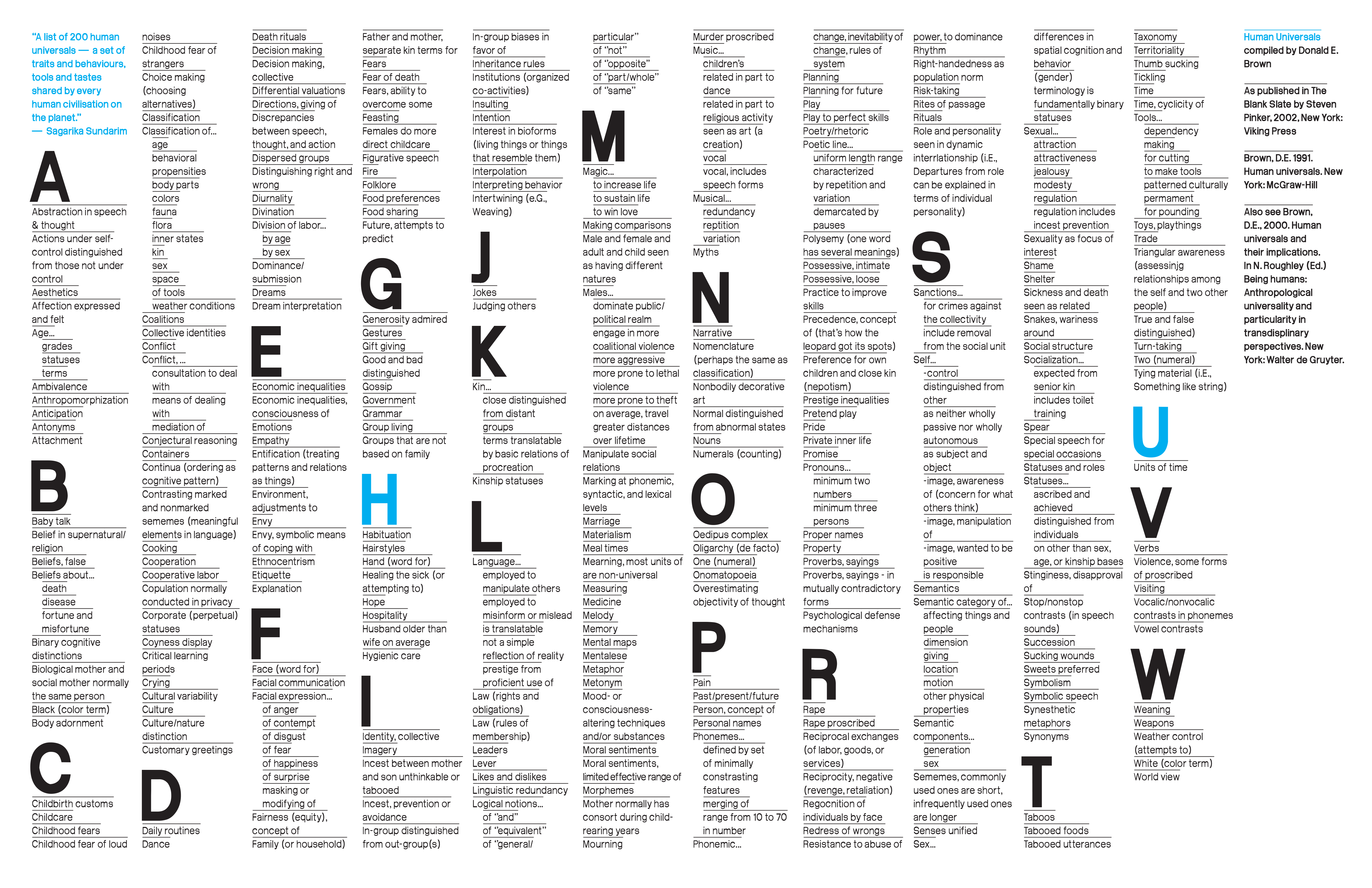
Human Universals‘ is a 1991 nonfiction book by Donald Brown, an American professor of anthropology (emeritus) at UC, Santa Barbara. Brown says human universals, ‘comprise those features of culture, society, language, behavior, and psyche for which there are no known exception.’

Universals include: age-grading, athletic sports, bodily adornment, calendar, cleanliness training, community organization, cooking, cooperative labor, cosmology, courtship, dancing, decorative art, divination, division of labor, dream interpretation, education, eschatology, ethics, ethno-botany, etiquette, faith healing, family feasting, fire-making, folklore, food taboos, funeral rites, games, gestures, gift-giving, government, greetings, hair styles, hospitality, housing, hygiene, incest taboos, inheritance rules, joking, kin groups, kinship nomenclature, language, law, luck superstitions, magic, marriage, mealtimes, medicine, obstetrics, penal sanctions, personal names, population policy, postnatal care, pregnancy usages, property rights, propitiation of supernatural beings, puberty customs, religious ritual, residence rules, sexual restrictions, soul concepts, status differentiation, surgery, tool-making, trade, visiting, weather control, weaving.

Tags:
June 2, 2014

A Modern Utopia

The Wheels of Chance by lisa congdon

Because of the complexity and sophistication of its narrative structure, H.G. Wells’s 1905 novel ‘A Modern Utopia‘ (1905) has been called ‘not so much a modern as a postmodern utopia.’ The book is best known for its notion that a voluntary order of nobility known as the Samurai could effectively rule a ‘kinetic and not static’ world state so as to solve ‘the problem of combining progress with political stability.’

In terms of Northrop Frye’s classification of literary genres, ‘A Modern Utopia’ is not a novel but an anatomy, a book that divides a topic into parts for detailed examination or analysis. Frye, narrowed the definition of the word to mean a work resembling a ‘Menippean satire,’ which ridicules foolish or undisciplined mental attitudes instead of specific individuals.

read more »

Tags: ,
April 23, 2014

The Golden Ass

the golden ass

‘The Metamorphoses’ by Apuleius (Lucius Apuleius Madaurensis, a Roman writer) which St. Augustine referred to as ‘The Golden Ass‘ (Asinus aureus), is the only Ancient Roman novel in Latin to survive in its entirety. The protagonist of the novel is called Lucius, like the author. At the end of the novel, he is revealed to be from Madaurus (present day Algeria), the hometown of Apuleius himself.

The plot revolves around the protagonist’s curiosity (curiositas) and insatiable desire to see and practice magic. While trying to perform a spell to transform into a bird, he is accidentally transformed into an ass. This leads to a long journey, literal and metaphorical, filled with inset tales (short stories told by characters encountered by the protagonist; some act as independent narratives, while others interlock with plot developments). He finally finds salvation through the intervention of the goddess Isis, whose cult he joins.

read more »

Tags: ,
March 6, 2014

Hard to Be a God

Holy Order

Hard to be a God is a 1964 science fiction novel by Arkady and Boris Strugatsky set in their ‘Noon Universe (a fictional setting in the 22nd century). The novel follows Anton, an undercover operative from the future planet Earth, in his mission on an alien planet, that is populated by human beings, whose society has not advanced beyond the Middle Ages. The novel’s core idea is that human progress throughout the centuries is often cruel and bloody, and that religion and blind faith can be effective tools of oppression, working to destroy the emerging scientific disciplines and enlightenment.

The title ‘Hard to be a God’ refers to Anton’s (known by his alias ‘don Rumata’ throughout the book) perception of his precarious role as an observer on the planet, for while he has far more advance knowledge than the people around him, he is forbidden to assist too actively, as it would interfere with the natural progress of history. The book pays a lot of attention to the internal world of the main character, showing his own evolution from an emotionally uninvolved ‘observer’ to the person who rejects the blind belief in theory when confronted with the cruelty of real events.

read more »

Tags: ,