March 12, 2013
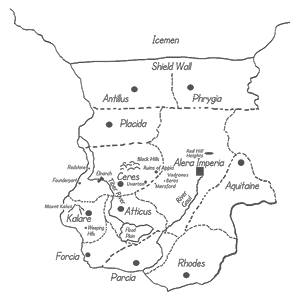
‘Codex Alera‘ is a fantasy book series by novelist Jim Butcher. The series chronicles the coming-of-age of a young man named Tavi in the realm of Alera, an empire similar to Rome, on the world of Carna. Every Aleran has some degree of command over elemental forces or spirits called furies, save for Tavi, who is considered unusual for his lack of one. As the aging First Lord struggles to maintain his hold on a realm on the brink of civil war, Tavi must use all of his intelligence to save Alera.
The inspiration for the series came from a bet Jim was challenged to by a member of the Delray Online Writer’s Workshop. The challenger bet that Jim could not write a good story based on a lame idea, and Jim countered that he could do it using two lame ideas of the challenger’s choosing. The ‘lame’ ideas given were ‘Lost Roman Legion,’ and ‘Pokémon.’
Posted in Art, Humor, Language |
Leave a Comment »
March 7, 2013

‘Science Made Stupid: How to Discomprehend the World Around Us’ is a book written and illustrated by Tom Weller in 1985. The winner of the 1986 Hugo Award for Best Non-Fiction Book, it is a parody of a junior high or high school-level science textbook. Though currently out-of-print, high-resolution scans are available online, as well as an abridged transcription, both of which have been endorsed by Weller.
Highlights of the book include a satirical account of the creationism vs. evolution debate and Weller’s drawings of fictional prehistoric animals (e.g., the duck-billed mastodon.) Weller released a companion volume, ‘Culture Made Stupid’ (also spelled ‘Cvltvre Made Stvpid’), which satirizes literature and the humanities.
Posted in Education, Humor, Science |
1 Comment »
March 2, 2013

‘Fresh Off the Boat: A Memoir‘ is a 2013 autobiography by American food personality Eddie Huang. The book relates Huang’s early life and rise in the food celebrity scene in New York, and his relationship with his Asian background.
Huang, educated as a lawyer, became prominent in New York’s restaurant scene after the success of his BaoHaus, a purveyor of Chinese Cha siu bao, or pork buns. He developed a reputation as a food personality after hosting food-themed programs on the Food Network and Vice TV.
read more »
Posted in Food, Humor, Language |
1 Comment »
February 25, 2013
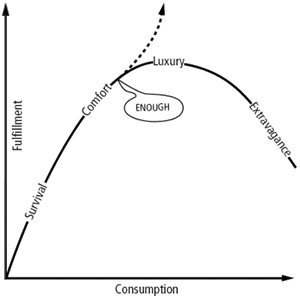
Growth Fetish is a 2003 book about economics and politics by the Australian liberal political theorist Clive Hamilton. The book argues that the policies of unfettered capitalism pursued by the west for the last 50 years has largely failed, since the underlying purpose of the creation of wealth is happiness, and Hamilton contends that people in general are no happier now than 50 years ago, despite the huge increase in personal wealth. In fact, he suggests that the reverse is true. He states that the pursuit of growth has become a fetish, in that it is seen as a universal magic cure for all of society’s ills.
Hamilton also proposes that the pursuit of growth has been at a tremendous cost in terms of the environment, erosion of democracy, and the values of society as a whole. One result is that we, as a society, have become obsessed with materialism and consumerism. Hamilton’s catchphrase ‘People buy things they don’t need, with money they don’t have, to impress people they don’t like’ neatly sums up his philosophy on consumerism.
read more »
Posted in Language, Money |
Leave a Comment »
February 18, 2013

‘Private Guns, Public Health‘ is a 2004 non-fiction book by David Hemenway, an economist who has served as Professor of Health Policy at the Harvard School of Public Health as well as the Director of Harvard’s Injury Control Research Center. He argues that the widespread ownership of firearms in private hands in the U.S. promotes the spread of the ‘disease’ of gun violence, and he takes a collective interpretation of the Second Amendment while stating that increased regulations are absolutely necessary in the purposes of public safety. Hemenway makes the central case that ‘more guns in a community lead to more homicide.’
Hemenway interprets the issues of gun violence and gun politics in the U.S. through a public health lens, which he believes ’emphasizes prevention rather than fault-finding, blame, or revenge.’ He writes that he is not ‘anti-gun’ or ‘anti-gun owner’ any more than people who advocate for consumer safety measures in cars are ‘anti-cars.’ He sums the goal of the book up as ‘injury prevention.’
read more »
Posted in Health, Language, Politics |
Leave a Comment »
February 18, 2013

‘More Guns, Less Crime‘ is a book by economist John Lott that says violent crime rates go down when states permit the concealed carry of guns. He presents the results of his statistical analysis of crime data for every county in the United States during 29 years from 1977 to 2005. The book examines city, county and state level data from the entire United States and measures the impact of 11 different types of gun control laws on crime rates. The book expands on an earlier study published in 1997 by Lott and his co-author David Mustard in ‘The Journal of Legal Studies.’
Lott also examines the effects of gun control laws, including the Brady Law. His conclusion is that ‘shall issue’ laws, which allow citizens to carry concealed weapons, steadily decrease violent crime. He explains that this result makes sense because criminals are deterred by the risk of attacking an armed victim. As more citizens arm themselves, the danger to criminals increases. Lott also examines the effects of training requirements on crime rate and accident rate. He finds that training requirements have very little effect on both crime rates and accident rates.
read more »
Posted in Language, Politics |
Leave a Comment »
February 14, 2013

‘The Rebel Sell: Why the culture can’t be jammed’ (published in the US as ‘Nation of Rebels: Why Counterculture Became Consumer Culture’) is a non-fiction book written by University of Toronto philosopher Joseph Heath and Canadian journalist Andrew Potter in 2004. Their central claim is that counter-cultural movements have failed, and that they all share a common fatal error in the way they understand society; thus counter-culture is not a threat to ‘the system.’
Following their claim that conformity isn’t something perpetuated by mainstream media, Potter and Heath identify other sources of conformity using work from Hobbes, Rousseau, and Freud. They describe conformity as often the byproduct of simple market preferences or, alternatively, as an attempt to resolve a collective action problem. For instance, they claim that school uniforms curb the fashion ‘arms race’ created between students when no restrictions are in place, and that they are not intended merely to stamp out individualism, as many counter-cultural figures have suggested.
read more »
Posted in Language, Money, Politics |
Leave a Comment »
February 10, 2013

Naked Lunch is a novel by William S. Burroughs originally published in 1959. The book is structured as a series of loosely-connected vignettes. Burroughs stated that the chapters are intended to be read in any order.
The reader follows the narration of junkie William Lee, who takes on various aliases, from the US to Mexico, eventually to Tangier and the dreamlike Interzone (international zone, a type of extraterritoriality governed by international law). The vignettes (called ‘routines’) are drawn from Burroughs’ own experience in these places, and his addiction to drugs (heroin, morphine, and while in Tangier, ‘Majoun’—a strong marijuana confection—as well as a German opioid, brand name Eukodol, of which he wrote frequently).
read more »
Posted in Drugs, Language, Politics |
Leave a Comment »
February 8, 2013

‘A Study of History‘ is the 12-volume magnum opus of British historian Arnold J. Toynbee, finished in 1961, in which the author traces the development and decay of all of the major world civilizations in the historical record. Toynbee applies his model to each of these civilizations, detailing the stages through which they all pass: genesis, growth, time of troubles, universal state, and disintegration.
The major civilizations, as Toynbee sees them, are: Egyptian, Andean, Sinic, Minoan, Sumerian, Mayan, Indic, Hittite, Hellenic, Western, Orthodox Christian (Russia), Far Eastern, Orthodox Christian (main body), Persian, Arabic, Hindu, Mexican, Yucatec, and Babylonic. There are four ‘abortive civilizations’ (Abortive Far Western Christian, Abortive Far Eastern Christian, Abortive Scandinavian, Abortive Syriac) and five ‘arrested civilizations’ (Polynesian, Eskimo, Nomadic, Ottoman, Spartan).
read more »
Posted in Language, Politics, World |
1 Comment »
February 7, 2013

‘Dark Age Ahead‘ is a 2004 book by Jane Jacobs describing what she sees as the decay of five key ‘pillars’ in North America: community and family, higher education, science and technology, taxes and government responsive to citizen’s needs, and self-policing by the learned professions. She argues that this decay threatens to create a dark age unless the trends are reversed. Jacobs characterizes a dark age as a ‘mass amnesia’ where even the memory of what was lost is lost.
People are increasingly choosing consumerism over family welfare, that is: consumption over fertility; debt over family budget discipline; fiscal advantage to oneself at the expense of community welfare. Universities are more interested in credentials than providing high quality education. Economics has become as the main ‘science’ to consider in making major political decisions. Governments are more interested in deep-pocket interest groups than the welfare of the population. She describes, a culture that prevents people from understanding/realizing the deterioration of fundamental physical resources which the entire community depends on.
read more »
Posted in Language, Politics |
1 Comment »
February 6, 2013

‘Help at Any Cost: How the Troubled-Teen Industry Cons Parents and Hurts Kids’ is a 2006 non-fiction book by science journalist Maia Szalavitz analyzing the controversy surrounding the tough love behavior modification industry. Szalavitz focuses on four programs: Straight, Incorporated, a copy of the Straight Inc. program called KIDS, North Star wilderness boot camp, and the World Wide Association of Specialty Programs and Schools.
She discusses the background, history and methodology of the troubled teen industry, including techniques drawn from attack therapy, Erhard Seminars Training (est), and Synanon, all of which are highly controversial. She uses first-person accounts and court testimony in her research, and states that no evidence exists proving that these programs are effective. The book also includes advice for parents and an appendix with additional resources on how to get responsible help for teenagers.
read more »
Posted in Health, Money, Politics |
Leave a Comment »
February 5, 2013
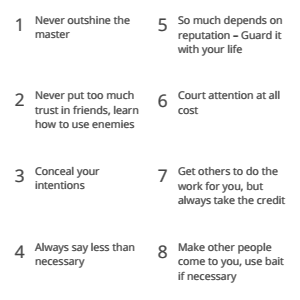
‘The 48 Laws of Power‘ (2000) is the first book by American author Robert Greene. The book, an international bestseller, is a practical guide for anyone who wants power, observes power, or wants to arm himself against power, and is popular with famous rappers, entrepreneurs, celebrities, athletes and actors including 50 Cent, Jay-Z, Kanye West, Dov Charney, Brian Grazer, Chris Bosh, and Will Smith. ‘The 48 Laws of Power’ is taught in business management classes and is one of the most requested books in American prison libraries.
The 48 Laws of Power are a distillation of 3,000 years of the history of power, drawing on the lives of strategists and historical figures like Niccolò Machiavelli, Sun Tzu, Carl von Clausewitz, Queen Elizabeth I, Henry Kissinger, and P.T. Barnum. The book is intended to show people how to gain power, preserve it, and defend themselves against power manipulators.
read more »
Posted in Language, Money, Politics |
Leave a Comment »


 The Daily Omnivore