January 28, 2013
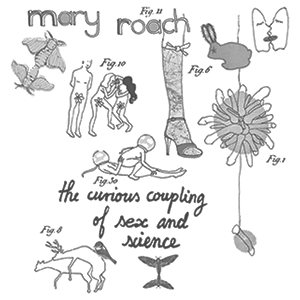
Bonk: The Curious Coupling of Science and Sex was written by Mary Roach in 2008. The book follows the winding history of science and its exploration of human sexuality, going back as far as Aristotle and finally ending with recent discoveries about the origination and anatomy of the female orgasm. Throughout, Mary Roach provides a humorous and often very personal view—both as a participant and observer—of humans, scientists, animals, and sex machines.
Of the book’s numerous accounts, Roach discusses artificial insemination of sows in Denmark, the notorious history of sex machines, as well as much discussion and commentary on Kinsey’s notorious attic sex experiments. Her footnotes provide additional humor; as in a sentence which includes several DSM diagnoses listed as acronyms she adds ‘And from HAFD (hyperactive acronym formation disorder).’ In the book, Mary Roach describes a session in which she and her husband Ed volunteer to have sex in a 20-inch-diameter (510 mm) MRI tube in the interests of science. During the experiment, a doctor looks on, making suggestions, and finally telling Ed that he ‘may ejaculate now.’
Posted in Humor, Language, Sex |
Leave a Comment »
January 23, 2013
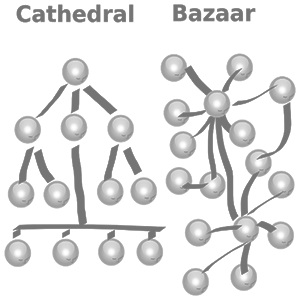
‘The Cathedral and the Bazaar: Musings on Linux and Open Source by an Accidental Revolutionary’ is an essay by Eric S. Raymond on software engineering methods, based on his observations of the Linux kernel development process and his experiences managing an open source project, fetchmail. It examines the struggle between top-down and bottom-up design. It was first presented by the author at the Linux Kongress in 1997 in Germany and was published as part of a book of the same name in 1999.
The essay contrasts two different free software development models: the Cathedral model, in which source code is available with each software release, but code developed between releases is restricted to an exclusive group of software developers. And, the Bazaar model, in which the code is developed over the Internet in view of the public. Raymond credits Linus Torvalds, leader of the Linux kernel project, as the inventor of this process. Raymond also provides anecdotal accounts of his own implementation of this model for the Fetchmail project.
read more »
Posted in Language, Technology |
Leave a Comment »
January 10, 2013

‘Moonwalking with Einstein: The Art and Science of Remembering Everything’ is a nonfiction book by Joshua Foer, first published in 2011. Foer describes his book as participatory journalism in the world of competitive memorization and attempts to delineate the capacity of the human mind. He sets out to investigate the underpinnings of those with enhanced memory, soon finding himself at the 2005 U.S. Memory Championship.
He covers the scientific basis of memory creation and historical attitudes towards memory, including its negative reputation in the Western educational system, a perception which Foer is largely opposed to. He explores common mnemonic tools for improving memory: the techniques of Roman rhetoricians and the tannaim (‘reciters’) of Sri Lanka, the Major System and the PAO System for memorizing numbers and cards, and Mind Mapping, a note-taking technique developed by educational consultant Tony Buzan. These methods are all a form of the method of loci, in which data is stored in a sequence of memorable images that are decomposable into their original form.
read more »
Posted in Education, Games, Language |
Leave a Comment »
January 9, 2013

‘Neuromancer‘ is a 1984 novel by William Gibson, a seminal work in the cyberpunk genre and winner of the science-fiction ‘triple crown’ — the Nebula Award, the Philip K. Dick Award, and the Hugo Award. It was Gibson’s first novel and the beginning of the ‘Sprawl’ trilogy (which takes place in a near-future world dominated by corporations and ubiquitous technology, after a limited World War III).
The novel tells the story of a washed-up computer hacker hired by a mysterious employer to work on a dangerous hack. ‘Neuromancer’ is considered the archetypal cyberpunk work. Gibson himself coined the term ‘cyberspace’ in his novelette ‘Burning Chrome,’ published in 1982 by ‘Omni’ magazine.
read more »
Posted in Art, Language, Technology |
Leave a Comment »
January 8, 2013

Fear and Loathing: On the Campaign Trail ’72 is a collection of articles covering the 1972 presidential campaign written by Hunter S. Thompson and illustrated by Ralph Steadman. The articles were first serialized in ‘Rolling Stone’ magazine throughout 1972 and later released as a book in early 1973. The book focuses almost exclusively on the Democratic Party’s primaries and the breakdown of the party as it splits between the different candidates.
Of particular focus is the manic maneuvering of the George McGovern campaign during the Miami convention as they sought to ensure the Democratic nomination despite attempts by the Hubert Humphrey campaign and other candidates to block McGovern. Thompson began his coverage of the campaign in December 1971, just as the race toward the primaries was beginning, from a rented apartment in Washington, DC (a situation he compared to ‘living in an armed camp, a condition of constant fear’). Over the next 12 months, in voluminous detail, he covered every aspect of the campaign, from the smallest rally to the raucous conventions.
read more »
Posted in Humor, Language, Politics |
Leave a Comment »
December 24, 2012

‘No Logo: Taking Aim at the Brand Bullies’ is a book by Canadian author Naomi Klein.
First published in December 1999, shortly after the 1999 WTO Ministerial Conference protests in Seattle had generated media attention around such issues, it became one of the most influential books about the alter-globalization movement. The book focuses on branding, and often makes connections with the alter-globalization movement (also known as the the global justice movement).
read more »
Posted in Language, Money, Politics |
1 Comment »
December 6, 2012

The Shockwave Rider is a 1975 science fiction novel by John Brunner, notable for its hero’s use of computer hacking skills to escape pursuit in a dystopian future, and for the coining of the word ‘worm’ to describe a program that propagates itself through a computer network. It also introduces the concept of a ‘Delphi pool’ (a large group of people used as a statistical sampling resource), perhaps derived from the RAND Corporation’s Delphi method – a futures market on world events which bears close resemblance to DARPA’s controversial and cancelled Policy Analysis Market (dubbed the ‘Terrorism Market’ by the media).
The title derives from the futurist work ‘Future Shock’ by Alvin Toffler. The hero is a survivor in a hypothetical world of quickly changing identities, fashions, and lifestyles, where individuals are still controlled and oppressed by a powerful and secretive state apparatus. His highly developed computer skills enable him to use any public telephone to punch in a new identity, thus reinventing himself. As a fugitive, he must do this from time to time in order to escape capture. The title is also a metaphor for survival in an uncertain world.
read more »
Posted in Art, Language, Technology |
Leave a Comment »
December 2, 2012
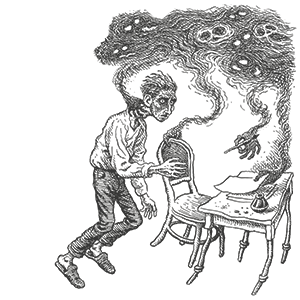
Introducing Kafka, also known as Kafka for Beginners, is a 1993 illustrated biography of Franz Kafka by David Zane Mairowitz and Robert Crumb. The book includes comic adaptations of some of Kafka’s most famous works including ‘The Metamorphosis,’ ‘A Hunger Artist,’ ‘In the Penal Colony,’ and ‘The Judgment,’ as well as brief sketches of his three novels ‘The Trial,’ ‘The Castle,’ and ‘Amerika.’
The book also details Kafka’s biography in a format that is part illustrated essay, part sequential comic panels. The book was released as part of the ‘Introducing…’ series by Totem Books which also features a volume each on Sigmund Freud and Wilhelm Reich. The popularity of Crumb’s renditions of Kafka’s works led to additional printings under the title ‘R. Crumb’s Kafka.’
Posted in Art, Humor, Language |
1 Comment »
November 29, 2012
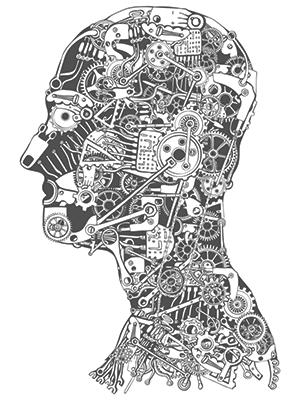
‘The Singularity Is Near: When Humans Transcend Biology’ is a 2005 update of Raymond Kurzweil’s 1999 book ‘The Age of Spiritual Machines’ and his 1990 book ‘The Age of Intelligent Machines.’ In it, as in the two previous versions, Kurzweil attempts to give a glimpse of what awaits us in the near future.
He proposes a coming technological singularity (a period of rapid change), and how we would thus be able to augment our bodies and minds with technology. He describes the singularity as resulting from a combination of three important technologies of the 21st century: genetics, nanotechnology, and robotics (including artificial intelligence).
read more »
Posted in Language, Technology |
Leave a Comment »
November 13, 2012

The Morning of the Magicians, first published as ‘Le Matin des magiciens’ was written by Louis Pauwels and Jacques Bergier in 1960, it became a bestseller, first in French, then translated into English in 1963 as ‘The Dawn of Magic.’ A German edition was published with the title ‘Aufbruch ins dritte Jahrtausend’ (‘Departure into the third Millennium’).
In a generalized and wide ranging overview of the occult, the book speculates on a variety of Forteana (anomalous phenomena), mysticism, and conspiracy theories such as secret societies, ancient prophesies, alchemical transmutation, a giant race that once ruled the Earth, and the Nazca Lines. It also includes speculations such as Nazi occultism and supernatural phenomena conspiracy theory that the Vril Society and the Thule Society were the philosophical precursors to the NSDAP Nazi party.
read more »
Posted in Philosophy |
1 Comment »
November 8, 2012

‘Modernist Cuisine: The Art and Science of Cooking’ is a 2011 cookbook by Nathan Myhrvold, Chris Young, and Maxime Bilet. The book is an encyclopedia and a guide to the science of contemporary cooking. Five volumes cover history and fundamentals, techniques and equipment, animals and plants, ingredients and preparation, plated dish recipes; the sixth volume is a kitchen manual.
Myhrvold has attended Ecole de Cuisine la Varenne, a cooking school in Burgundy, France and has also cooked part-time at Rover’s, a French restaurant in Seattle owned by Thierry Rautureau. He is also a scientist, having earned advanced degrees in geophysics, space physics, and theoretical and mathematical physics, done post-doctoral research with Stephen Hawking at Cambridge University, and worked for many years as the chief technology officer and chief strategist of Microsoft.
read more »
Posted in Food, Language, Science |
Leave a Comment »
November 7, 2012

‘Our Dumb World‘ is a parody of the standard desk atlas created by the staff of ‘The Onion’ and published in 2007. It is The Onion’s first book of entirely original content since 1999’s ‘Our Dumb Century.’ The book, written in the satirical paper’s editorial voice, contains entries for nearly every country on Earth, including detailed maps and humorous stereotyped descriptions of regional history and customs. For example, Canada’s entry is subtitled, ‘For the United States, see pages 9 – 22.’ The sections devoted to the Northern and Southern Poles and Greenland, are touted as, ‘larger than Africa and South America combined.’
The visual style of the atlas has been compared to Dorling Kindersley’s ‘Eyewitness’ series. The book uses faux xenophobia to illustrate the cultural differences of various nations, often mocking racial stereotypes with satirical comments. In the ‘New York Times,’ William Grimes called it ‘an astoundingly offensive guide to the states of the union and the countries of the world, compiled on the premise that all countries are ridiculous and contemptible’ and found it ‘sophomoric, transgressive, and intermittently brilliant.’ Elements of the book have been transferred to an electronic format available on the paper’s website and as a layer on Google Earth.
Posted in Humor, Language, World |
Leave a Comment »


 The Daily Omnivore