August 24, 2010
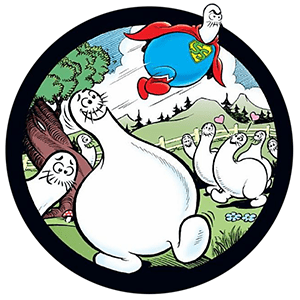
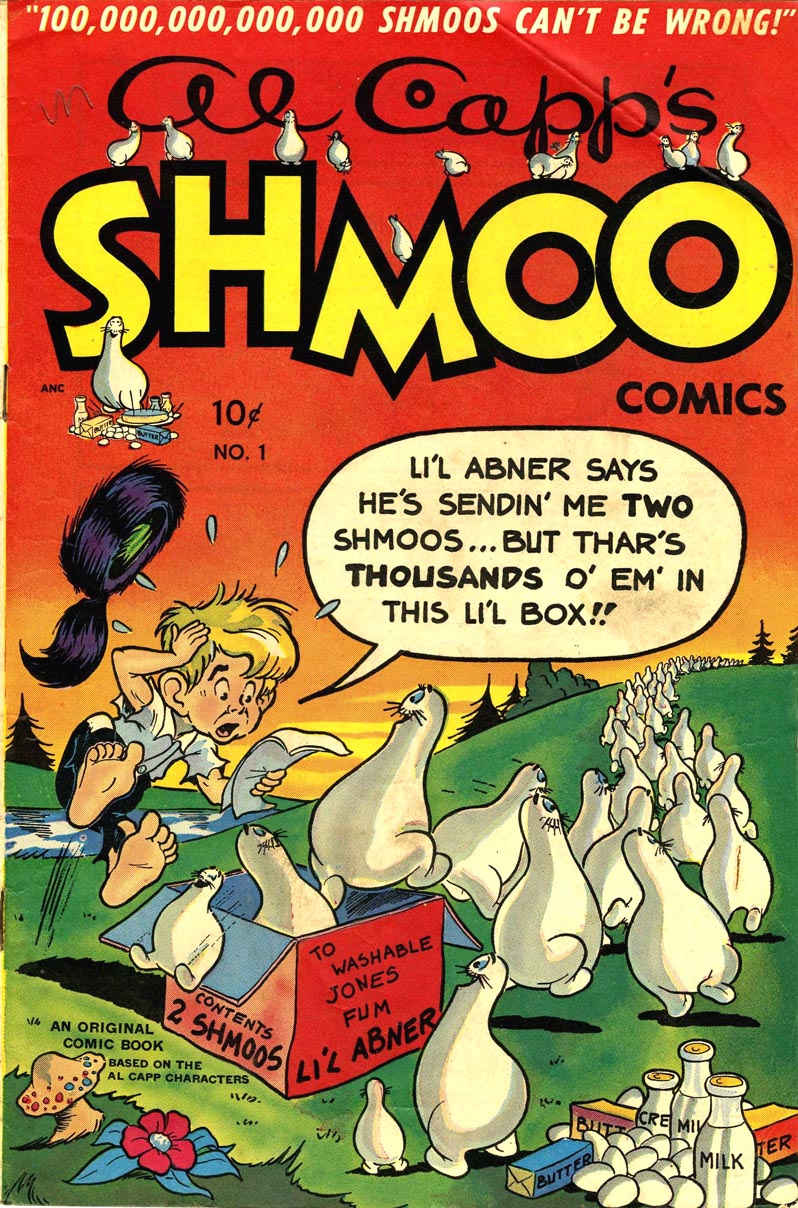
A shmoo is a fictional cartoon creature created by Al Capp. They first appeared in his comic strip ‘Li’l Abner’ on August 31, 1948, and quickly became a postwar national craze in the USA. Shmoon reproduce asexually, require no sustenance other than air, make good pets, are delicious to eat, and are eager to be eaten. Their pelts make perfect boot leather or house timber, depending on how thick you slice it. They have no bones, their eyes make the best suspender buttons, and their whiskers make perfect toothpicks. In short, they are the ideal herd animal.
In the comic strip the frolicking of shmoon is so entertaining that people no longer feel the need to watch television or go to the movies. It’s been used in discussions of socioeconomics, for instance, a widget is any material good which is produced through labor from a finite resource. In contrast, a shmoo is a material good that reproduces itself and is captured or bred as an economic activity.
Posted in Art, Humor, Money |
Leave a Comment »
August 16, 2010
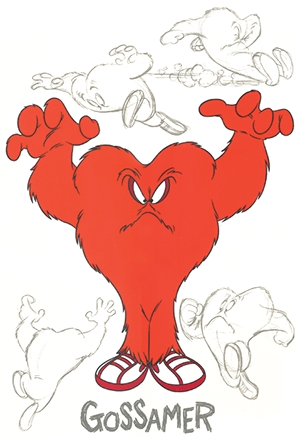
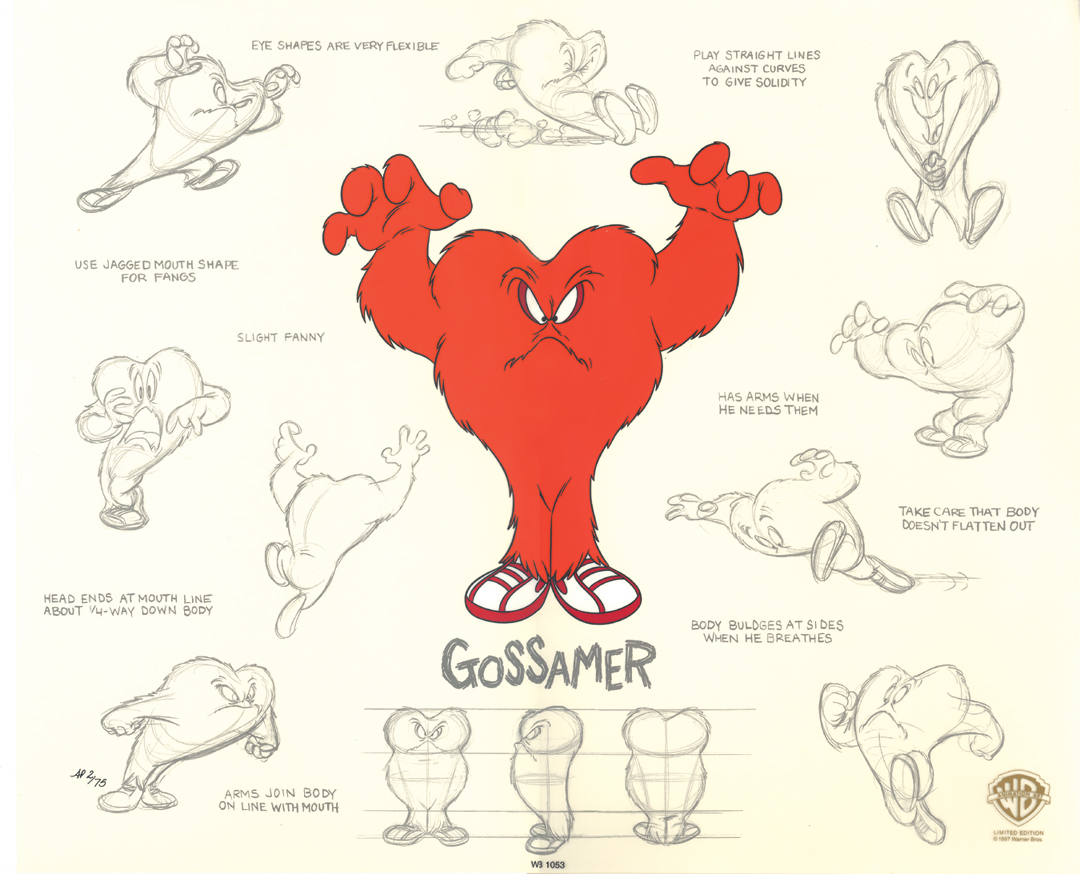
Gossamer is an animated cartoon character in the Warner Bros. Looney Tunes and Merrie Melodies series of cartoons. The character is a hairy, orange monster. His rectangular body is perched on two giant tennis shoes, and his heart-shaped face is composed of only two oval eyes and a wide mouth, with two hulking arms. The monster’s main trait, however, is bright uncombed red hair.
In fact, a gag in the 1980 short Duck Dodgers and the Return of the 24½th Century lampoons this by revealing that Gossamer is, in fact, composed entirely of hair. He was originally voiced by Mel Blanc and has been voiced by Joe Alaskey and Jim Cummings. The word ‘Gossamer’ refers to things light, delicate, or insubstantial. The name is meant to be ironic, since the character is large, menacing, and destructive.
Posted in Art, Humor |
Leave a Comment »
August 3, 2010
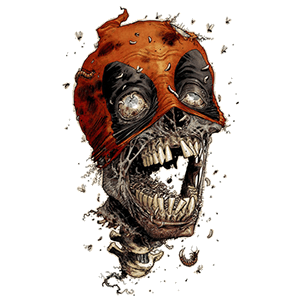
Deadpool is a fictional character and anti-hero appearing in comic books published by Marvel Comics. Created by artist Rob Liefeld and writer Fabian Nicieza, Deadpool first appeared in ‘The New Mutants’ #98 in 1991. A disfigured and mentally unstable mercenary, Deadpool originally appeared as a villain, but the character has since starred in several ongoing series, which is used by writers for humorous effect. The character is famous for his tendency to break the fourth wall and is frequently referred to by the moniker ‘Merc with a Mouth.’
In 1991 Rob Liefeld, a fan of the ‘Teen Titans’ comics, showed his new character to then writer Fabian Nicieza. Upon seeing the costume and noting his characteristics (killer with super agility), Nicieza said, ‘this is Deathstroke from Teen Titans.’ Nicieza gave Deadpool the real name of ‘Wade Wilson’ as an in-joke to being related to ‘Slade Wilson,’ aka Deathstroke. In his first appearance, Deadpool was hired to attack Cable and the New Mutants. After subsequently appearing in ‘X-Force’ as a recurring character, Deadpool began making guest appearances in various different Marvel Comics titles such as the ‘Avengers,’ ‘Daredevil,’ and ‘Heroes for Hire.’
read more »
Posted in Art, Humor |
Leave a Comment »
July 12, 2010

Scheherazade [shuh-her-uh-zahd] is a legendary Persian queen and the storyteller of One Thousand and One Nights, a collection of Middle Eastern and South Asian stories and folk tales compiled in Arabic during the Islamic Golden Age. It is often known in English as the Arabian Nights. Some of the best-known stories of The Nights, particularly ‘Aladdin’s Wonderful Lamp’, ‘Ali Baba and the Forty Thieves’ and ‘The Seven Voyages of Sinbad the Sailor,’ while almost certainly genuine Middle-Eastern folk tales, were not part of The Nights in Arabic versions, but were interpolated into the collection by European translators.
Posted in Art, World |
Leave a Comment »
June 25, 2010
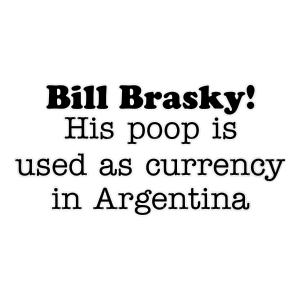
Bill Brasky was the subject of a series of sketches on Saturday Night Live between 1996 and 1998. The sketches were written by cast member Will Ferrell and writer Adam McKay. The format of the sketches resembles the short-form improv game ‘Two Describe a Third.’ Three or four friends (known as the ‘Bill Brasky Buddies’) gather in a public place to drink Scotch, smoke cigars, and loudly reminisce about their mutual acquaintance Bill Brasky. While the friends refer to Brasky in both present and past tense on occasion, it appears that Brasky is still alive: some sketches end with Brasky’s appearance via a forced perspective shot that makes him look like a giant. One sketch, set at Brasky’s funeral, ends with Brasky breaking out of the coffin holding a glass of Scotch.
Most of the friends’ discussions focus on their admiration of Brasky’s superhuman accomplishments, usually focused on his huge size, virility, celebrity connections, amazing tolerance for drugs and alcohol, and reckless disregard for human life. The stories of Brasky’s life and seemingly legendary accomplishments are exaggerated to absurd levels in the American tradition of tall tales.
Posted in Art, Humor |
Leave a Comment »


 The Daily Omnivore