April 18, 2013
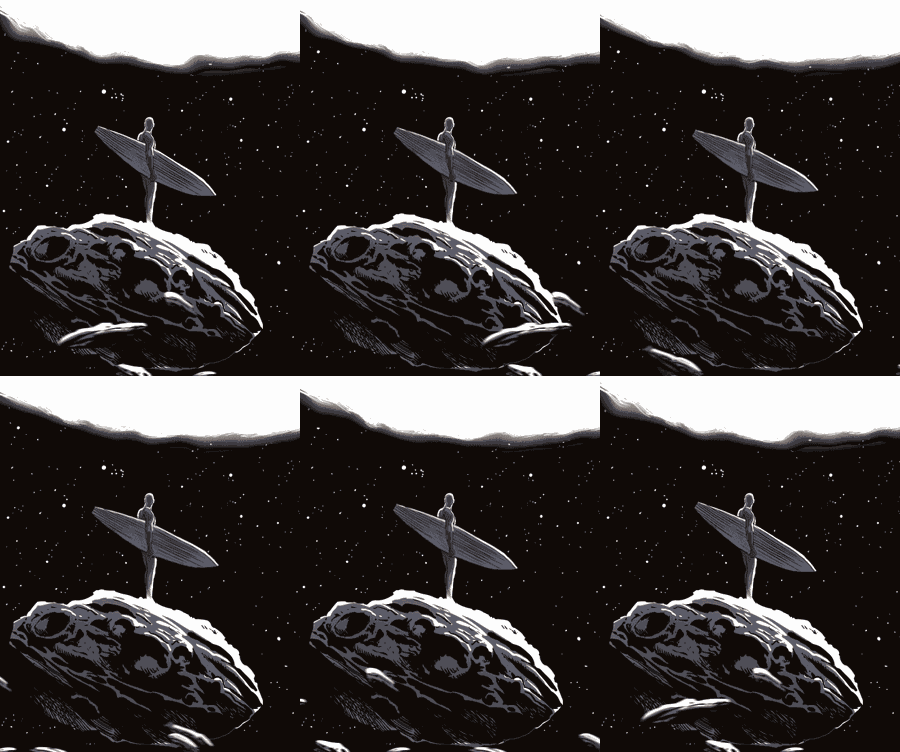
The Silver Surfer is a fictional character, a superhero appearing in comic books and other publications by Marvel Comics. Originally a young astronomer named Norrin Radd on the planet Zenn-La, he saved his homeworld from the planet devourer, Galactus, by serving as his herald. Imbued in return with a tiny portion of Galactus’s Power Cosmic, Radd acquired vast power, a new body and a surfboard-like craft on which he could travel faster than light.
As the Silver Surfer, Radd roamed the cosmos searching for planets for Galactus to consume. When his travels took him to Earth, he met the Fantastic Four, a team of powerful superheroes who helped him rediscover his humanity and nobility of spirit. Betraying Galactus, the Surfer saved Earth but was exiled there as punishment.
read more »
Posted in Art |
Leave a Comment »
April 17, 2013
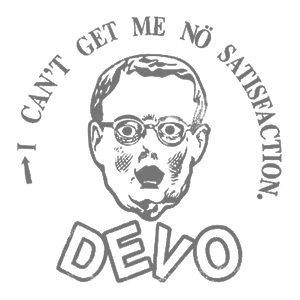
Booji Boy is a character created in the early 1970s by American New Wave band Devo. The name is pronounced ‘Boogie Boy’—the strange spelling resulted when the band was using Letraset to produce captions for a film, and ran out of the letter ‘g.’ When the ‘i’ was added but before the ‘e,’ Devo lead singer Mark Mothersbaugh reportedly remarked that the odd spelling ‘looked right.’
Booji Boy has traits of a simian child and typically wears an orange nuclear protection suit. He is portrayed by Mothersbaugh in a mask and is the son of another fictitious Devo character, General Boy. The intent of the figure is to satirize infantile regression in Western culture, a quality Devo enjoyed elucidating. This character was officially introduced in the 1976 short film ‘The Truth About De-Evolution.’
read more »
Posted in Art, Games, Humor |
Leave a Comment »
April 15, 2013

The Signifying Monkey is a character of African-American folklore that derives from the trickster figure of Yoruba mythology, Esu Elegbara. This character was transported with Africans to the Americas under the names of Exu, Echu-Elegua, Papa Legba, and Papa Le Bas. Esu and his variants all serve as messengers who mediated between the gods and men by means of tricks. The Signifying Monkey is ‘distinctly Afro-American’ but is thought to derive from Yoruban mythology, which depicts Echu-Elegua with a monkey at his side.
Numerous songs and narratives concern the Signifying Monkey and his interactions with his friends, the Lion and the Elephant. In general the stories depict the Signifying Monkey insulting the Lion, but claiming that he is only repeating the Elephant’s words. The Lion then confronts the Elephant, who soundly beats the Lion. The Lion later comes to realize that the Monkey has been signifyin(g) and has duped him and returns angrily. The Signifying Monkey is a classic routine originally on a comedy album by Rudy Ray Moore.
Posted in Humor, Language |
Leave a Comment »
April 2, 2013
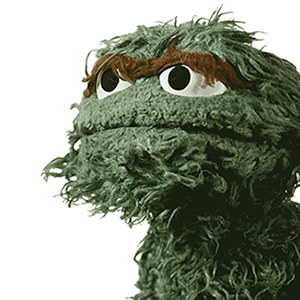
Oscar the Grouch is a Muppet character on the television program ‘Sesame Street.’ He has a green body (during the first season he was orange), has no visible nose, and lives in a trash can. His favorite thing in life is trash, as evidenced by the song ‘I Love Trash.’ A running theme is his compulsive hoarding of seemingly useless items.
‘The Grouch’ aptly describes his misanthropic interaction with the other characters, but also refers to his species. The character is performed by Caroll Spinney, and has been performed by him since the show’s first episode.
read more »
Posted in Education, Humor |
Leave a Comment »
March 29, 2013
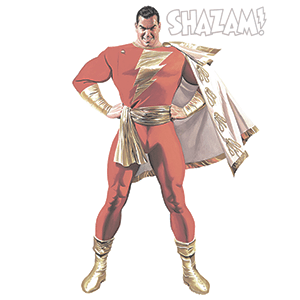
Captain Marvel, also known as ‘Shazam,’ is a fictional comic book superhero, originally published by Fawcett Comics and later by DC. Created in 1939 by artist C. C. Beck and writer Bill Parker, the character first appeared in 1940 in ‘Whiz Comics’ #2. With a premise that taps adolescent fantasy, Captain Marvel is the alter ego of Billy Batson, a youth who works as a radio news reporter and was chosen to be a champion of good by the wizard Shazam.
Whenever Billy speaks the wizard’s name, he is struck by a magic lightning bolt that transforms him into an adult superhero empowered with the abilities of six archetypal, historical figures. Several friends and family members, most notably Marvel Family cohorts Mary Marvel and Captain Marvel Jr., can share Billy’s power and become ‘Marvels’ themselves.
read more »
Posted in Art, Money |
1 Comment »
March 28, 2013
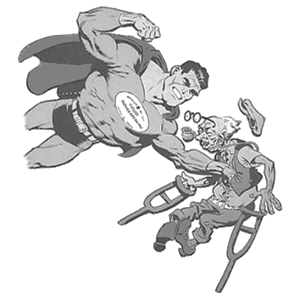
‘Superduperman‘ is a satirical story by cartoonists Harvey Kurtzman and Wally Wood that was published in the fourth issue of ‘Mad’ in 1953. Lampooning both Superman and Captain Marvel, it revolutionized the types of stories seen in ‘Mad,’ leading to greatly improved sales. Writers such as Alan Moore have cited this story as an influence.
The plot parallels the Superman scenario of the period: ‘Clark Bent’ is a lowly assistant to the copy boy at ‘The Daily Dirt’ newspaper, where he tries, unsuccessfully, to woo the narcissistic and indifferent ‘Lois Pain.’
read more »
Posted in Humor, Money |
1 Comment »
March 28, 2013
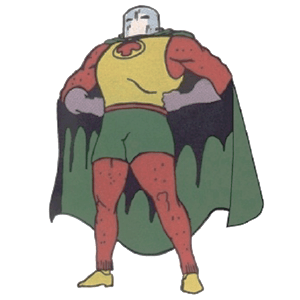
The Red Tornado is a fictional character, a superhero in the DC Comics universe, debuting during the Golden Age of Comic Books. Created by Sheldon Mayer, she first appeared in her civilian identity as Abigail Mathilda ‘Ma’ Hunkel in All-American Publications’ ‘All-American Comics’ #3 (June 1939), and became the ‘Red Tornado’ in ‘All-American Comics’ #20 (Nov. 1940).
As the Red Tornado, she was one of the first superhero parodies, as well as one of the first female superheroes (possibly the very first), and, when occasionally disguised as a man, comics’ first cross-dressing heroine. (Madame Fatal, earlier that year, was the first cross-dressing hero.) Initially as simply ‘Ma Hunkel,’ the Golden Age Red Tornado originated in Sheldon Meyer’s semi-autobiographical humor feature ‘Scribbly,’ about a boy cartoonist, in ‘All-American Comics.’ The feature ran through ‘All-American Comics’ #59, in 1944, the year DC Comics absorbed All-American Publications.
read more »
Posted in Humor |
Leave a Comment »
March 28, 2013
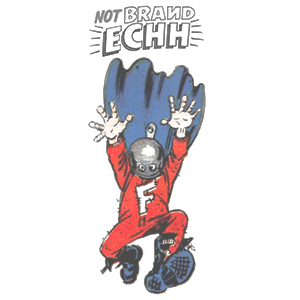
Forbush Man is the mascot of Marvel Comics’ satirical ‘Not Brand Echh’ (1967); he is the alter-ego of Irving Forbush, a fictional gofer at Marvel Comics. Forbush was dreamed up in 1955 by Marvel editor Stan Lee to refer to an imaginary low-grade colleague who was often the butt of Lee’s jokes.
Irving Forbush was originally introduced in 1955 in Marvel’s short-lived ‘Snafu’ magazine as a clone of the ‘Mad Magazine’ mascot Alfred E. Neuman (‘Snafu’ was itself a virtual clone of ‘Mad’). Forbush was given a line in the magazine’s content page where he was credited as Snafu’s founder (much as Benjamin Franklin was given the same credit in the ‘Saturday Evening Post’). (‘Snafu’ also listed another Forbush family member, as the other side of the magazine’s content column read ‘Losted [sic] by his cousin, Melvin Forbush’).
read more »
Posted in Humor |
Leave a Comment »
March 27, 2013

The 2000 Year Old Man is a persona in a comedy skit, originally created by Mel Brooks and Carl Reiner in 1961. Mel Brooks played the oldest man in the world, interviewed by Carl Reiner in a series of comedy routines that appeared on television, as well as being made into a collection of records. In a Jewish accent, Brooks would improvise answers to topics such as the earliest known language (‘basic Rock’). The inspiration for the skit was a tape-recorded exchange between Brooks and Reiner at a party. The tape recorder was brought into the mix shortly after the opening salvos, as the two comics soon had the party audience in stitches.
In 1961, when the duo began doing the skit on television, Brooks had just undergone surgery for gout. Because of his post-surgical discomfort, Brooks quipped, ‘I feel like a 2000-year-old man,’ which led Reiner to begin questioning him about what it’s like to be a 2000-year-old man and to describe history as Brooks saw it. Many of the jokes (especially the caveman jokes) were eventually brought to the screen in Brooks’ film ‘History of the World, Part I.’
Posted in Humor |
Leave a Comment »
February 25, 2013

Felix the Cat is a cartoon character created in the silent film era. His black body, white eyes, and giant grin, coupled with the surrealism of the situations in which his cartoons place him, combine to make Felix one of the most recognized cartoon characters in film history. Felix was the first character from animation to attain a level of popularity sufficient to draw movie audiences. Felix’s origins remain disputed. Australian cartoonist/film entrepreneur Pat Sullivan, owner of the Felix character, claimed during his lifetime to be its creator.
However, American animator Otto Messmer, Sullivan’s lead animator, has also been credited as such. What is certain is that Felix emerged from Sullivan’s studio in NYC, and cartoons featuring the character enjoyed success and popularity in 1920s popular culture. Aside from the animated shorts, Felix starred in a comic strip (drawn by Messmer) beginning in 1923, and his image soon adorned merchandise such as ceramics, toys and postcards. Several manufacturers made stuffed Felix toys. Jazz bands such as Paul Whiteman’s played songs about him (1923’s ‘Felix Kept On Walking’ and others).
read more »
Posted in Art, Humor, Money |
Leave a Comment »
February 6, 2013

Dan Hibiki is a video game character from Capcom’s ‘Street Fighter’ series of fighting games. Introduced in 1995 as a secret character in ‘Street Fighter Alpha,’ Dan is consistently portrayed as an arrogant, overconfident, yet utterly feeble character. Shortly after the release of ‘Street Fighter II’ in 1991, rival company SNK released their own fighting game, ‘Art of Fighting.’
The principal character of this series, Ryo Sakazaki, bore a resemblance in appearance and name to ‘Street Fighter’ mascots Ryu, as well as other aesthetic similarities to Ken, wearing an orange gi and sporting blonde hair. In humorous retaliation, ‘Street Fighter II’ co-designer Akiman drew an artwork of Sagat holding a defeated opponent by the head during the release of ‘Street Fighter II: Champion Edition.’ The defeated opponent wore an attire similar to Ryo’s: an orange karate gi with a torn black shirt underneath and geta sandals; but had long dark hair tied to a ponytail like Robert Garcia, another character from the ‘Art of Fighting’ series. This character design would become the basis of Dan.
read more »
Posted in Games, Humor |
Leave a Comment »
February 6, 2013

A femme fatale [fem fuh-tahl] is a mysterious and seductive woman whose charms ensnare her lovers in bonds of irresistible desire, often leading them into compromising, dangerous, and deadly situations. She is an archetype of literature and art. Her ability to entrance and hypnotize her victim with a spell was in the earliest stories seen as being literally supernatural; however, the femme fatale today is still often described as having a power akin to an enchantress, seductress, vampire, witch, or demon, having some power over men. The phrase is French for ‘deadly woman.’
A femme fatale tries to achieve her hidden purpose by using feminine wiles such as beauty, charm, and sexual allure. In some situations, she uses lying or coercion rather than charm. She may also make use of some subduing weapon such as sleeping gas, a modern analog of magical powers in older tales. She may also be (or imply that she is) a victim, caught in a situation from which she cannot escape; ‘The Lady from Shanghai’ (a 1947 film noir) is one such example. A younger version of a femme fatale would be called a fille fatale, or ‘deadly girl.’
read more »
Posted in Art, Sex |
1 Comment »


 The Daily Omnivore