March 16, 2012

Vale tudo [val-ay / too-doe] (Portuguese: ‘anything goes’) are full-contact unarmed combat events, with a limited number of rules, that became popular in Brazil during the 20th century. While Vale Tudo uses techniques from many martial art styles, making it similar to modern mixed martial arts competitions, it is a distinct style in its own right. Fighting sideshows, termed ‘Vale Tudo,’ became popular in Brazilian circuses during the 1920s.
Examples of such bouts were described in the ‘Japanese-American Courier’ in 1928: ‘One report from São Paulo declares that Jiu Jitsu is truly an art and that in an interesting exhibition in the side tent to the big circus a Bahian of monstrous dimensions met his waterloo at the hands of a diminutive Japanese wrestler. The man was an expert at capoeira, an old South American style of fighting, but after putting the Japanese on his back and trying to kick his head … the little oriental by the use of a Jiu Jitsu hold threw the Bahian and after a short struggle he was found sitting on the silent frame of the massive opponent.
read more »
Posted in Games, Money, World |
Leave a Comment »
March 16, 2012


Mixed martial arts (MMA) is a full contact combat sport that allows the use of both striking and grappling techniques, both standing and on the ground, including boxing, wrestling, Brazilian jiu-jitsu, muay Thai, kickboxing, taekwondo, karate, judo and other styles. The roots of modern mixed martial arts can be traced back to the ancient Olympics where one of the earliest well documented systems of codified full range unarmed combat was utilized in the sport of Pankration.
Various mixed style contests also took place throughout Europe, Japan and the Pacific Rim during the early 1900s. The combat sport of Vale Tudo that had developed in Brazil from the 1920s was brought to the United States by the Gracie family in 1993 with the founding of the Ultimate Fighting Championship (UFC), which is currently the largest MMA promotion company worldwide. Prior to the UFC, professional MMA events had also been held in Japan by Shooto since 1989.
read more »
Posted in Games, Money, Politics |
Leave a Comment »
March 14, 2012
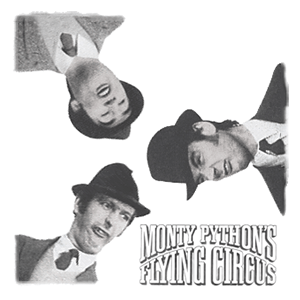
The Upper Class Twit of the Year is a classic comedy sketch that was seen on the TV show ‘Monty Python’s Flying Circus,’ and also in a modified format as the finale of the movie ‘And Now For Something Completely Different.’ It is notable for its savage satire on dim-witted members of the English upper class. The sketch features horse race style commentary by John Cleese about an obstacle-course race among five stereotypical, upper-class twits (imbeciles), to determine the 127th Annual Upper-Class Twit of the Year.
The obstacles include: Kicking The Beggar (the Twits must approach a beggar with a tray and kick him until he falls over); Reversing Into The Old Lady (the Twits must get into their sports cars and reverse them into a cardboard cut-out of an old lady, then speed off; into Waking The Neighbor (the Twits must drive their cars forward and then try to wake up a neighbor (who is attempting to get some sleep) by slamming their doors, tooting their horns, etc. Finally, the Twits approach a table with five revolvers on it. The winner is the first Twit to shoot himself. The three coffins of the winning Twits are placed on the medal rostrum and medals are draped around them. Cleese ends his commentary by remarking that ‘there’ll certainly be some car door slamming in the streets of Kensington tonight.’
Posted in Art, Humor, Money |
Leave a Comment »
March 12, 2012
The World Beard and Moustache Championships is a biennial competition in which men with beards and moustaches display lengthy, highly-styled facial hair in several categories which are rated by a panel of judges. The first Championship took place in Höfen-Enz, Germany, in 1990. The 2011 championships were hosted by ‘The Norwegian Moustache Club of 91’ in Trondheim, Norway.
The 12th incarnation of the contest will be in Stuttgart, Germany in 2013 and will be hosted by Belle Moustache Beard and Culture Club. There are 3 brackets of facial hair: Moustache, Partial Beard and Full Beard. Each bracket is broken into individual categories. There are usually 17 categories but there were 18 different categories for the 2009 championships.
Posted in Games, Humor, World |
Leave a Comment »
March 5, 2012
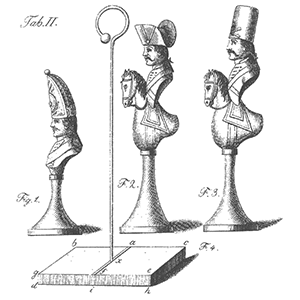
Kriegsspiel [kreeg-speel] (German: ‘wargame’) was a system used for training officers in the Prussian army. The first set of rules was created in 1812 and named ‘Instructions for the Representation of Tactical Maneuvers under the Guise of a Wargame.’ It was originally produced and developed further by Lieutenant Georg Leopold von Reiswitz and his son Georg Heinrich Rudolf von Reiswitz of the Prussian Army. Their system for simulating war was initially based around a specially designed table created for King Friedrich Wilhelm III.
The table divided the game field into a grid system, a core element of many later wargame and roleplaying systems, and included different pre-cast terrain types used in modular combinations, as well as making use of special gaming pieces and dice. The system also included a position called ‘confidant,’ an impartial third party calculating and assessing the moves, analogous to the modern gamemaster or dungeon master.
read more »
Posted in Games, War, World |
Leave a Comment »
February 28, 2012

Competitive eating is a sport in which participants compete against each other to consume large quantities of food in a short time period. Contests are typically less than 15 minutes in length, with the person consuming the most food being declared the winner. Competitive eating is most popular in the United States and Japan, where organized professional eating contests often offer $10,000 or more in prize money. Competitive eaters are sometimes known as ‘gurgitators,’ a word used by those close to the sport and an assumed opposite of regurgitation.
The chief criticism of competitive eating is the message the gluttonous sport sends in an age of rising obesity levels among Americans and the example it sets for today’s youth. Others contend that competitive eating is an example of Western gluttony at a time when others around the world are starving. Gastroparesis, also known as stomach paralysis, is also a concern among those who routinely stretch their stomachs beyond capacity. The condition may lead to the stomach’s inability to contract and lose its ability to empty itself.
read more »
Posted in Food, Games, Health |
Leave a Comment »
February 27, 2012

Cycle polo is a team sport invented in Ireland in 1891 by retired cyclist Richard J. Mecredy. It is similar to traditional polo, except that bicycles are used instead of horses. In recent years, an alternate form of the game known as ‘Hardcourt Bike Polo’ or ‘Urban Bike Polo’ has grown in popularity. In this variation, teams composed of three to five players compete on tennis courts, street hockey rinks, or whatever other surfaces are available.
The rules vary slightly by city. In the case of a ‘foot down’ or ‘dab’ (touching the ground with one’s foot) the player must ‘tap out’ by riding to mid-court and hitting a designated area with their mallet. There is usually a tap-out located on either side of the court. In order to score, the offensive player must hit the ball across the goal line using the narrow end of the mallet – this is called a ‘shot’ or ‘hit’ – hitting the ball across the goal line with the wide end of the mallet is called a ‘shuffle.’
Posted in Games, Humor |
Leave a Comment »
January 5, 2012
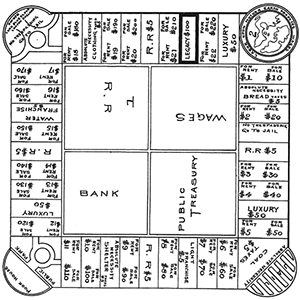
The Landlord’s Game is a board game patented in 1904 by Elizabeth Magie. It is a realty and taxation game, which is considered to be a direct inspiration for the board game ‘Monopoly.’
Though many similar home-made games were played at the beginning of the 20th century, it is the first of its kind to have an attested patent. Magie designed the game to be a ‘practical demonstration of the present system of land grabbing with all its usual outcomes and consequences.’
read more »
Posted in Games, Money, Politics |
Leave a Comment »
December 19, 2011
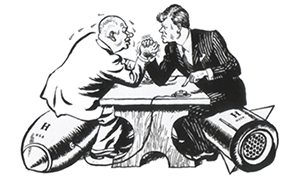

The game of chicken, also known as the hawk-dove or snowdrift game, is an influential model of conflict for two players in game theory. The principle of the game is that while each player prefers not to yield to the other, the worst possible outcome occurs when both players do not yield.
The name ‘chicken’ has its origins in a game in which two drivers drive towards each other on a collision course: one must swerve, or both may die in the crash, but if one driver swerves and the other does not, the one who swerved will be called a ‘chicken,’ meaning a coward; this terminology is most prevalent in political science and economics.
read more »
Posted in Games, Politics, Science |
Leave a Comment »
December 14, 2011
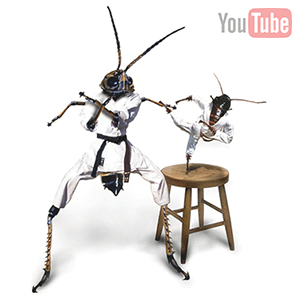
Insect fighting is an activity involving insects (and sometimes, arachnids, centipedes, millipedes and mollusks). It is practiced in areas in China, Japan, Vietnam, and Thailand. Cricket fighting is a traditional Chinese pastime that dates back to the Tang Dynasty (618-907). Originally nurtured by emperors, it was later popularized by commoners. It is also a casual activity for youth in western countries and is known colloquially as ‘bugfighting.’
Some of the most popular species used are the Stag Beetle, Rhinoceros Beetle, Kabutomushi, Jerusalem Cricket, and Goliath Beetle, as their sheer size and jumping ability make them formidable opponents. They are trained by their owners to become stronger and more aggressive. With beetles, a small noisemaker is used that duplicates the female’s mating call (fighting beetles are male). Getting beetles to fight requires patience and is much different than other types of animal fighting. The loser is pushed onto its back by the winner, pushed off of a tree limb, or a predetermined area, or is killed.
Posted in Games, Humor, World |
Leave a Comment »
December 13, 2011


Wok racing was developed by the German TV host Stefan Raab. Modified Chinese woks are used to make timed runs down an Olympic bobsled track. There are competitions for one-person-woksleds and four-person-woksleds, the latter using four woks per sled. Wok racing was inspired by a bet on a German TV show in 2003. Participants are mostly b-list celebrities. The typical racing woks are the ordinary round-bottomed Chinese pans, usually directly imported from China. The only modifications are that the bottom is reinforced with an epoxy filling and the edges of the wok are coated with polyurethane foam to avoid injuries.
Four-person woksleds consist of two pairs of woks, each of them is held together by a rounded frame. The two pairs are connected by a coupling. Due to the rather risky nature of the sport the participants wear heavy protective gear, usually similar to ice hockey equipment. To further reduce friction and the risk of injuries, the athletes wear ladles under their feet. To improve performance, the underside of the woks are often heated with a blowlamp before the race.
Posted in Games, Humor, World |
Leave a Comment »
December 13, 2011

Kinetic sculpture races are organized contests of human-powered amphibious all-terrain works of art. The original event, the Kinetic Grand Championship in Humboldt County, California, is also called the ‘Triathlon of the Art World’ because art and engineering are combined with physical endurance during a three day cross country race that includes sand, mud, pavement, a bay crossing, a river crossing and major hills.
The concept of kinetic sculpture racing originated in Ferndale, California in 1969 when local sculptor Hobart Brown ‘improved’ the appearance of his son’s tricycle by welding on two additional wheels and other embellishments. Seeing this ‘Pentacycle,’ fellow artist Jack Mays challenged him to a race.
read more »
Posted in Art, Games, Humor |
Leave a Comment »


 The Daily Omnivore