September 21, 2016

In educational institutions, safe-space (or safer-space or positive space) originally were terms used to indicate that a teacher, educational institution or student body does not tolerate anti-LGBT violence, harassment or hate speech, thereby creating a safe place for all lesbian, gay, bisexual, and transgender students. The term safe space has been extended to refer to a space for individuals who are marginalized to come together to communicate regarding their experiences with marginalization, typically on a university campus. It has been criticized for being contrary to freedom of speech.
In the U.S. the concept originated in the women’s movement, where it ‘implies a certain license to speak and act freely, form collective strength, and generate strategies for resistance…a means rather than an end and not only a physical space but also a space created by the coming together of women searching for community.’ The first safe spaces were gay bars and consciousness raising groups. Positive Space initiatives are prevalent in post-secondary institutions across Canada including McGill University and the University of Toronto.
read more »
Posted in Education, Politics, Sex |
Leave a Comment »
July 7, 2016
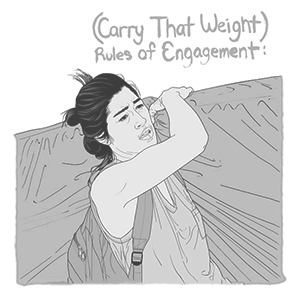
‘Mattress Performance (Carry That Weight)’ was a work of endurance performance art by Emma Sulkowicz, conducted as her senior thesis during the final year of her visual arts degree at Columbia University in New York City.
Begun in September 2014, the piece involved her carrying a 50-lb mattress – of the kind Columbia uses in its dorms – wherever she went on campus. She said the piece would end when a student she alleges raped her in her dorm room in 2012 was expelled from or otherwise left the university. Sulkowicz carried the mattress until the end of the Spring semester as well as to her graduating ceremony in May 2015.
read more »
Posted in Art, Politics, Sex |
1 Comment »
June 29, 2016

Mechanical doping is a recent term describing the use of secret motors in competitive cycling events. As a form of ‘technological fraud’ it is banned by the Union Cycliste Internationale, the international governing body of cycling. One of the first allegations of motor doping dates to the 2010 Tour of Flanders when Fabian Cancellara climbed a steep part of Kapelmuur while unusually seated, leading to allegations that there was an powered device hidden in his bike.
The first confirmed use of mechanical doping in the sport was discovered at the 2016 UCI Cyclo-cross World Championships when one of the bikes of Belgian cyclist Femke Van den Driessche was found to have a secret motor inside.
read more »
Posted in Games, Politics, Technology |
1 Comment »
March 21, 2016

Manspreading, or man-sitting, is the practice of sitting in public transport with legs wide apart, thereby covering more than one seat. Both this posture and usage of the term ‘manspreading’ have caused some internet criticism, and debates. The term first appeared in public debate when a feminist anti-manspreading campaign was started on Tumblr in 2013. The Oxford English Dictionary added it as a word in August 2015.
The Metropolitan Transportation Authority in New York and Sound Transit of Seattle instituted poster campaigns encouraging respectful posture when other passengers have to stand due to crowding on buses and trains. The MTA campaign carried slogans like ‘Dude, stop the spread please!’
read more »
Posted in Humor, Politics |
Leave a Comment »
November 13, 2015


Political correctness (PC) means using words or behavior which will not offend any group of people. The term arose in the 1970s as a way of encouraging the replacement of bygone phrases such as ‘colored.’ By the 1990s, it had taken on pejorative and mocking overtones, and was described as symptomatic of excessive liberalism and the ‘nanny state.’ The phrase was widely used in the debate about the 1987 book ‘The Closing of the American Mind’ by philosopher Allan Bloom, and gained further currency in response to social commentator Roger Kimball’s ‘Tenured Radicals’ (1990).
Conservative author Dinesh D’Souza’s ‘Illiberal Education’ duology of books (1991, 1992) condemned what he saw as liberal efforts to advance victimization, multiculturalism through language, and affirmative action. Advocates of political correctness, however, argue that libertarians made an issue of the term in order to divert attention from more substantive matters of discrimination and as part of a broader culture war against liberalism. They have also said that the right wing has it own forms of political correctness.
read more »
Posted in Language, Politics |
Leave a Comment »
February 6, 2014

A wardrobe malfunction is accidental exposure of intimate parts. It is different from indecent exposure or flashing, as the latter ones imply a deliberate exposure. There has been a long history of such incidents, though the term itself was coined in the mid-2000s and has become one of the most common fashion faux pas. In everyday context it often happens as a ‘nipple slip’ to women and is relatively common, but wardrobe malfunction suggests a public event or performance, particularly when there are allegations that it was deliberately staged for publicity reasons.
The American Dialect Society defines it as ‘an unanticipated exposure of bodily parts.’ Global Language Monitor, which tracks usage of words on the internet and in newspapers worldwide, identified the term as the top Hollywood contribution to English in 2004, surpassing words like ‘girlie men’ and ‘Yo!’
read more »
Posted in Humor, Politics, Sex |
Leave a Comment »
August 19, 2013

‘More popular than Jesus‘ was a controversial remark made by musician John Lennon of the Beatles in 1966: Lennon said that Christianity was in decline and that the Beatles had become more popular than Jesus Christ.
When the quote appeared in the American teen magazine ‘Datebook,’ angry reactions flared up from Christian communities. Lennon had originally made the remark in March 1966 during interviews with Maureen Cleave on the lifestyles of the four individual Beatles. When Lennon’s words were first published, in the ‘London Evening Standard’ in the United Kingdom, they had provoked no public reaction.
read more »
Posted in Language, Philosophy, Politics |
Leave a Comment »
August 17, 2013
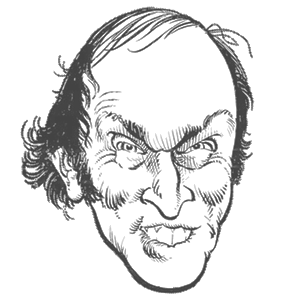
‘Just watch me‘ is a phrase made famous by Canadian Prime Minister Pierre Trudeau on October 13, 1970, during the October Crisis (two kidnappings of government officials by Québécois separatists). The term is still regularly used in Canadian political discussion. Trudeau, who had in previous years been a strong proponent of civil liberties, spoke of the need for drastic action to restore order in Quebec.
When questioned by CBC reporter Tim Ralfe on how far he would go in the suspension of civil liberties to maintain order, Trudeau replied ‘Well, just watch me.’ Three days later he invoked the ‘War Measures Act,’ which led to police action against many Quebec dissidents and great public controversy.
Posted in Language, Politics |
1 Comment »
April 29, 2013

Reverse discrimination is discrimination against members of a dominant or majority group or in favor of members of a minority or historically disadvantaged group. Groups may be defined in terms of race, gender, ethnicity, or other factors.
This discrimination may seek to redress social inequalities where minority groups have been denied access to the same privileges of the majority group. In such cases it is intended to remove discrimination that minority groups may already face. Reverse discrimination may also be used to highlight the discrimination inherent in affirmative action programs.
read more »
Posted in Money, Politics, Sex |
Leave a Comment »
April 29, 2013
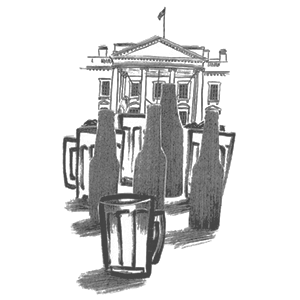
Reverse racism is a term which refers to racial prejudice or discrimination directed against members of one’s own race. The term came into use as the struggle for African-American rights divided the white community.
In 1966, Hosea Williams of the Southern Christian Leadership Conference (SCLC), publicly accused members of the Student Nonviolent Coordinating Committee (SNCC) of reverse racism in their efforts to exclude or expel whites from local government in Alabama to make room for blacks. Williams argued that SNCC’s (unsuccessful) ‘all-black’ campaign in Alabama would drive white moderates out of the civil rights movement. ‘Black racism’ was a more common term in this era, used to describe SNCC and groups like the Black Panthers.
read more »
Posted in Language, Politics, World |
2 Comments »
April 1, 2013
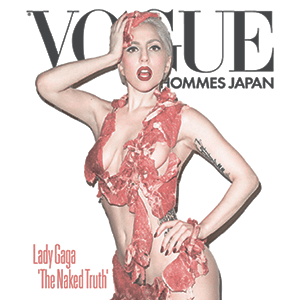
American pop singer Lady Gaga wore a dress made of raw beef, which was commonly referred to by the media as the meat dress, to the 2010 MTV Video Music Awards. Designed by Argentine designer Franc Fernandez and styled by Nicola Formichetti, the dress was condemned by animal rights groups, and named by ‘Time’ as the top fashion statement of 2010. The press speculated on the originality of the meat dress idea, with comparisons made to similar images found in contemporary art and popular culture. Architects Diller Scofidio + Renfro, for example, had designed a meat dress in 2006.
As with her other dresses, it was archived, but went on display in 2011 at the Rock and Roll Hall of Fame after being preserved by taxidermists as a type of jerky. Gaga explained following the awards ceremony that the dress was a statement about one’s need to fight for what one believes in, and highlighted her distaste for the US military’s don’t-ask-don’t-tell policy.
read more »
Posted in Food, Politics |
Leave a Comment »
March 18, 2013
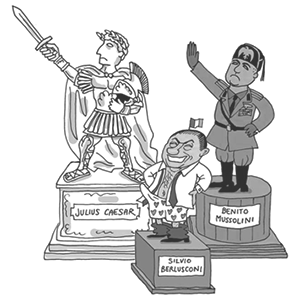
The Roman salute (Saluto Romano) is a gesture in which the arm is held out forward straight, with palm down, and fingers touching. In some versions, the arm is raised upward at an angle; in others, it is held out parallel to the ground. The former is a well known symbol of fascism that is commonly perceived to be based on a custom in ancient Rome. However, no Roman text gives this description and the Roman works of art that display gestures of salutation bear little resemblance to the modern Roman salute.
Jacques-Louis David’s painting ‘The Oath of the Horatii’ (1784) provided the starting point for the gesture that became later known as the Roman salute. The gesture and its identification with Roman culture was further developed in other French neoclassic artworks.
read more »
Posted in Politics, War, World |
1 Comment »


 The Daily Omnivore