March 18, 2013
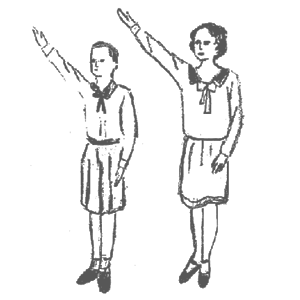
The Bellamy salute is a salute chosen by American socialist Francis Bellamy to accompany the American Pledge of Allegiance, which he wrote. During the period when it was used with the Pledge of Allegiance, it was sometimes known as the ‘flag salute.’ During the 1920s and 1930s, Italian fascists and Nazis adopted salutes which were similar in form, resulting in controversy over the use of the Bellamy salute in the United States.
It was officially replaced by the hand-over-heart salute when Congress amended the Flag Code in December of 1942. The inventor of the saluting gesture was James B. Upham, junior partner and editor of ‘The Youth’s Companion.’ Bellamy recalled Upham, upon reading the pledge, came into the posture of the salute, snapped his heels together, and said ‘Now up there is the flag; I come to salute; as I say ‘I pledge allegiance to my flag,’ I stretch out my right hand and keep it raised while I say the stirring words that follow.’
read more »
Posted in Politics, War, World |
1 Comment »
March 7, 2013

Payola [pey-oh-luh], in the American music industry, is the illegal practice of payment or other inducement by record companies for the broadcast of recordings on music radio in which the song is presented as being part of the normal day’s broadcast.
A radio station can play a specific song in exchange for money, but this must be disclosed on the air as being sponsored airtime, and that play of the song should not be counted as a ‘regular airplay.’ The term has come to refer to any secret payment made to cast a product in a favorable light (such as obtaining positive reviews). Some radio stations report spins of the newest and most popular songs to industry publications. The number of times the songs are played can influence the perceived popularity of a song.
read more »
Posted in Money, Politics |
Leave a Comment »
February 13, 2013

The Heart Attack Grill is an American hamburger restaurant in Las Vegas (formerly located in Chandler, Arizona). It has courted controversy by serving high-calorie menu items with deliberately provocative names coupled with waitresses in sexually provocative clothing. The establishment is a hospital theme restaurant: waitresses (‘nurses’) take orders (‘prescriptions’) from the customers (‘patients’).
A tag is wrapped on the patient’s wrist showing which foods they order and a ‘doctor’ examines the ‘patients’ with a stethoscope. The menu includes ‘Single,’ ‘Double,’ ‘Triple,’ and ‘Quadruple Bypass’ hamburgers, ranging from a half pound to two pounds of beef (up to about 8,000 calories), all-you-can-eat ‘Flatliner Fries’ (cooked in pure lard), beer and tequila (shots are served in four ounce novelty syringes.), ‘butter-fat Shakes,’ and soft drinks such as Jolt and Mexican-bottled Coca-Cola made with real sugar. Customers over 350 lb in weight eat for free if they weigh in with a doctor or nurse before each burger. Beverages and to-go orders are excluded and sharing food is also not allowed for the free food deal.
Posted in Food, Health, Humor |
1 Comment »
February 11, 2013

Commodification (or commoditization) is the transformation of goods, ideas, or other entities that may not normally be regarded as goods into a commodity. American author and feminist bell hooks refers to cultural commodification [kuh-mod-uh-fi-key-shuhn] as ‘eating the other.’ By this she means that cultural expressions, revolutionary, or post modern, can be sold to the dominant culture. Any messages of social change are not marketed for their messages but used as a mechanism to acquire a piece of the ‘primitive.’ Any interests in past historical culture almost always have a modern twist.
According to Mariana Torgovnick, ‘What is clear now is that the West’s fascination with the primitive has to do with its own crises in identity, with its own need to clearly demarcate subject and object even while flirting with other ways of experiencing the universe.’ Hooks states that marginalized groups are seduced by this concept because of ‘the promise of recognition and reconciliation.’ ‘When the dominant culture demands that the Other be offered as sign that progressive political change is taking place, that the American Dream can indeed be inclusive of difference, it invites a resurgence of essentialist cultural nationalism.’
read more »
Posted in Money, Politics, World |
1 Comment »
December 22, 2012

Male circumcision has often been, and remains, the subject of controversy on a number of grounds—including religious, ethical, sexual, and health related. The Ancient Greeks and Romans valued the foreskin and were opposed to circumcision – an opposition inherited by the canon and secular legal systems of the Christian West that lasted at least through to the Middle Ages. Traditional Judaism and Islam have advocated male circumcision as a religious obligation.
The ethics of circumcision are sometimes controversial. From the mid-19th century, there has been advocacy in some Anglophone countries on medical grounds, such as the prevention of masturbation and ‘reflex neurosis.’ Modern proponents argue that circumcision reduces the risks of a range of infections and diseases as well as conferring sexual benefits. In contrast, opponents, particularly of infant circumcision, often question its effectiveness in preventing disease, and object to subjecting newborn boys, without their consent, to a procedure they consider to have debatable benefits, significant risks, and a potentially negative impact on general health and later sexual enjoyment.
read more »
Posted in Health, Philosophy, Sex |
2 Comments »
October 9, 2012

‘Conversion therapy‘ (also known as ‘Reparative therapy’) is a pseudo-scientific therapy that aims to change sexual orientation. Mainstream American medical and scientific organizations have expressed concern over conversion therapy and consider it potentially harmful. The advancement of conversion therapy may cause social harm by disseminating inaccurate views about sexual orientation. As a result, conversion therapy on minors is illegal in California.
The American Psychiatric Association has condemned psychiatric ‘treatment’ which is ‘based upon the assumption that homosexuality per se is a mental disorder or based upon the a priori assumption that a patient should change his/her sexual homosexual orientation.’ It states that, ‘Ethical practitioners refrain from attempts to change individuals’ sexual orientation.’ And that political and moral debates over the integration of gays and lesbians into the mainstream of American society have obscured scientific data about changing sexual orientation ‘by calling into question the motives and even the character of individuals on both sides of the issue.’
read more »
Posted in Health, Philosophy, Sex |
1 Comment »
September 29, 2012
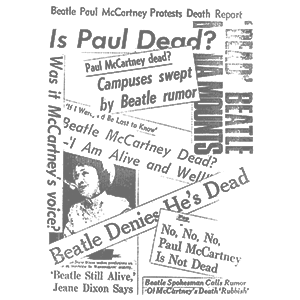
Backmasking is a recording technique in which a sound or message is recorded backward on to a track that is meant to be played forward. Backmasking is a deliberate process, whereas a message found through ‘phonetic reversal’ may be unintentional. Backmasking was popularized by The Beatles who used backward instrumentation on their 1966 album ‘Revolver.’ Artists have since used backmasking for artistic, comedic and satiric effect, on both analogue and digital recordings.
The technique has also been used to censor words or phrases for ‘clean’ releases of rap songs. Backmasking has been a controversial topic in the United States since the 1980s, when allegations from Christian groups of its use for Satanic purposes were made against prominent rock musicians, leading to record-burning protests and proposed anti-backmasking legislation by state and federal governments.
read more »
Posted in Humor, Philosophy, Science |
Leave a Comment »
September 14, 2012

‘Vast right-wing conspiracy‘ was a theory advanced by then First Lady of the United States Hillary Rodham Clinton in 1998 in defense of her husband, President Bill Clinton, and his administration during the Lewinsky scandal, characterizing the Lewinsky charges as the latest in a long, organized, collaborative series of charges by Clinton’s political enemies. While popularized by Mrs. Clinton in her 1998 interview, the phrase did not originate with her.
In 1991 the ‘Detroit News’ wrote: ‘Thatcher-era Britain produced its own crop of paranoid left-liberal films. … All posited a vast right-wing conspiracy propping up a reactionary government ruthlessly crushing all efforts at opposition under the guise of parliamentary democracy.’ An AP story in 1995 also used the phrase, relating an official’s guess that the Oklahoma City bombing was the work of ‘maybe five malcontents’ and not ‘some kind of vast right-wing conspiracy.’
read more »
Posted in Language, Politics |
2 Comments »
August 25, 2012

In 2003, the columnist and gay rights activist Dan Savage held a contest among his readers to create a definition for the word ‘santorum‘ as a response to comments by then-U.S. Senator Rick Santorum that had been criticized as anti-gay. Savage announced the winning entry, which defined ‘santorum’ as ‘the frothy mixture of lube and fecal matter that is sometimes the byproduct of anal sex.’
He created a web site, spreadingsantorum.com (and santorum.com), to promote the definition, which became a prominent search result for Santorum’s name on several web search engines. In 2010 Savage offered to take the site down if Santorum donated US$5 million to Freedom to Marry, a group advocating legal recognition of same-sex marriages. In 2011 Santorum asked Google to remove the definition from its search engine index. Google refused, responding that the company does not remove content from search results except in very limited circumstances.
read more »
Posted in Language, Politics, Sex |
1 Comment »
May 31, 2012

‘Teach the Controversy‘ is the name of a campaign by the Discovery Institute (a conservative Christian think tank based in Seattle) to promote a variant of traditional creationism, intelligent design, while attempting to discredit evolution in US public high school science courses.
The central claim is that fairness and equal time requires educating students with a ‘critical analysis of evolution’ where ‘the full range of scientific views,’ evolution’s ‘unresolved issues,’ and the ‘scientific weaknesses of evolutionary theory’ will be presented and evaluated alongside intelligent design concepts like irreducible complexity. The overall goal of the movement is to ‘defeat [the] materialist world view’ represented by the theory of evolution and replace it with ‘a science consonant with Christian and theistic convictions.’
read more »
Posted in Education, Philosophy, Science |
Leave a Comment »
February 8, 2012

‘Manifold Destiny‘ is a 2006 article in ‘The New Yorker’ written by Sylvia Nasar (known for her biography of John Forbes Nash, ‘A Beautiful Mind’) and David Gruber. It gives a detailed account (including interviews with many mathematicians) of some of the circumstances surrounding the proof of the Poincaré conjecture, one of the most important accomplishments of 20th and 21st century mathematics, and traces the attempts by three teams of mathematicians to verify the proof given by Grigori Perelman.
Subtitled ‘A legendary problem and the battle over who solved it,’ the article concentrates on the human drama of the story, especially the discussion on who contributed how much to the proof of the Poincaré conjecture. Interwoven with the article is an interview with the reclusive mathematician Grigori Perelman, whom the authors tracked down to the St. Petersburg apartment he shares with his mother. The article describes Perelman’s disillusionment and withdrawal from the mathematical community and paints an unflattering portrait of the 1982 Fields Medalist, Shing-Tung Yau.
read more »
Posted in Language, Science |
1 Comment »
November 16, 2011
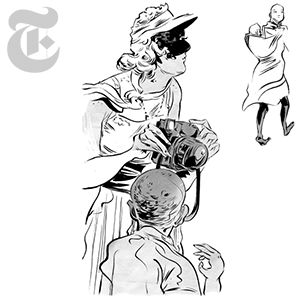
Slum tourism is a type of tourism that involves visiting impoverished areas, which has become increasingly prominent in several developing countries like India, Brazil, Kenya, and Indonesia. The Oxford English Dictionary found the first use of the word ‘slumming’ in 1884. In London, people visited neighborhoods such as Whitechapel or Shoreditch to see how the poor lived. In 1884 the concept moved to New York City to the Bowery and the Five Points area of the Lower East Side were visited to see ‘how the other half lives.’ In the 1980s in South Africa ‘township tours’ were organized to educate local governments on how the black population lived. It then attracted international tourists that wanted to support and learn more about apartheid. Prior to the release of ‘Slumdog Millionaire’ in 2008, Mumbai was a slum tourist destination.
Critics say slum tourism, like poorism, is likened to a kind of voyeurism, exploiting people less fortunate, snapping pictures and leaving nothing in return. Some tours do use portions of the profits to help out however. They have also courted controversy because of disputes about their safety, and fears that they misrepresent local culture.
Posted in Money, Politics, World |
Leave a Comment »


 The Daily Omnivore