June 28, 2011

Contempt of cop is law enforcement jargon in the United States for behavior by citizens towards law enforcement officers that the officers perceive as disrespectful or insufficiently deferential. The phrase is associated with arbitrary arrest and detention and is often discussed in connection to police misconduct such as use of excessive force or even police brutality as a reaction to disrespectful behavior rather than for any legitimate law enforcement purpose.
A similar idiom is ‘disturbing the police,’ a play on ‘disturbing the peace.’ It has also been referred to as ‘flunking the attitude test.’ In some areas it is called P.O.P. or ‘Pissing Off the Police.’
read more »
Posted in Politics |
1 Comment »
March 29, 2011
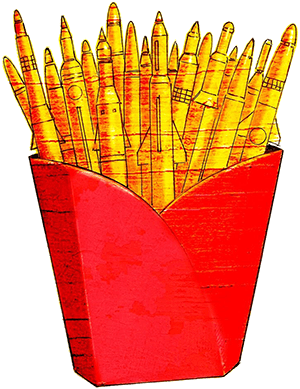
Freedom fries is a political euphemism for French fries used in the US as a result of anti-French sentiment during the controversy over the decision to invade Iraq in 2003. France expressed strong opposition in the UN, leading to boycotts of French goods and the removal of the country’s name from products.
Representatives Robert W. Ney (R-Ohio) and Walter B. Jones, Jr. (R-North Carolina) declared that all references to French fries and French toast on the menus of the restaurants and snack bars run by the House of Representatives would be removed. House cafeterias were ordered to rename French fries ‘freedom fries.’ This action was carried out without a congressional vote, under the authority of Ney’s position as Chairman of the Committee on House Administration, which oversees restaurant operations for the chamber.
read more »
Posted in Humor, Politics, World |
Leave a Comment »
March 10, 2011
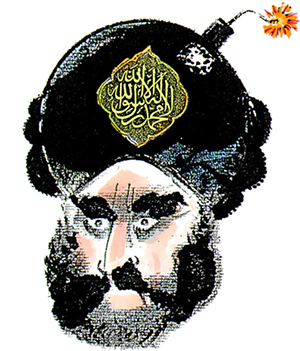
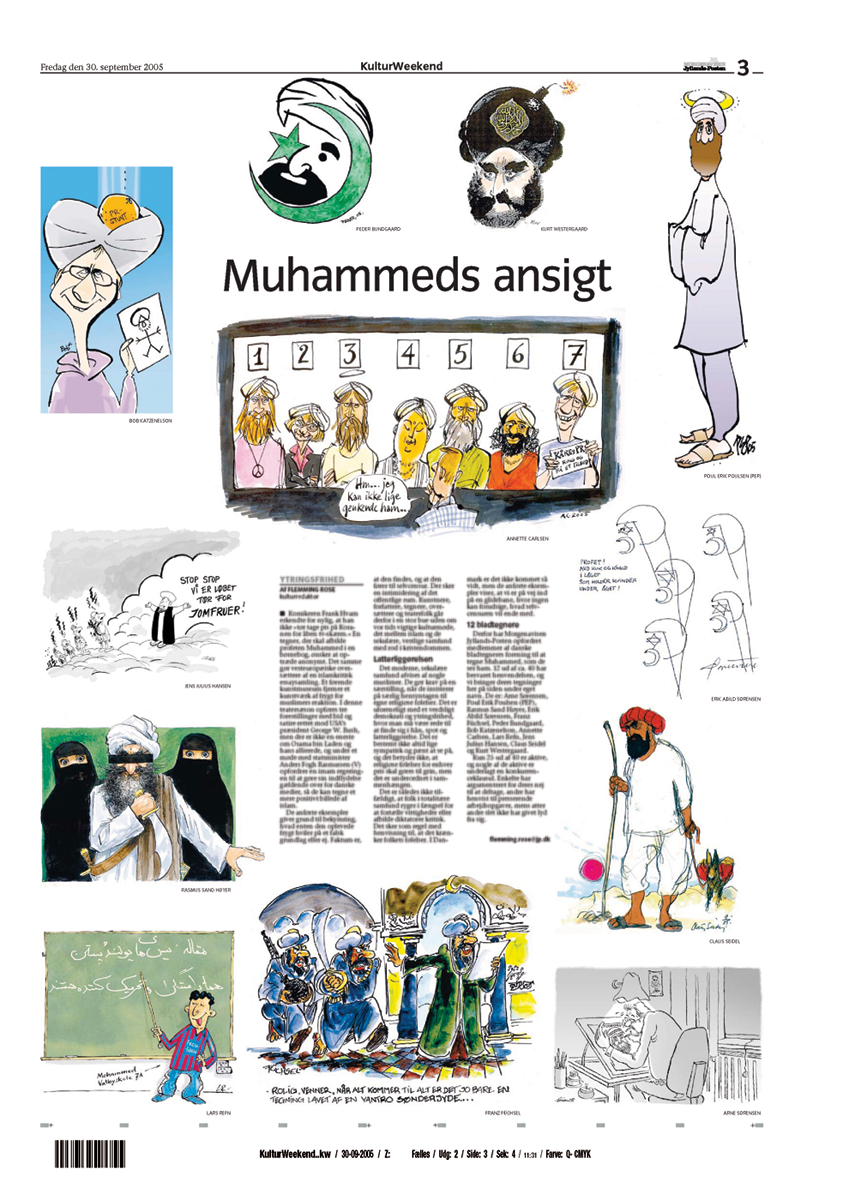
The Jyllands-Posten Muhammad cartoons controversy began after 12 editorial cartoons, most of which depicted the Islamic prophet Muhammad, were published in the Danish newspaper ‘Jyllands-Posten’ in 2005. The newspaper announced that this publication was an attempt to contribute to the debate regarding criticism of Islam and self-censorship. Danish Muslim organizations responded by holding public protests. The cartoons were reprinted in newspapers in more than 50 other countries, expanding the controversy.
Critics of the cartoons described them as Islamophobic or racist, and argued that they are blasphemous to people of the Muslim faith, are intended to humiliate a Danish minority, or are a manifestation of ignorance about the history of Western imperialism. Supporters have said that the cartoons illustrated an important issue in a period of Islamic terrorism and that their publication is a legitimate exercise of the right of free speech, explicitly tied to the issue of self-censorship.
Posted in Philosophy, Politics, World |
Leave a Comment »
November 4, 2010

The 2010 Duke University sex thesis (also known as the ‘Duke Fuck List’) controversy arose from a private document written by senior, Karen Owen, in the format of a thesis about her sexual experiences during her time attending the university. Owen wrote and distributed the document to three friends shortly after graduating from the university, in May 2010. By mid-September it was widely available on the internet. In the satirical thesis, titled ‘An education beyond the classroom: excelling in the realm of horizontal academics,’ Owen ranked her partners based on her criteria for performance.
The bulk of the controversy surrounded whether she invaded her partners’ rights to privacy, and whether the subjects of Owen’s paper have a right to sue, as in the case of Jessica Cutler when Cutler published details of her sex life on a blog. It also raised questions as to whether double standards exist if the reaction would have been the same had the document been written by a male. The paper attracted additional attention because some of the men which Owen ranked were from the lacrosse team, and there was an unrelated sex controversy surrounding the team a few years prior.
Posted in Education, Humor, Sex |
Leave a Comment »


 The Daily Omnivore