November 11, 2010

A quantum computer is a device for computation that makes direct use of quantum mechanical phenomena, such as superposition and entanglement, to perform operations on data. Quantum computers are different from traditional computers based on transistors. The basic principle behind quantum computation is that quantum properties can be used to represent data and perform operations on these data. If large-scale quantum computers can be built, they will be able to solve certain problems much faster than any current classical computers (for example Shor’s algorithm). The Bloch sphere is a representation of a qubit, the fundamental building block of quantum computers.
A classical computer has a memory made up of bits, where each bit represents either a one or a zero. A quantum computer maintains a sequence of qubits. A single qubit can represent a one, a zero, or, crucially, a quantum superposition where it is all possible states simultaneously. Although quantum computing is still in its infancy, experiments have been carried out in which quantum computational operations were executed on a very small number of qubits. Both practical and theoretical research continues, and many national government and military funding agencies support quantum computing research to develop quantum computers for both civilian and national security purposes, such as cryptanalysis.
Posted in Technology |
Leave a Comment »
November 7, 2010

An orrery [awr-uh-ree] is a mechanical device that illustrates the relative positions and motions of the planets and moons in the solar system in a heliocentric model. They are typically driven by a clockwork mechanism with a globe representing the Sun at the centre, and with a planet at the end of each of the arms. The first modern orrery was built circa 1704 by George Graham and Thomas Tompion. Eisinga’s ‘Planetarium’ (actually, an orrery) was built from 1774 to 1781 by Eise Eisinga in his home in Franeker, in the Netherlands. It displays the planets across the width of a room’s ceiling, and has been in operation almost continually since it was created.
According to Cicero, the Greek philosopher Posidonius constructed an orrery that exhibited the diurnal motions of the sun, moon, and the five known planets. Cicero’s account was written in the first century BCE. The Antikythera mechanism is one of the first orreries. It is an ancient mechanical calculator designed to calculate astronomical positions. It was discovered in an ancient shipwreck off the Greek island of Antikythera, between Kythera and Crete, and has been dated to about 150-100 BC. Technological artifacts of similar complexity would not be common for a thousand years.
Posted in Technology |
Leave a Comment »
November 3, 2010

The DARPA PowerSwim program is developing a human-powered swimming device for use by combat and reconnaissance swimmers. The device uses the same oscillating foil approach to swimming that is exhibited by many fish and aquatic birds. This propulsion approach is more than 80-percent efficient in conversion of human motions to forward propulsion. Typical recreational swim fins are no more than 15-percent efficient in their conversion of human exertion to propulsive power, and freestyle swimming converts only 3-percent.
Posted in Technology, War |
Leave a Comment »
September 19, 2010


The Original Whizzinator is a product intended to fraudulently defeat drug tests. The Whizzinator comes as a kit complete with dried urine and syringe, heater packs (to keep the urine at body temperature), a false penis (available in several skin tones including white, tan, latino, brown, and black) and an instruction manual. The company also offered a female version of the Whizzinator, called ‘Number One.’
The device received media coverage in 2005 after Onterrio Smith, a former Minnesota Vikings running back, was caught with one at the Minneapolis-St. Paul International Airport, which resulted in his suspension. Actor Tom Sizemore was also caught with a Whizzinator that year. In 2008, federal prosecutors in Pittsburgh won a 19-count indictment against Puck Technology, maker of the Whizzinator, and its owners for fraud and selling drug paraphernalia. As of 2011, the Whizzinator-XXX is being marketed by Alternative Lifestyle Systems for $139.95 through ‘High Times’ magazine as a strap-on ‘wet sex simulator’ containing ‘synthetic urine,’ ostensibly for synthetic watersports activity.
Posted in Drugs, Politics, Sex |
Leave a Comment »
September 13, 2010

A stalking horse is a person who acts on the behalf of an anonymous third party. The expression is generally used in politics and business. The term originally derived from the practice of hunting wildfowl, which flee immediately on the approach of humans, but tolerate the close presence of animals such as horses and cattle. Hunters slowly approach their quarry by walking alongside their horses, keeping out of sight until the flock is within firing range. Animals or devices used for this purpose are called stalking horses.
The phenomenon occurs particularly in politics, where a junior politician acts as the stalking horse to promote the interests of a senior politician who remains unseen in case the actions would damage him or her but nevertheless wants to provoke a debate or challenge to a party colleague. In some cases stalking horses are not working for a particular individual but may wish to provoke a response that leads others to join in. In politics, the truth about the relationship between an individual stalking horse and a candidate may never be known, as both sides may claim that the (alleged) stalking horse acted without the agreement of anyone else.
Posted in Language, Money, Politics |
Leave a Comment »
August 9, 2010
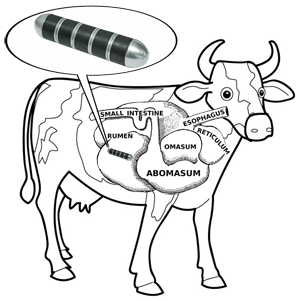
A cow magnet is a preventive veterinary medical device for cattle. A rancher or dairy farmer feeds a magnet to each calf at branding time; the magnet settles in the rumen or reticulum and remains there for the life of the animal. When the cow grazes, it often consumes and swallows what is called tramp iron: baling and barbed wire, staples, nails, and other metallic objects.
These objects are indigestible and would lodge in the reticulum and cause inflammation resulting in lower milk production (for dairy cattle) or lower weight gain (for feeder stock). This condition is called hardware disease. The cow magnet attracts such objects and prevents them from becoming lodged in the animal’s tissue. While the resultant mass of iron remains in the cow’s rumen as a sort of bezoar, it does not cause the severe problems of hardware disease.
Posted in Food, Technology |
1 Comment »



 The Daily Omnivore