November 28, 2012
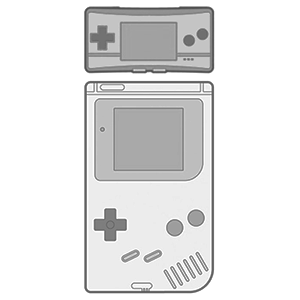
Game Boy Micro is a handheld game console developed and manufactured by Nintendo. It was first released in 2005. The system is the last console of the Game Boy line. The Game Boy Micro is the size of a typical Nintendo Entertainment System controller and a typical Famicom controller. The console retains some of the functionality of the Game Boy Advance SP, but with an updated form factor. It is unable to play original Game Boy and Game Boy Color games due to design changes. Even though it still has the required Z80 processor and graphics hardware necessary to run the old games, it is missing other circuitry necessary to be compatible with the old Game Boy cartridges.
It is officially incompatible with the Nintendo e-Reader and some other peripherals due to design issues. Additionally, it features a backlit screen with the ability to adjust the brightness so as to adapt to lighting. The Game Boy Micro features a removable face plate that allows consumers to purchase alternative designs. This device can play MP3 and digital video files from SD cards. The system retailed for US$99, compared to US$79 for the Game Boy Advance SP. Generally, the Game Boy Micro did not sell well, and failed to reach the company’s aim of units sold.
Posted in Games, Money, Technology |
Leave a Comment »
October 28, 2012

Die Glocke (‘The Bell’) was a purported top secret Nazi scientific technological device, secret weapon, or ‘Wunderwaffe.’ First described by Polish journalist Igor Witkowski in 2000, it was later popularized by military journalist and author Nick Cook as well as by writers such as Joseph P. Farrell, who associates it with Nazi occultism and antigravity or free energy research.
According to Patrick Kiger writing in ‘National Geographic,’ Die Glocke has become a ‘popular subject of speculation’ and a following similar to science fiction fandom exists around it and other alleged Nazi ‘miracle weapons.’ Mainstream reviewers such as former aerospace scientist David Myhra express skepticism that such a device ever actually existed.
read more »
Posted in Philosophy, War |
Leave a Comment »
October 24, 2012

The orgasmatron is a fictional device that appears in the 1973 movie ‘Sleeper,’ which also shows the effects of a related device, an orgasmic orb. Similar devices have appeared in other fictional works. The term has also been applied to a non-fictional device capable of triggering an orgasm-like sensation using electrodes implanted at the lower spine. Author Christopher Turner has suggested that the orgasmatron was a parody of Wilhelm Reich’s ‘orgone accumulator,’ a device which claims to concentrate ‘orgone,’ a bioenergy theorized by Reich.
The orgasmatron is a fictional device in the fictional future society of 2173 in the Woody Allen movie ‘Sleeper.’ It is a large cylinder big enough to contain one or two people. The orgasmatron was made by decorating an elevator in the home where the movie was filmed. Once entered, it contains some (otherwise undescribed) future technology that rapidly induces orgasms. This is required, as almost all people in the ‘Sleeper’ universe are impotent or frigid, although males of Italian descent are considered the least impotent of all groups.
read more »
Posted in Humor, Sex, Technology |
Leave a Comment »
October 14, 2012

The Kill A Watt is an electricity usage monitor marketed by P3 International. It features a large LCD display and it enables cost forecasting.
It measures the energy used by individual appliances plugged into the meter, as opposed to in-home energy use displays, which display the energy used by an entire household. The name is a play on the word kilowatt. The device can give an indication of the standby power used by appliances.
Posted in Money, Technology |
Leave a Comment »
October 9, 2012

A powered exoskeleton, also known as powered armor, or exoframe, is a powered mobile machine consisting primarily of an exoskeleton-like framework worn by a person and a power supply that supplies at least part of the activation-energy for limb movement. Powered exoskeletons are designed to assist and protect the wearer. They may be designed, for example, to assist and protect soldiers and construction workers, or to aid the survival of people in other dangerous environments. A wide medical market exists in the future of prosthetics to provide mobility assistance for aged and infirm people.
Other possibilities include rescue work, such as in collapsed buildings, in which the device might allow a rescue worker to lift heavy debris, while simultaneously protecting the worker from falling rubble. A fictional ‘mech’ is different from a powered exoskeleton in that the mecha is typically much larger than a normal human body, and does not directly enhance the motion or strength of the physical limbs. Instead the human operator occupies a cabin or pilot’s control seat inside a small portion of the larger system. Within this cabin the human may wear a small lightweight exoskeleton that serves as a haptic control interface for the much larger exterior appendages.
read more »
Posted in Health, Technology, War |
Leave a Comment »
September 14, 2012

A gyroscopic exercise tool is a device used to exercise the wrist as part of physical therapy or in order to build palm, forearm, and finger strength. It can also be used as a unique demonstration of some aspects of rotational dynamics. The non impact nature of the products combined with the soothing resistance of the spinning rotor have made them good rehabilitation devices for persons suffering from carpal tunnel syndrome, arthritis, RSI, bone breakage etc.
The device consists of a tennis ball-sized plastic or metal shell around a free-spinning mass, which is started with a short rip string. Once the gyroscope inside is going fast enough, a person holding the device can accelerate the spinning mass to high revolution rates by moving the wrist in a circular motion. The shell almost completely covers the mass inside, with only a small round opening allowing the gyroscope to be manually started.
Posted in Games, Health |
Leave a Comment »
September 3, 2012

A corkscrew is a kitchen tool for drawing corks from wine bottles. Generally, a corkscrew consists of a pointed metallic helix (often called the ‘worm’) attached to a handle.
The user grips the handle and screws the metal point into the cork, until the helix is firmly embedded, then a vertical pull on the corkscrew extracts the cork from the bottle. Corkscrews are necessary because corks themselves, being small and smooth, are difficult to grip and remove, particularly when inserted fully into an inflexible glass bottle. The handle of the corkscrew, often a horizontal bar of wood attached to the screw, allows for a commanding grip to ease removal of the cork. Corkscrew handles may incorporate levers that further increase the amount of force that can be applied outwards upon the cork.
read more »
Posted in Drugs, Food, Technology |
Leave a Comment »
August 2, 2012

A head-mounted display is a display device worn on the head or as part of a helmet, that has a small display optic in front of one (monocular HMD) or each eye (binocular HMD). A typical HMD has either one or two small displays with lenses and semi-transparent mirrors embedded in a helmet, eye-glasses (also known as data glasses), or visor. The display units are miniaturised and may include CRT, LCDs, Liquid crystal on silicon (LCos), or OLED. Some vendors employ multiple micro-displays to increase total resolution and field of view.
HMDs differ in whether they can display just a computer generated image (CGI), show live images from the real world, or a combination of both. Some HMDs allow a CGI to be superimposed on a real-world view. This is referred to as augmented reality or mixed reality. Combining real-world view with CGI can be done by projecting the CGI through a partially reflective mirror and viewing the real world directly. This method is often called ‘Optical See-Through.’ Combining real-world view with CGI can also be done electronically by accepting video from a camera and mixing it electronically with CGI. This method is often called ‘Video See-Through.’
read more »
Posted in Games, Technology, War |
1 Comment »
July 31, 2012


Kinect is a motion sensing input device released by Microsoft in 2010 for the Xbox 360 game console, and in 2012 for Windows PC. Based around a webcam-style add-on peripheral, it enables users to control and interact with software without the need to touch a game controller (through a natural user interface using gestures and spoken commands).
The project is aimed at broadening the Xbox 360’s audience beyond its typical gamer base. Kinect competes with the Wii Remote Plus and PlayStation Move with PlayStation Eye motion controllers for the Wii and PlayStation 3 home consoles, respectively. After selling a total of 8 million units in its first 60 days, the Kinect holds the Guinness World Record of being the ‘fastest selling consumer electronics device.’
read more »
Posted in Games, Money, Technology |
Leave a Comment »
July 31, 2012

The Dreameye is a digital camera released for the Dreamcast in 2000 in Japan only. It was designed to be used as a webcam and a digital still camera, and there were plans for games to involve the Dreameye. The Dreameye was only released in Japan, and Dreameye functionality was absent in non-Japanese versions of the games it could be used with. It came with the Divers 2000 Dreamcast (a rare all-in-one console unit developed by Fuji, intended as a video communications and gaming device for the consumer and hospitality markets) but was also sold separately. The DreamEye can be seen as the first use of a digital camera on a video games console.
The Dreameye came with a microphone headset, a stand, batteries, software, a cable to connect it to the Dreamcast, and a Dreameye microphone plug card. The Dreameye takes pictures at approximately 0.3 megapixels (640×480 pixels), but in order to send them via e-mail the pictures in question had to be first saved to a Dreamcast memory card. Upon transferring the pictures off of the card they resized to a resolution of 320px by 240px.
Posted in Games, Technology |
Leave a Comment »
July 31, 2012
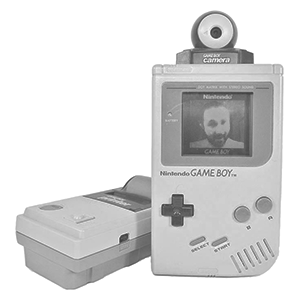
The Game Boy Camera is an official Nintendo accessory for the handheld Game Boy and Super Game Boy gaming consoles and was released in 1998. It is also compatible with all of the Game Boy platforms (with the exception of Game Boy Micro). The camera can take 256×224 (down scaled to half resolution on the unit with anti-aliasing), black & white digital images using the 4-color palette of the Game Boy system.
It interfaced with the Game Boy Printer, which utilized thermal paper to print any saved images, making a hard copy. Both the camera and the printer were marketed by Nintendo as light-hearted entertainment devices aimed mainly at children. The Game Boy Camera was used to take the photographs for the album cover of Neil Young’s album ‘Silver & Gold.’
Posted in Games, Technology |
Leave a Comment »
July 3, 2012


A Video Synthesizer is a device that electronically creates a video signal. A video synthesizer is able to generate a variety of visual material without camera input through the use of internal video pattern generators. It can also accept and ‘clean up and enhance’ or ‘distort’ live television. Video pattern generators may produce static or moving or evolving imagery. Examples include geometric patterns ( in 2D or 3D ), subtitle text characters in a particular font, or weather maps.
The history of video synthesis is tied in to a ‘real time performance’ ethic. The equipment is usually expected to function on input camera signals the machine has never seen before, delivering a processed signal continuously and with a minimum of delay in response to the ever changing live video inputs.
read more »
Posted in Art, Technology |
Leave a Comment »


 The Daily Omnivore