February 11, 2011
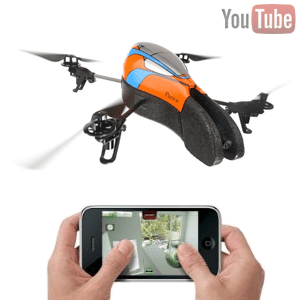
The Parrot AR.Drone is a RC quadricopter with cameras attached to it built by French wireless products manufacturer Parrot. It is designed to be controllable with an iPhone, iPad, or an iPod Touch. Parrot demos the device with 2 games, a virtual combat called ‘DRONE WAR’ with solo and multiplayer mode and a ‘ROBOT’ solo game demo against a virtual Robot. Parrot has launched ARdrone.org Open API game development platform, to gather game studios and developers. It sells for around $300 on Amazon.com.
Posted in Games, Money, Technology |
Leave a Comment »
February 10, 2011


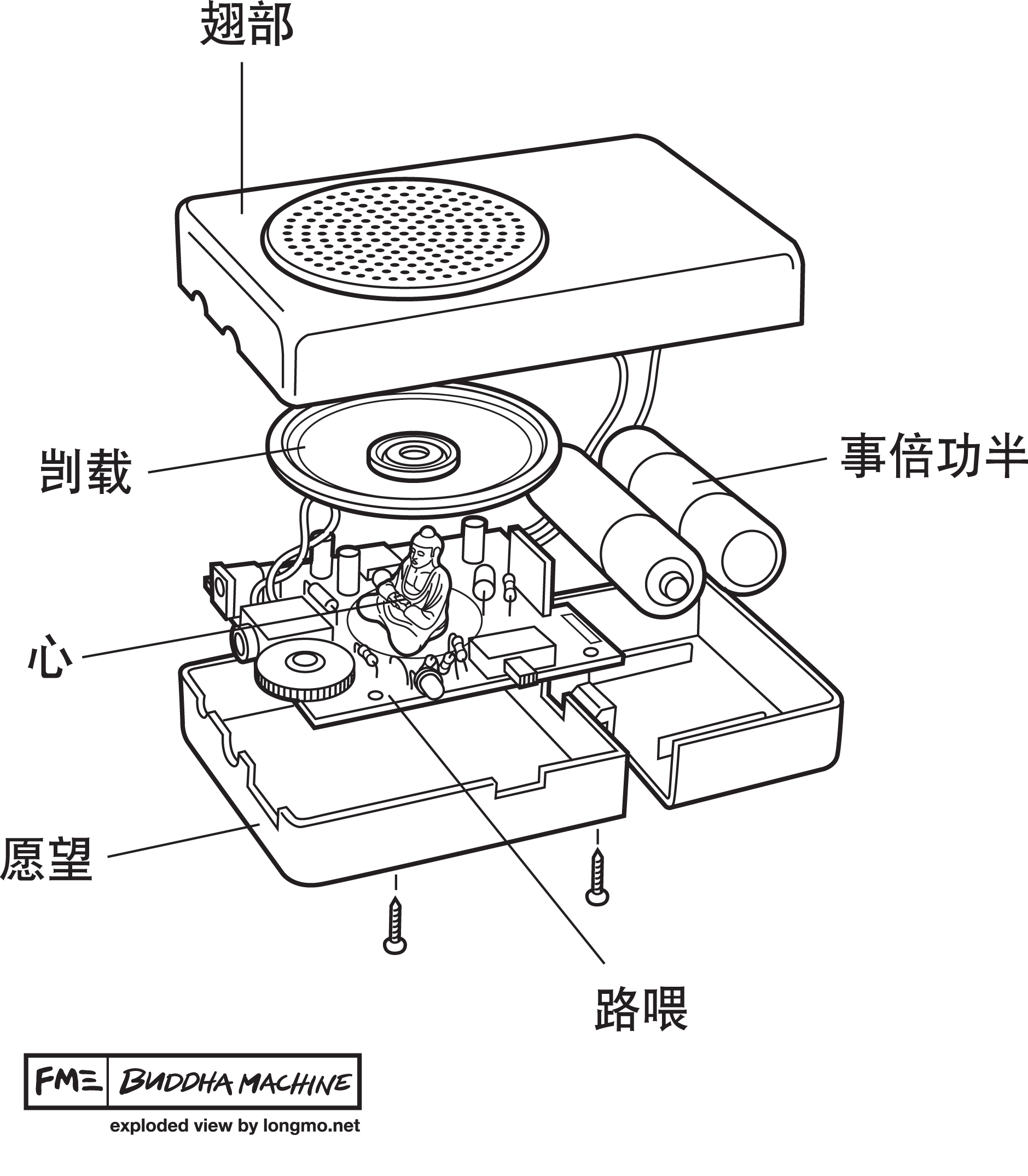
The Buddha Machine is a small musical loop player released by FM3, a China-based music duo. The name and idea derived from a popular Chinese music player that intones repeating loops of Buddhist chanting. The Buddha Machine continuously plays one of 9 ambient sound loops (drones) that range in length from 5 to 40 seconds. Resembling a small transistor radio, the device has a volume control that doubles as an on/off switch; a headphone jack; a 4.5V AC adapter jack; and a switch that, when moved, selects the next of 9 ambient loops. In 2008, the second edition (version 2.0) was released commercially; it replaces the original nine loops with nine new ones (totaling approximately 300 seconds of sound), and includes a new control that allows the user to alter the pitch of the sound.
In 2009, FM3 Productions Ltd released an iPhone app that has similar functionality to the real device. It has the option to select from version 1.0 or version 2.0 of the device and a single button that selects the loop to play. Also that year, Throbbing Gristle & Industrial Records released their version of the Buddha Machine, ‘Gristleism,’ with more loops and almost twice the frequency range of the Buddha Machine. In 2010, FM3 released the third generation Buddha Machine, titled Chan Fang. The music is divided into four loops which were composed and performed on the Gu Qin, an ancient Chinese classical instrument.
Posted in Art, Philosophy, Technology |
Leave a Comment »
February 8, 2011
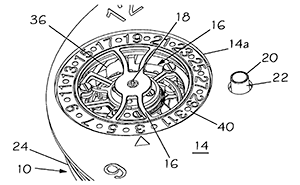

A tourbillon [tor-bee-yon] (French for ‘whirlwind’) is an addition to the mechanics of a watch escapement (the device which converts continuous rotational motion into an oscillating or back and forth motion; the source of the ‘ticking’ sound produced by watches and clocks).
Developed around 1795 by the French – Swiss watchmaker Abraham-Louis Breguet from an earlier idea by the English chronometer maker John Arnold a tourbillon counters the effects of gravity by mounting the escapement and balance wheel in a rotating cage. Originally an attempt to improve accuracy, tourbillons are still included in some expensive modern watches as a novelty and demonstration of watchmaking virtuosity. The mechanism is usually exposed for display on the watch’s face.
Posted in Art, Money, Technology |
Leave a Comment »
February 3, 2011

Poken is a device that utilizes a proprietary Near Field Communication (NFC) technology to allow the exchange of online social networking data between two keychain accessories. The primary information exchanged via the poken is a ‘social business card,’ a digital replacement for a physical business card. By touching two devices together, a unique ID is exchanged that links to contact information on the Poken website. Users of the Poken website can use a ‘social dashboard’ to manage, and interact with their contacts.
Posted in Technology |
Leave a Comment »
January 24, 2011
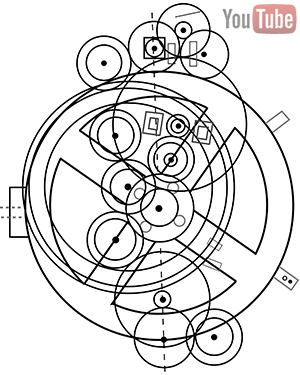
The Antikythera [an-ti-ki-theer-uh] mechanism is an incredibly old mechanical calculator, often described as the first mechanical computer. It was discovered in 1901 in a shipwreck off the coast of Antikythera, Greece. The device was used to figure out the positions of stars in the sky. It was probably made in about 150-100 BC, and is now on display in the Bronze Collection of the National Archaeological Museum of Athens.
Its significance and complexity were not understood until decades after its discovery. The degree of mechanical sophistication is comparable to a 19th century Swiss clock. Technological artifacts of similar complexity and workmanship did not reappear until the 14th century, when mechanical astronomical clocks were built in Europe.
Posted in Technology |
Leave a Comment »
January 6, 2011

The TI-83 series of graphing calculators is manufactured by Texas Instruments. The original TI-83 is itself an upgraded version of the TI-82. Released in 1996, it is one of the most used graphing calculators for students. TI replaced the TI-83 with the TI-83 Plus calculator in 1999, which included flash memory, enabling the device’s operating system to be updated if needed, or for large new Flash Applications to be stored, accessible through a new Apps key.
The Flash memory can also be used to store user programs and data. In 2001 the TI-83 Plus Silver Edition was released, which featured approximately nine times the available Flash memory, and over twice the processing speed (15 MHz) of a standard TI-83 Plus.
Posted in Education, Money, Technology |
Leave a Comment »
January 2, 2011
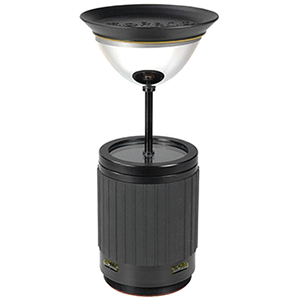
In photography, an omnidirectional camera is a camera with a 360-degree field of view in the horizontal plane, or with a visual field that covers (approximately) the entire sphere. Omnidirectional cameras are important in areas where large visual field coverage is needed, such as in panoramic photography and robotics.
Posted in Art, Technology |
Leave a Comment »
December 23, 2010

TV-B-Gone is a type of simple universal remote control device for turning off a large majority of the current available brands of television sets. It was created to allow people in a public place to turn off nearby television sets, presumably because the broadcast was distracting them from other activities. Its inventor has referred to it as ‘an environmental management device.’
The device is part of a key-chain, and, like other remote devices, is battery-powered. Although it can require up to 69 seconds for the device to find the proper code for a particular television receiver, the most popular televisions turn off in the first few seconds. During the 2008 Consumer Electronics Show, some individuals from gadget blog, Gizmodo brought a TV-B-Gone remote control and shut off many display monitors at booths and during demos affecting several companies. These actions caused the individual from Gizmodo to be banned for life from future CES events.
Posted in Humor, Technology |
Leave a Comment »
December 23, 2010

A cochlear [kok-leer] implant (CI) is a surgically implanted electronic device that provides a sense of sound to a person who is profoundly deaf or severely hard of hearing. The cochlear implant is often referred to as a bionic ear. It will not cure deafness or hearing impairment, but is a prosthetic substitute for hearing.
While cochlear implants restore physical ability to hear, this does not mean the brain can learn to process and distinguish speech if the recipient has passed the critical period of adolescence. As a result, those born profoundly deaf who receive an implant as an adult can only distinguish simple sounds, such as a ringing phone vs. a doorbell, while others who receive implants early can understand speech.
read more »
Posted in Health, Technology |
Leave a Comment »
December 23, 2010

FakeTV is a burglar deterrent that makes it look like someone is home watching television by recreating the sort of light produced by an HDTV. It comes with an internal light sensor which allows the device to activate when it becomes totally dark (0.5 lux or lower) and a built in timer with four modes of operation: Always On, Dusk +4 HRS, Dusk +7 HRS, and Off. It retails for $30.
Posted in Money, Technology |
Leave a Comment »
December 7, 2010

Ducking-stools and cucking-stools are chairs formerly used for punishment. They were both instruments of social humiliation and censure, primarily for the offense of scolding or back biting, and less often for sexual offenses like having an illegitimate child or prostitution. They were technical devices which formed part of the wider method of law enforcement through social humiliation.
Most were simply chairs into which the victim could be tied and exposed at her door or the site of her offence and publicly shamed. Some were on wheels and could be dragged around the parish. Some were put on poles so that they could be plunged into water, hence ‘ducking’ stool.
read more »
Posted in Language, Philosophy, Politics |
Leave a Comment »
November 18, 2010

An EyeTap is a device that is worn in front of the eye that acts as a camera to record the scene available to the eye as well as a display to superimpose a computer-generated imagery on the original scene. In order to capture what the eye is seeing as accurately as possible, an EyeTap uses a beam splitter to send the same scene (with reduced intensity) to both the eye and a camera. The camera then digitizes the reflected image of the scene and sends it to a computer. The computer processes the image and then sends it to a projector.
The projector sends the image to the other side of the beam splitter so that this computer-generated image is reflected into the eye to be superimposed on the original scene. Stereo EyeTaps modify light passing through both eyes, but many research prototypes (mainly for reasons of ease of construction) only tap one eye. EyeTap is also the name of an organization founded by inventor Steve Mann to develop and promote EyeTap-related technologies such as wearable computing.
Posted in Technology |
Leave a Comment »

.png/1024px-Ducking-Stool_1_(PSF).png "ducking stool")



 The Daily Omnivore