March 11, 2012
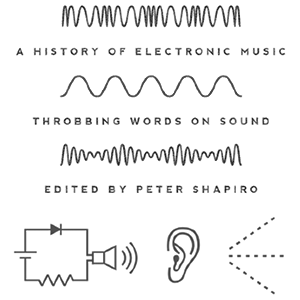
Modulations is a multi-media exploration into the history of electronic music, consisting of a documentary film, its soundtrack album, and a book. The project was directed by Iara Lee, the maker of the documentary film ‘Synthetic Pleasures’ (which explored the implications of virtual reality, biotechnology, plastic surgery, and mood-altering drugs). People interviewed in the film include Robert Moog, DJ Funk, and Frankie Knuckles.
The book was edited by Peter Shapiro and features: Rob Young on the pioneers of electronic music, Simon Reynolds on krautrock, Peter Shapiro on disco & post-punk, Kodwo Eshun on house, David Toop on hip hop, Mike Rubin on techno, Chris Sharp on jungle, Tony Marcus on ambient, Kurt Reighley on downtempo, and Michael Berk on the technology of electronic music. Also interviewed is industrial music founder Genesis P-Orridge.
Posted in Art, Technology, World |
Leave a Comment »
February 29, 2012
The Century of the Self is a British television documentary film; it focuses on how Sigmund Freud, Anna Freud, and Edward Bernays influenced the way corporations and governments have analyzed, dealt with, and controlled people.
Director Adam Curtis said: ”This series is about how those in power have used Freud’s theories to try and control the dangerous crowd in an age of mass democracy.’
read more »
Posted in Money, Politics |
Leave a Comment »
December 30, 2011

Last Tango in Paris (Italian: ‘Ultimo Tango a Parigi’) is a 1972 Italian romantic drama film directed by Bernardo Bertolucci which portrays a recent American widower who takes up an anonymous sexual relationship with a young, soon-to-be-married Parisian woman. It stars Marlon Brando, Maria Schneider, and Jean-Pierre Léaud. The film’s raw portrayal of sexual violence and emotional turmoil led to international controversy and drew various levels of government censorship. The MPAA gave the film an X rating upon release in the United States. After revisions were made to the MPAA ratings code, it was classified as an NC-17 in 1997.
The idea grew from Bernardo Bertolucci’s sexual fantasies, stating ‘he once dreamed of seeing a beautiful nameless woman on the street and having sex with her without ever knowing who she was.’
read more »
Posted in Art, Politics, Sex |
Leave a Comment »
December 13, 2011

‘Carts of Darkness‘ is a 2008 National Film Board of Canada documentary film by Murray Siple about a group of homeless men in North Vancouver, who use shopping carts to collect bottles and cans to return for money and also race down the city’s steep slope for thrills. The subjects in the film control the carts using only their weight and one foot, during descents that cross intersections, with top speeds claimed to be as high as 70 km/h.
Siple, a former director of extreme sports videos and avid skateboarder and snowboarder, became a quadriplegic after a car accident in 1996. His first film after his accident, ‘Carts of Darkness’ allowed the filmmaker to regain the excitement he had experienced with extreme sports as well as relate to a fellow group of outsiders.
Posted in Art, Games, Money |
1 Comment »
December 11, 2011

The Millennium series (1954 – 2004) is a series of bestselling novels originally written in Swedish by the late Stieg Larsson. The primary characters in the series are Lisbeth Salander, an intelligent, eccentric woman in her twenties with a photographic memory and poor social skills, and Mikael Blomkvist, an investigative journalist and editor of a magazine called ‘Millennium.’ Blomkvist, the character, has a history similar to Larsson, the author.
There are three books in the series: ‘The Girl with the Dragon Tattoo,’ ‘The Girl Who Played with Fire,’ and ‘The Girl Who Kicked the Hornets’ Nest.’ When he died suddenly of a heart attack in 2004, Larsson left behind manuscripts of the completed but unpublished novels written as a series. He had written them for his own pleasure after returning home from his job in the evening, and had made no attempt to get them published until shortly before his death.
read more »
Posted in Art, Language |
Leave a Comment »
October 10, 2011

‘Drive‘ is a 2011 film directed by Nicolas Winding Refn, and starring Ryan Gosling as the eponymous driver, with Carey Mulligan, Ron Perlman, Bryan Cranston, Christina Hendricks, and Albert Brooks. Although ‘Drive’ shares several characteristics with the similarly-named 1978 Walter Hill car-chase film, ‘The Driver,’ it is actually adapted from the 2005 James Sallis novel of the same name, with a screenplay by Hossein Amini.
Like the book, the movie is about a Hollywood stunt performer who moonlights as a getaway driver. The director has said influences came from ‘Bullitt’ (1968) and ‘The Day of the Locust’ (1975); and that ‘Drive’ was a tribute to cult film legend Alejandro Jodorowsky and shares some of his existentialist themes.
read more »
Posted in Art |
1 Comment »
July 25, 2011

Wave Twisters (2001) is an animated film, also known as the first turntablism-based musical. It is based on DJ Q-Bert’s album of the same name. The film is entirely scripted to match the DJ Q-Bert recording. As such, it can seem a little disjointed at times. It was produced digitally using Adobe After Effects and a relatively small team of animators. Buckethead makes a short appearance in the film as well, near the beginning.
A crew of heroes is determined to save the lost arts of Hip Hop. Break Dancing, Graffiti, MCing, and DJing from total extinction. The lost arts are being oppressed throughout inner-space by lord Ook and his evil minions the Chinheads. The dental commander Dr. Julio Azul DDS, assumed to be secretary Honey Drips, Dental Hygienist/Robot Rubbish, and Grandpa have a series of adventures, synced to the music. Armed with the ancient relic known as the Wave Twister (a small turntable/wristwatch, the only weapon powerful enough to defeat their enemies), they travel to the far ends of inner-space for a final confrontation with the sinister army of oppressors. The film ends with the team teaching the liberated the lost fundamentals of hip hop.
Posted in Art, Humor, Technology |
Leave a Comment »
July 25, 2011

Idiocracy is a 2006 American film, a satirical science fiction comedy, directed by Mike Judge. The film tells the story of two ordinary people who are taken into a top-secret military hibernation experiment which goes awry, and awaken 500 years in the future. They discover that the world has degenerated into a dystopia where advertising, commercialism, and cultural anti-intellectualism run rampant and dysgenic pressure has resulted in a uniformly stupid human society devoid of intellectual curiosity, social responsibility and coherent notions of justice and human rights. Rather, this future society emphasizes popularity, sexual attraction, and hedonism.
During the prologue, a narrator explains that in our modern society, natural selection does not favor the intelligent (who are very selective and careful in how they have children) and that less-intelligent people procreate freely and easily out-breed the intelligent. This, combined with a general celebration of the cultural ‘lowest common denominator’ and general anti-intellectual cultural mores result in a world that has degenerated into a barely functioning society held together by a rapidly crumbling, mostly automated technological infrastructure that was created by intelligent individuals many years (perhaps centuries) earlier that few, if any, of the members of 26th Century society know how to operate or fix.
Posted in Art, Humor, Politics |
Leave a Comment »
July 17, 2011

My Neighbor Totoro is a 1988 Japanese animated fantasy film written and directed by Hayao Miyazaki and produced by Studio Ghibli. The film follows the two young daughters of a professor and their interactions with friendly wood spirits in postwar rural Japan. The art director was Kazuo Oga, who was drawn to the film when Hayao Miyazaki showed him an original image of Totoro standing in a satoyama (foothills). Oga’s was recognized as ‘updating the traditional Japanese animist sense of a natural world that is fully, spiritually alive.’ ‘Set in a period that is both modern and nostalgic, the film creates a fantastic, yet strangely believable universe of supernatural creatures coexisting with modernity. A great part of this sense comes from Oga’s evocative backgrounds, which give each tree, hedge and twist in the road an indefinable feeling of warmth that seems ready to spring into sentient life.’ Oga’s style became a trademark style of Studio Ghibli.
As is the case with Disney’s other English dubs of Miyazaki films, the Disney version of Totoro features a star-heavy cast, including Dakota and Elle Fanning as Satsuki and Mei, and Timothy Daly as Mr. Kusakabe. ‘My Neighbor Totoro’ helped bring Japanese animation into the global spotlight, and set its writer-director Hayao Miyazaki on the road to success. The film’s central character, Totoro, is as famous among Japanese children as Winnie-the-Pooh is among British ones.
Posted in Art, World |
Leave a Comment »
July 12, 2011
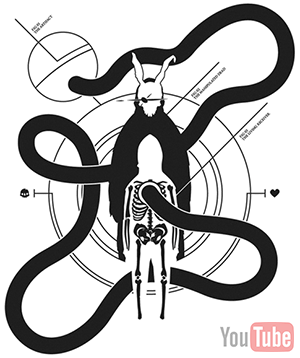
Donnie Darko is a 2001 American psychological thriller written and directed by Richard Kelly, starring Jake Gyllenhaal. The film depicts the reality-bending adventures of the title character as he seeks the meaning and significance behind his troubling Doomsday-related visions. In October 1988, teenager Donnie Darko has been seeing a psychiatrist because of his troubled history. Donnie sleepwalks, and he has visions of Frank, a menacing, demonic-looking rabbit. On October 2, Frank draws Donnie out of his room to tell him, in 28 days, 6 hours, 42 minutes, and 12 seconds, the world will end. While Donnie is outside, a jet engine crashes through his bedroom. The next morning, Donnie wakes up on a golf course. He returns home to find police and firemen inspecting the wreckage. No one knows where the jet engine has come from, since there were no planes flying in the vicinity, and no airline reported losing an engine.
Music is used heavily in the film. One continuous sequence involving an introduction of Donnie’s high school prominently features the song ‘Head over Heels’ by Tears for Fears, Donnie’s sister’s dance group, ‘Sparkle Motion,’ performs with the song ‘Notorious’ by Duran Duran, and ‘Under the Milky Way’ by The Church is played after Donnie and Gretchen emerge from his room during the party. ‘Love Will Tear Us Apart’ by Joy Division also appears in the film. The opening sequence is set to ‘The Killing Moon’ by Echo & the Bunnymen.
Posted in Art |
1 Comment »
July 12, 2011

Southland Tales is a 2006 science fiction dark comedy-drama film, written and directed by Richard Kelly. The title refers to the Southland, a name used by locals to refer to Southern California and Greater Los Angeles. Set in the then near future of an alternate history, the film is a portrait of Los Angeles and a comment on the military-industrial news-tainment complex. The film features an ensemble cast. Original music for the film was provided by Moby. The film was a critical and financial failure.
The film opens on El Paso and Abilene, Texas, both of which fall victim to twin nuclear attacks on July 4, 2005—a catastrophe of unimaginable proportions which launches America into World War III. The PATRIOT Act has extended authority to a new agency known as US-IDent, which keeps constant tabs on citizens and heavily censors the media and the Internet.
read more »
Posted in Art, Humor, Politics |
Leave a Comment »
July 4, 2011

Enter the Void is a 2009 French film written and directed by Gaspar Noé, labeled by Noé as a ‘psychedelic melodrama. The story is set in Tokyo and focuses on Oscar, a young American drug dealer who gets shot by the police, but continues to watch over his sister Linda and the events which follow during an out-of-body experience, floating above Tokyo’s streets. The film is shot from a first-person view, and occasionally features Oscar staring over his own shoulder as he recalls moments from his past.
Having been Noé’s dream project for many years, the production of ‘Enter the Void’ was made possible due to the commercial success of ‘Irréversible,’ the director’s previous feature film. The film makes heavy use of imagery inspired by experimental cinema and psychedelic drug experiences. Principal photography took place on location in Tokyo and involved many complicated crane shots.
read more »
Posted in Art, Drugs, World |
1 Comment »


 The Daily Omnivore