January 10, 2011
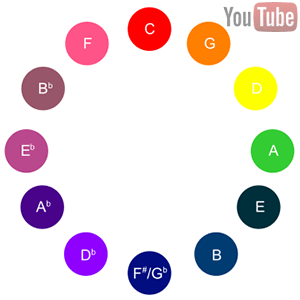
The clavier [kluh-veer] à [ah] lumières [ly-myer] keyboard with lights) was a musical instrument invented by Russian composer, Alexander Scriabin for use in his work Prometheus: Poem of Fire. However, only one version of this instrument was constructed, for the performance in New York in 1915. The instrument’s keyboard lights up as synesthetic system, specified in the score.
Scriabin was a friend of Nikolai Rimsky-Korsakov, who was a synesthete (someone with a neurologically-based condition in which stimulation of one sensory or cognitive pathway leads to automatic, involuntary experiences in a second sensory or cognitive pathway). Scriabin was also heavily influenced by Theosophy, which had its own different system of associating colors and pitches.
Posted in Art, Technology |
Leave a Comment »
December 16, 2010

An amplified cactus is a cactus plant used as a musical instrument. It harnesses the acoustic properties of a cactus (preferably a Denmoza or Geohintonia), by applying contact microphones and amplifying their projection and tone. The effect is somewhat ethereal: Vivien Schweitzer of The New York Times reports ‘Jason Treuting played an amplified cactus, running his hand over the plant’s unfriendly spikes to produce an alluring sound like a babbling brook.’
The amplified cactus is a medium rarely written for, even in the contemporary music genre. John Cage, perhaps one of the most recognizable names in the contemporary music genre, composed Child of Tree (1975) and Branches (1976) for what he described as ‘amplified plant materials.’ Cage was a large proponent of chance music and felt that the organic nature of music without man-made instruments was very strong and influential. Another of the most famous pieces for amplified cactus is called Degrees of Separation ‘Grandchild of Tree’ by Paul Rudy which received mention at the Bourges International Competition for Electroacoustic Music in 2000.
Posted in Art, Technology |
Leave a Comment »
November 4, 2010

The Roland TR-808 Rhythm Composer was one of the first programmable drum machines. Introduced by the Roland Corporation in early 1980, it was originally manufactured for use as a tool for studio musicians to create demos. Like earlier Roland drum machines, it does not sound very much like a real drum kit.
One of the machine’s earliest mainstream hits in the United States was on Marvin Gaye’s ‘Sexual Healing.’ A TR-808 was also David Byrne’s sole accompaniment (apart from his acoustic guitar) at the beginning of ‘Stop Making Sense.’
read more »
Posted in Art, Technology |
Leave a Comment »


 The Daily Omnivore