March 27, 2012

The Grass Mud Horse or Caoníma, is a Chinese Internet meme widely used as a form of symbolic defiance of the widespread Internet censorship in China. It is a play on the Mandarin language words which translate literally to, ‘fuck your mother,’ and is one of the so-called ’10 mythical creatures’ created in a hoax article on ‘Baidu Baike’ (a collaborative encyclopedia) in early 2009 whose names form obscene puns. Official ‘cleanup’ of the internet, which threatens the Caonima, has led Chinese internet users to create other ‘Mud Horse’ variants, such as the ‘Rolling Mud Horse’ and ‘Working Mud Horse,’ which are also puns for ‘fuck your mother.’
The ‘China Digital Times’ sees Caonima as the ‘de facto mascot of netizens in China fighting for free expression, inspiring poetry, photos and videos, artwork, lines of clothing, and more.’ It is an illustration of the ‘resistance discourse’ of Chinese internet users with ‘increasingly dynamic and sometimes surprising presence of an alternative political discourse: images, frames, metaphors and narratives that have been generated from Internet memes [that] undermine the values and ideology that reproduce compliance with the Chinese Communist Party’s authoritarian regime, and, as such, force an opening for free expression and civil society in China.’
read more »
Posted in Humor, Language, Politics |
1 Comment »
March 27, 2012

Very erotic very violent is a Chinese internet meme that originated from a news report on China Central Television’s flagship ‘Xinwen Lianbo’ program (a daily news show) allegedly quoting a schoolgirl describing a web page. On the Chinese Internet, this incident was widely parodied and weakened the credibility of the state broadcaster’s newscasts. This Chinese phrase follows the form of ‘very good very mighty,’ a snowclone (cliché template) for Internet slang popularized earlier that year.
In late 2007, ‘Xinwen Lianbo’ aired a report about the wide and easy availability of explicit content on the internet. The report appealed to juristic institutions and those seeking legislation in order to purify the internet environment. In the report, a young student described a pop-up advertisement she saw as being ‘very erotic, [and] very violent.’ After the airing of the report, internet users began to ridicule and parody the quote and question the program’s credibility, believing that it would be unlikely for a person of that age to find a web page to be both erotic and violent at the same time.
Posted in Humor, Politics, Sex |
Leave a Comment »
January 15, 2012
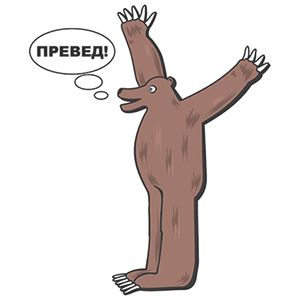
Preved is a term used in Russian Internet slang (Padonkaffsky jargon); it is a meme which developed out of a heavily-circulated picture, and consists of choosing alternative spellings for words for comic effect. The picture, a modified version of John Lurie’s watercolor ‘Bear Surprise,’ features a man and a woman having sex in the clearing of a forest, being surprised by a bear calling ‘Surprise!’ with its paws raised. In later Russian adaptations, the bear shouts ‘Preved!’ (a deliberate misspelling of ‘privet,’ ‘hi!’).
The word and the bear image have found their way into the mainstream mass media, such as a poster for the Russian edition of ‘Newsweek.’ In 2006 at an online conference, Vladimir Putin was asked: ‘PREVED, Vladimir Vladimirovich! How do you regard MEDVED?’ No answer was given, but the Associated Press, informing on the questions collection process, reportedly interpreted it as a reference to then-vice-prime-minister Dmitry Medvedev. It was the most popular question asked at the conference (the third most popular question was ‘How does one patch KDE2 under FreeBSD?’).
Posted in Humor, Sex, World |
Leave a Comment »
November 22, 2011

A motivational poster (or affirmation poster or inspirational poster) is a type of poster commonly designed for use in schools and offices. The intent of motivational posters is to make people achieve more, or to think differently about the things that they may be learning or doing. Motivational posters can have behavioral effects. For example, the University of Glasgow found in one study that their placement of a motivational poster that promotes stair use in front of an escalator and a parallel staircase, in an underground station, doubled the amount of stair use.
This kind of poster has been repeatedly parodied, and parody motivational posters have become an Internet meme. One famous motivational poster features a kitten hanging from a tree branch along with the phrase ‘Hang in There, Baby!’ This has been the target of various reproductions and parodies, such as an appearance on ‘The Simpsons’ episode ‘The Twisted World of Marge Simpson’ where Marge Simpson notices the copyright date (1968) and comments, ‘…determined or not, that cat must be long dead. That’s kind of a downer.’ Despair, Inc. has made a business out of such parody and cynical posters, with ‘demotivational posters’ ranging from a picture of a tree bent over by wind with the caption ‘ADVERSITY: That which does not kill me postpones the inevitable.’ to a picture of a sinking ship with the caption ‘MISTAKES: It could be that the purpose of your life is only to serve as a warning to others.’
Posted in Humor, Language, Money |
Leave a Comment »
October 20, 2011

We are the 99% is a political solidarity slogan and implicit economic claim that emerged from the ‘Occupy’ protests in 2011. It is a reference to the difference in wealth between the top 1% and all the remaining citizens of the United States. It started as a tumblr blog and became an Internet meme that went viral, showing a picture of a person holding a piece of paper with their story on it, ending with the phrase, ‘We are the 99%.’ New York times columnist Anne-Marie Slaughter described pictures on the ‘We are the 99’ website as as ‘page after page of testimonials from members of the middle class who took out loans to pay for education, took out mortgages to buy their houses and a piece of the American dream, worked hard at the jobs they could find, and ended up unemployed or radically underemployed and on the precipice of financial and social ruin.’
In 2006, filmmaker and Johnson & Johnson heir Jamie Johnson filmed a documentary called ‘The One Percent’ about the growing wealth gap between America’s wealthy elite compared to the overall citizenry. The film’s title referred to the top one percent of Americans in terms of wealth, who controlled 38% of the nation’s wealth in 2001. The 1% percent in the United States starts with household annual incomes of greater than $593,000.
Posted in Money, Politics |
Leave a Comment »
August 4, 2010

Rule 34 is a generally accepted internet observation which states: ‘If it exists, there is porn of it. No exceptions.’ It implies that there is a sexual fetish for every conceivable subject matter. It originated from a 2003 webcomic drawn by Peter Morley-Souter to depict his shock at seeing Calvin and Hobbes parody porn. Morley-Souter posted his comic on the United Kingdom website ‘Zoom-Out in 2004,’ and it has been widely reproduced. ‘Boing Boing’ blogger Cory Doctorow writes of the meme: ‘Rule 34 can be thought of as a kind of indictment of the Web as a cesspit of freaks, geeks, and weirdos, but seen through the lens of cosmopolitanism,’ which ‘bespeaks a certain sophistication—a gourmet approach to life.’
The conundrum of finding an Internet pornographic exception to Rule 34’s ‘No exceptions’ led to Rule 35: ‘If no porn is found at the moment, it will be made.’
Posted in Humor, Sex |
Leave a Comment »


 The Daily Omnivore