November 6, 2014

In American suburban communities, McMansion is a pejorative for a type of large, new luxury house which is judged to be oversized for the parcel or incongruous and out-of-place for its neighborhood. Alternatively, a McMansion can be a large, new house in a subdivision of similarly large houses, which all seem mass-produced and lacking in distinguishing characteristics, as well as appearing at odds with the traditional local architecture.
The neologism seems to have been coined sometime in the early 1980s. It first appeared in print the ‘Los Angeles Times’ in 1990. Related terms include ‘Persian palace,’ ‘garage Mahal,’ ‘starter castle,’ and ‘Hummer house.’ Marketing parlance often uses the term ‘tract mansion’ or ‘executive home.’ An example of a McWord, ‘McMansion’ associates the generic quality of these luxury homes with that of mass-produced fast food by evoking the McDonald’s restaurant chain.
read more »
Posted in Language, Money |
Leave a Comment »
October 25, 2014

LOVEINT is the practice of intelligence service employees making use of their extensive monitoring capabilities to spy on their love interest or spouse. The term was coined in resemblance to intelligence terminology such as SIGINT (signals intelligence) or HUMINT (human intelligence). The term originated at the NSA, where at least one incident is reported every year. They are the lion’s share of unauthorized accesses reported by the NSA. Most incidents are self-reported, for example during a polygraph test.
The NSA sanctions include administrative action, up to termination of employment. In five of the cases, the NSA employee resigned, preempting any administrative action. In two other cases, they retired. The worst administrative sanction handed out was a ‘a reduction in pay for two months, a reduction in grade, and access to classified information being revoked.’ One case was forwarded to the Department of Justice, which however declined to prosecute.
Posted in Love, Politics, Technology |
1 Comment »
October 22, 2014


Slacktivism (‘slacker activism’) is a sometimes pejorative term that describes ‘feel-good’ measures, in support of an issue or social cause, that have little or no practical effect other than to make the person doing it take satisfaction from having contributed. The underlying assumption being promoted by the term is that these low cost efforts substitute for more substantive actions rather than supplementing them, although this assumption has not been borne out by research.
Proponents argue that slacktivism plays a significant role in repressive and authoritarian regimes. Journalist Courtney C. Radsch argues that low level engagement was an important form of activism for Arab youth during the Arab Spring because it was an outlet for free speech and sparked mainstream media coverage. She contends that when a hashtag becomes ‘a trending topic [it] helps generate media attention, even as it helps organize information. The power of social media to help shape the international news agenda is one of the ways in which they subvert state authority and power.’
read more »
Posted in Money, Politics |
1 Comment »
October 17, 2014

Misophonia [mee-so-fo-nee-uh], literally ‘hatred of sound,’ is a rarely diagnosed neuropsychiatric disorder in which negative emotions (anger, flight, hatred, disgust) are triggered by specific sounds. The sounds can be loud or soft. The term was coined by American neuroscientists Pawel Jastreboff and Margaret Jastreboff and is sometimes referred to as ‘selective sound sensitivity syndrome.’
A 2013 review of neurological studies and fMRI studies of the brain as it relates to the disorder postulated that abnormal or dysfunctional assessment of neural signals occurs in the anterior cingulate cortex and insular cortex. These cortices are also implicated in Tourette Syndrome, and are the hub for processing anger, pain, and sensory information. Other researchers concur that the dysfunction is in central nervous system structures. It has been speculated that the anatomical location may be more central than that involved in hyperacusis (over-sensitivity to certain frequency and volume ranges of sound). An alternate view, by two misophonia treatment providers, is that misophonia is a Pavlovian conditioned reflex.
read more »
Posted in Health |
1 Comment »
August 27, 2014
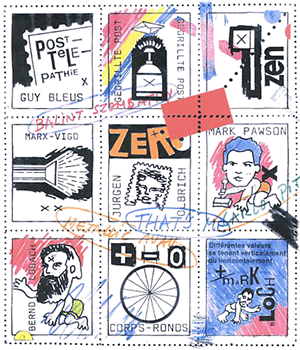
The term artistamp (a portmanteau of the words ‘artist’ and ‘stamp’) or artist’s stamp refers to a postage stamp-like art form used to depict or commemorate any subject its creator chooses. Artistamps are a form of ‘Cinderella stamp’ (unofficial stamps, not valid for postage), but they differ from forgeries or bogus Illegal stamps in that typically the creator has no intent to defraud postal authorities or stamp collectors.
Artistamp creators often include their work on legitimate mail, alongside valid postage stamps, in order to decorate the envelope with their art. In many countries this practice is legal, provided the artistamp isn’t passed-off as or likely to be mistaken for a genuine postage stamp. When so combined (and sometimes, less strictly speaking, even when not so) the artistamp may be considered part of the ‘mail art’ genre (a populist artistic movement centered around sending small scale works through the postal service, initially developed out of the Fluxus movement in the 1950s and 60s).
read more »
Posted in Art, Politics |
Leave a Comment »
August 5, 2014
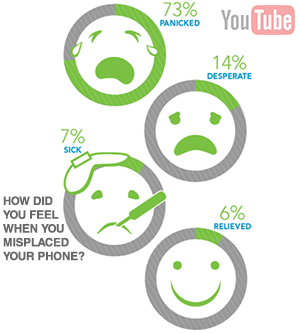
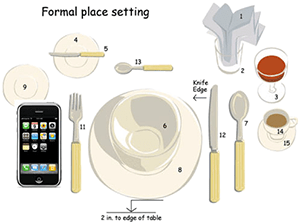
Nomophobia (‘no-mobile-phone phobia’) is the fear of being out of mobile phone contact. The term was coined during a 2010 study by the UK Post Office who commissioned YouGov, a UK-based research organization to look at anxieties suffered by mobile phone users. The study found that nearly 53% of mobile phone users in Britain tend to be anxious when they ‘lose their mobile phone, run out of battery or credit, or have no network coverage.’ The study found that about 58% of men and 47% of women suffer from the phobia, and an additional 9% feel stressed when their mobile phones are off.
The study indicated that stress levels induced by the average case of nomophobia are similar in severity to ‘wedding day jitters’ and trips to the dentists. Ten percent of those questioned said they needed to be contactable at all times because of work. It is, however, arguable that the word ‘phobia’ is misused and that in the majority of cases it is only a normal anxiety. More than one in two nomophobes never switch off their mobile phones. The study prompted two editorial columns authored by those who minimize their mobile phone use or choose not to own one at all, treating the condition with levity or outright disbelief.
Posted in Health, Humor, Technology |
Leave a Comment »
June 24, 2014


Antipatterns are common practices that initially appear to be beneficial, but ultimately result in bad consequences that outweigh hoped-for advantages. The term, coined in 1995 by programmer Andrew Koenig, was inspired by a book, ‘Design Patterns,’ in which the authors highlighted a number of practices in software development that they considered to be highly reliable and effective.
The term was popularized three years later by the book ‘AntiPatterns,’ which extended its use beyond the field of software design and into general social interaction and may be used informally to refer to any commonly reinvented but bad solution to a problem. Examples include analysis paralysis (over-analyzing a situation while indefinitely delaying making a decision), cargo cult programming (the ritual inclusion of code that serves no real purpose), death march (pressing ahead on a project members feel is destined to fail), groupthink (a desire for harmony in the group results in an irrational decision-making outcome), and vendor lock-in (preventing customers from seeking alternatives).
read more »
Posted in Money, Technology |
Leave a Comment »
June 4, 2014
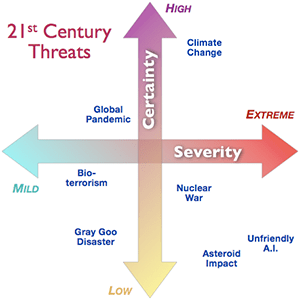
Ecophagy [ih-koh-fuh-jee] is a term coined by molecular engineering scientist Robert Freitas that means the literal consumption of an ecosystem. He wrote: ‘Perhaps the earliest-recognized and best-known danger of molecular nanotechnology is the risk that self-replicating nanorobots capable of functioning autonomously in the natural environment could quickly convert that natural environment (e.g., ‘biomass’) into replicas of themselves (e.g., ‘nanomass’) on a global basis, a scenario usually referred to as the ‘grey goo problem’ but perhaps more properly termed ‘global ecophagy.”
The term has since been used to describe several other world destroying events including nuclear war, catastrophic monoculture (lack of biodiversity in farming), and mass extinction due to climate change. Scholars suggest that these events might result in ecocide in that they would undermine the capacity of the Earth’s biological population to repair itself. Others suggest that more mundane and less spectacular events—the unrelenting growth of the human population, the steady transformation of the natural world by human beings—will eventually result in a planet that is considerably less vibrant, and one that is, apart from humans, essentially lifeless.
Posted in Death, Technology, World |
Leave a Comment »
May 20, 2014
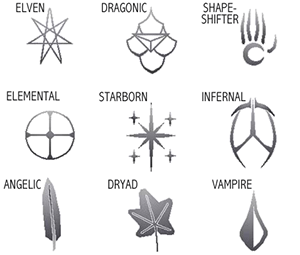
Otherkin is a description applicable to people who believe themselves to be partially or entirely non-human. They consider themselves to be other creatures (real, fictitious, or mythological) in spirit if not in body. This is explained by some members of the otherkin community as possible through reincarnation, having a nonhuman soul, ancestry, or symbolic metaphor. According to Joseph Laycock (who wrote a book about contemporary vampire culture), ‘scholarship has framed this claim as religious because it is frequently supported by a framework of metaphysical beliefs.’ Not all otherkin necessarily share these beliefs; some may simply prefer to identify as non-human.
Otherkin largely identify as mythical creatures, with others identifying as real-life creatures or creatures from fantasy or popular culture. Examples include: angels, demons, dragons, elves, fairies, sprites, and plants. Many otherkin believe in the existence of a multitude of parallel/alternative universes, which would explain the existence and the possibility to relate to fantastical beings and even fictional characters.
read more »
Posted in Health, Philosophy |
Leave a Comment »
March 20, 2014

Gaydar is a colloquialism referring to the intuitive ability of a person to assess others’ sexual orientations as gay, bisexual or heterosexual. Gaydar relies almost exclusively on non-verbal clues and LGBT stereotypes. These include (but are not limited to) the sensitivity to social behaviors and mannerisms; for instance, acknowledging flamboyant body language, the tone of voice used by a person when speaking, overtly rejecting traditional gender roles, a person’s occupation, and grooming habits.
The detection of sexual orientation by outward appearance or behavior is frequently challenged by situations in which masculine gay men who do not act in a stereotypically ‘gay’ fashion, or with metrosexual men (regardless of sexuality) who exhibit a lifestyle, spending habits, and concern for personal appearance stereotypical of fashionable urban gay men.
read more »
Posted in Language, Science, Sex |
Leave a Comment »
February 6, 2014

A wardrobe malfunction is accidental exposure of intimate parts. It is different from indecent exposure or flashing, as the latter ones imply a deliberate exposure. There has been a long history of such incidents, though the term itself was coined in the mid-2000s and has become one of the most common fashion faux pas. In everyday context it often happens as a ‘nipple slip’ to women and is relatively common, but wardrobe malfunction suggests a public event or performance, particularly when there are allegations that it was deliberately staged for publicity reasons.
The American Dialect Society defines it as ‘an unanticipated exposure of bodily parts.’ Global Language Monitor, which tracks usage of words on the internet and in newspapers worldwide, identified the term as the top Hollywood contribution to English in 2004, surpassing words like ‘girlie men’ and ‘Yo!’
read more »
Posted in Humor, Politics, Sex |
Leave a Comment »
November 19, 2013
Zoopharmacognosy [zoh-uh-fahr-muh-kog-nuh-see] refers non-human animal self-medication (using plants, soils, insects and psychoactive drugs to treat and prevent disease).
Coined by Dr. Eloy Rodriguez, a biochemist and professor at Cornell University, the term came to popular attention in 2003 from Open University lecturer Cindy Engel in ‘Wild Health: How Animals Keep Themselves Well and What We Can Learn from Them.’ A well-known example of zoopharmacognosy is when dogs eat grass to induce vomiting. Some species ingest non-foods such as clay, charcoal, and even toxic plants, apparently to ward off parasitic infestation or poisoning.
read more »
Posted in Drugs, Health, Science |
Leave a Comment »


 The Daily Omnivore