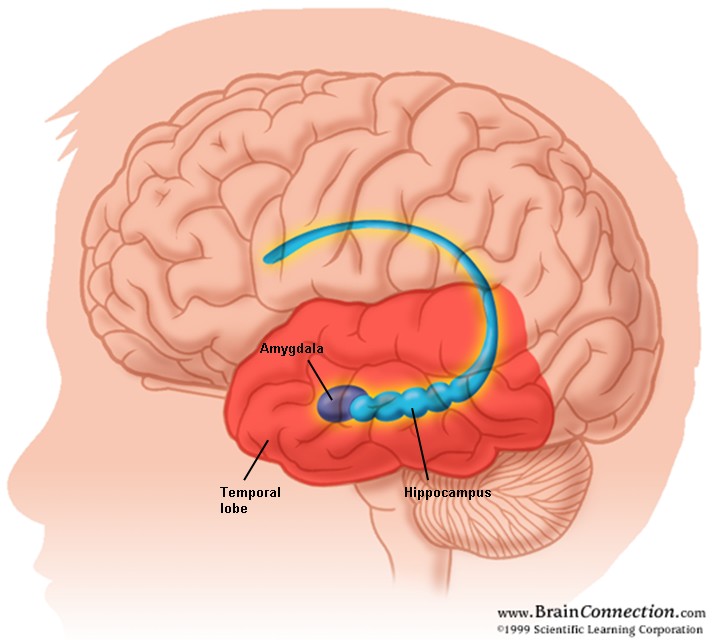
The amygdala [uh-mig-duh-luh] (Latin: ‘almond’) are almond-shaped groups of nuclei (clusters of neurons) located deep within the temporal lobes of the brain in complex vertebrates, including humans. Shown in research to perform a primary role in the processing and memory of emotional reactions, the amygdalae are considered part of the limbic system.
The amygdala sends impulses to the hypothalamus for activation of the sympathetic nervous system to trigger a fight or flight response, to the thalamic reticular nucleus for increased reflexes, to the nuclei of the trigeminal nerve and the facial nerve, and to the ventral tegmental area, locus coeruleus, and laterodorsal tegmental nucleus for activation of dopamine, norepinephrine and epinephrine (adrenalin).
read more »


 The Daily Omnivore