April 28, 2021

A jobsworth is a person who uses the (typically minor) authority of their job in a deliberately uncooperative way, or who seemingly delights in acting in an obstructive or unhelpful manner. It characterizes one who upholds petty rules even at the expense of effectiveness, efficiency, or common sense.
It is a British colloquial word derived from the phrase ‘I can’t do that, it’s more than my job’s worth,’ meaning that failing to do what is requested of them would be against what their job requires and would be likely to cause them to lose their job. English lexicographer Jonathon Green similarly it as ‘a minor factotum whose only status comes from enforcing otherwise petty regulations.’
read more »
Posted in Humor, Language |
Leave a Comment »
April 16, 2021

Simp is an Internet slang term describing someone who performs excessive sympathy and attention toward another person, typically someone who does not reciprocate the same feelings. This is usually done in pursuit of a sexual relationship.
Urban Dictionary defines a simp as ‘someone who does way too much for a person they like.’ This behavior, known as ‘simping,’ is carried out toward a variety of targets, including celebrities, politicians, e-girls, and e-boys.
read more »
Posted in Language |
Leave a Comment »
March 16, 2021

In U.S. political jargon, a smoke-filled room (sometimes called a ‘smoke-filled back room’) is a secret political gathering or round-table-style decision-making process. The phrase is generally used to suggest an inner circle of power brokers, as at a convention. It suggests a cabal of powerful or well-connected, cigar-smoking men meeting privately to nominate a dark horse political candidate or otherwise make decisions without regard for the will of the larger group.
The origin of the term was in a report by Raymond Clapper of United Press, describing rumors of the process by which Warren G. Harding was nominated at the 1920 Republican National Convention as the party’s candidate for the presidential election. After many indecisive votes, Harding, a relatively minor candidate who was the junior senator from Ohio was, legend has it, chosen as a compromise candidate by Republican power-brokers in a private meeting at the Blackstone Hotel in Chicago after the convention had deadlocked.
Posted in Politics |
Leave a Comment »
December 1, 2020

Jewish nose is a caricature of Jews with hooked noses with a convex nasal bridge and a downward turn of the tip of the nose that emerged in 13th century Europe. The stereotype persists despite the fact that this nose type is as common in the general population as it is among Jews in countries where it is prevalent, such as in the Mediterranean.
Around the middle of the 19th century, and lasting for more than a century, the term ‘Jewish nose’ was commonly used in scientific literature to describe a particular shape of nose which thought to be a race-based deformity characteristic of people with Jewish ancestry (which by unwitting efforts of plastic surgeons of early 20th century started to be viewed as a pathology to be corrected).
read more »
Posted in Philosophy, Politics, World |
Leave a Comment »
November 30, 2020
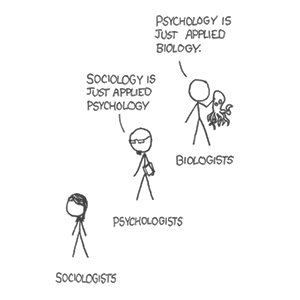
The term physics envy is a phrase used to criticize modern writing and research of academics working in areas such as ‘softer sciences,’ liberal arts, business studies, and humanities. The term argues that writing and working practices in these disciplines have overused, confusing jargon and complicated mathematics to seem more ‘rigorous’ and more like mathematics-based subjects like physics.
The success of physics in ‘mathematicizing’ itself, particularly since Isaac Newton’s ‘Principia Mathematica,’ is generally considered remarkable and often disproportionate compared to other areas of inquiry. ‘Physics envy’ refers to the envy (perceived or real) of scholars in other disciplines for the mathematical precision of fundamental concepts obtained by physicists.
read more »
Posted in Science |
1 Comment »
November 28, 2020
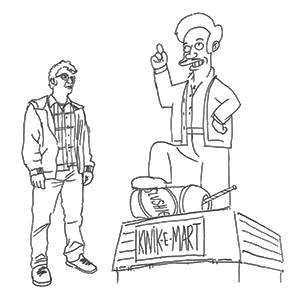
Cancel culture (or ‘call-out culture’) is a modern form of ostracism in which someone is thrust out of social or professional circles – either online on social media, in the real world, or both. Those who are subject to this ostracism are said to be ‘canceled.’ The expression ‘cancel culture’ has mostly negative connotations and is commonly used in debates on free speech and censorship.
Former U.S. President Barack Obama warned against social media call-out culture, saying ‘People who do really good stuff have flaws. People who you are fighting may love their kids and, you know, share certain things with you.’
read more »
Posted in Politics |
1 Comment »
August 15, 2020

Karen is a pejorative term used in the United States and other English-speaking countries for a person perceived as entitled or demanding beyond the scope of what is appropriate or necessary. A common stereotype is that of a white woman who uses her privilege to demand her own way at the expense of others.
Depictions also include demanding to ‘speak to the manager,’ anti-vaccination beliefs, being racist, or sporting a particular bob cut hairstyle. As of 2020, the term was increasingly being used as a general-purpose term of disapproval for middle-aged white women.
read more »
Posted in Language, Politics |
1 Comment »
June 29, 2020
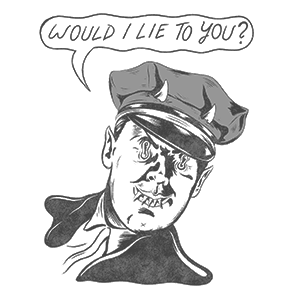
Police perjury (or testilying in U.S. police slang) is the act of a police officer giving false testimony. It is typically used in a criminal trial to ‘make the case’ against a defendant believed by the police to be guilty when irregularities during the suspect’s arrest or search threaten to result in acquittal.
It also can be extended further to encompass substantive misstatements of fact for the purpose of convicting those whom the police believe to be guilty, procedural misstatements to ‘justify’ a search and seizure, or even to include statements to frame an innocent citizen.
read more »
Posted in Politics |
1 Comment »
June 11, 2020

In law enforcement in the United States, a gypsy cop is a police officer who frequently transfers between police departments, having a record of misconduct or unsuitable job performance. The term is slang, referencing the stereotypical nomadic lifestyle of the Romani people, pejoratively ‘Gypsies.’ Some dictionaries recommend against using the word gypsy as a modifier with negative connotations, because such use could be considered a slur against the Romani people.
In use since the 1980s, the phrase entered public parlance in the 2000s after the infamous Tulia drug stings, where itinerant lawman Tom Coleman allegedly set up innocent people, most of them black, as part of a long-term undercover operation.
read more »
Posted in Politics |
Leave a Comment »
December 19, 2019

In discussion of science fiction, a Big Dumb Object (BDO) is any mysterious object, usually of extraterrestrial or unknown origin and immense power, in a story which generates an intense sense of wonder by its mere existence. To a certain extent, the term deliberately deflates this.
The term’s coinage is attributed to book reviewer Roz Kaveney, but it was popularized by its tongue-in-cheek inclusion in ‘The Encyclopedia of Science Fiction’ by Peter Nicholls in 1993.
read more »
Posted in Art, Technology |
Leave a Comment »
December 16, 2019
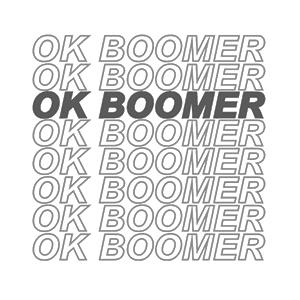
OK Boomer is a catchphrase and internet meme that gained popularity among younger cohorts throughout 2019, used to dismiss or mock attitudes stereotypically attributed to the baby boomer generation. The phrase first drew widespread attention in a 2019 TikTok video in response to an older man, though the phrase was coined years before that. It is considered by some to be ageist.
The phrase is a pejorative retort used to dismiss or mock perceived narrow-minded, outdated, negatively-judgemental, or condescending attitudes of older people, particularly baby boomers. The term has been used as a retort for perceived resistance to technological change, climate change denial, marginalization of minorities or opposition to younger generations’ ideals.
read more »
Posted in Humor, Politics |
Leave a Comment »
December 1, 2019

Mansplaining is a pejorative term meaning ‘(of a man) to comment on or explain something to a woman in a condescending, overconfident, and often inaccurate or oversimplified manner.’ Lily Rothman, of ‘The Atlantic,’ defines it as “‘explaining without regard to the fact that the explainee knows more than the explainer, often done by a man to a woman.’
In its original use, mansplaining differed from other forms of condescension in that it is rooted in the assumption that a man is likely to be more knowledgeable than a woman. However, it has come to be used more broadly, often applied when a man takes a condescending tone in an explanation to anyone, regardless of the age or gender of the intended recipients: a ‘man ‘splaining’ can be delivered to any audience.
read more »
Posted in Language, Politics |
Leave a Comment »


 The Daily Omnivore