
Joe Wong is a Chinese American comedian. He grew up in Jilin Province, China, and came to study chemistry at Rice University in Texas in 1994. He moved to Boston in 2001 and began to perform his comedy.
Everything is Interesting
Joe Wong is a Chinese American comedian. He grew up in Jilin Province, China, and came to study chemistry at Rice University in Texas in 1994. He moved to Boston in 2001 and began to perform his comedy.
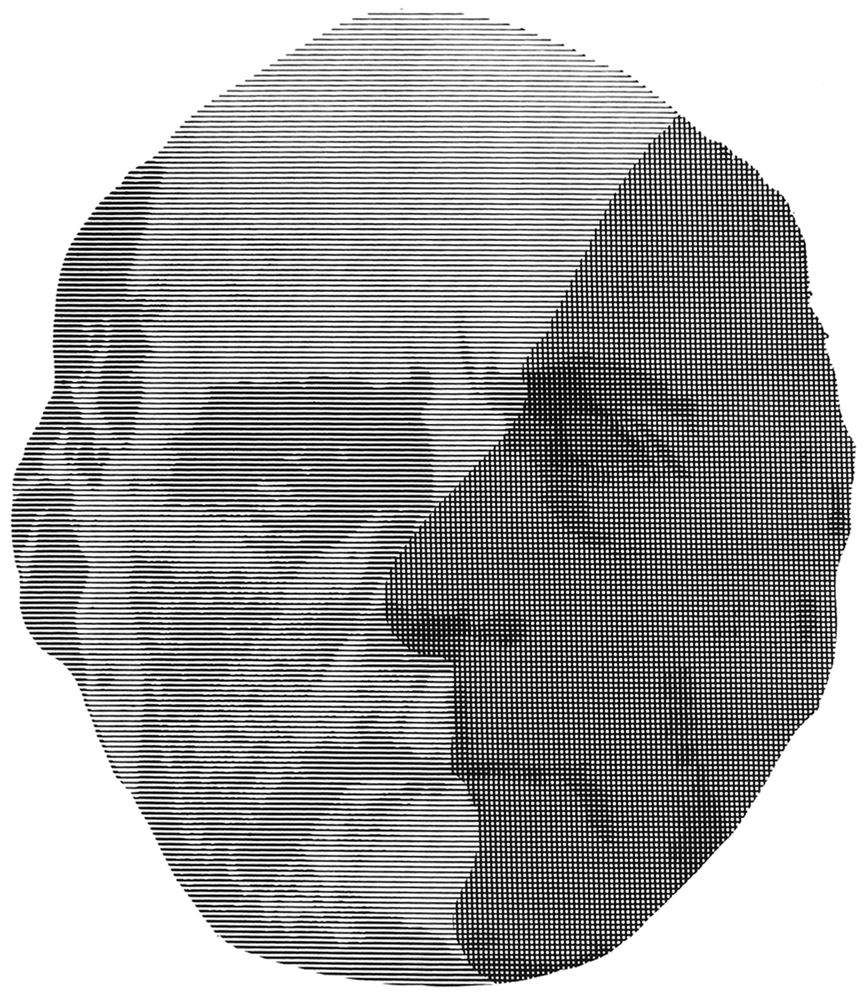
Francis Galton (1822 – 1911) was an English Victorian polymath: anthropologist, eugenicist, tropical explorer, geographer, inventor, meteorologist, and statistician. Galton had a prolific intellect, and produced over 340 papers and books throughout his lifetime. He also created the statistical concept of correlation. He was the first to apply statistical methods to the study of human differences and inheritance of intelligence, and introduced the use of questionnaires and surveys for collecting data on human communities.
He was a pioneer in eugenics, coining the term itself and the phrase ‘nature versus nurture.’ As the initiator of scientific meteorology, he devised the first weather map. He also invented the Dog Whistle for testing differential hearing ability.

Mark Mothersbaugh (b. 1950) is an American musician; he is the co-founder of the new wave band Devo and has been its lead singer since 1972. Mothersbaugh attended Kent State as an art student, where he met Devo co-founders Jerry Casale and Bob Lewis. In early 1970, Lewis and Casale formed the idea of the ‘devolution’ of the human race; Mothersbaugh, intrigued by the concept, joined them, building upon it with elements of early poststructuralist ideas and oddball arcana, most notably unearthing the infamous ‘Jocko-Homo Heavenbound’ pamphlet (the basis for the song).
Since Devo, Mothersbaugh developed a successful career writing musical scores for film and television. In film, he has worked frequently with filmmaker Wes Anderson, and scored many of his feature films (‘Bottle Rocket,’ ‘Rushmore,’ ‘The Royal Tenenbaums,’ and ‘The Life Aquatic with Steve Zissou’). His music has been a staple of the children’s television shows ‘Rugrats,’ ‘Beakman’s World,’ and ‘Clifford the Big Red Dog.’ He also wrote some music for ‘Pee-Wee’s Playhouse’ in 1990. His commercial work is often performed with Mutato Muzika, the music production company he formed with several other former members of Devo including his brother, Bob Mothersbaugh.
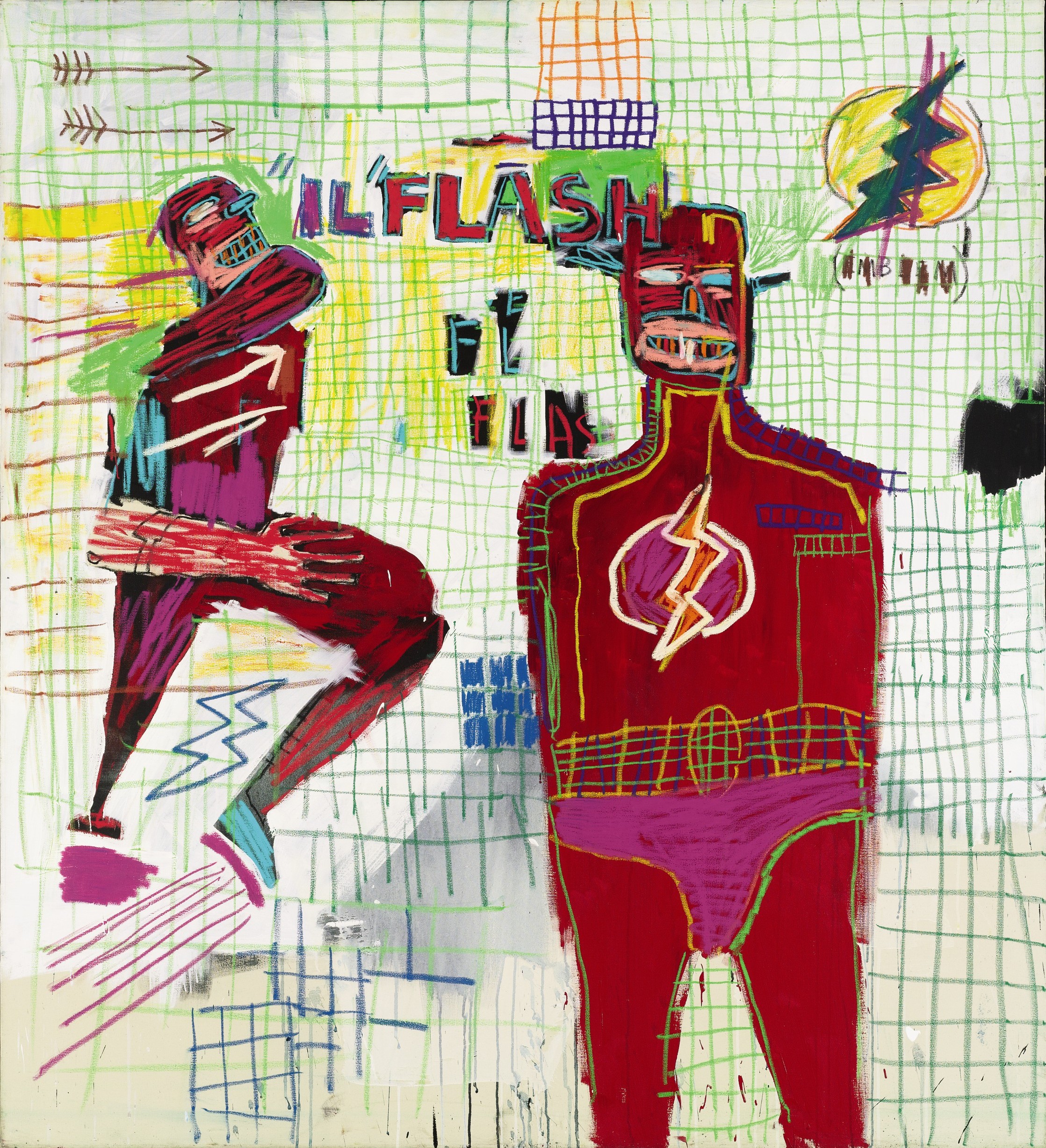
Jean-Michel Basquiat [bah-skee-ott] (1960 – 1988) was a Neo-expressionist painter who got his start as a graffiti artist in NYC in the late 1970s. He died of a heroin overdose at the age of 27. In 1976, Basquiat and friend Al Diaz began spray-painting political-poetical graffiti on buildings in Lower Manhattan, working under the pseudonym SAMO. In 1979, he formed the noise rock band Gray with Vincent Gallo. In 1983-84 he was a frequent collaborator with Andy Warhol. The record price for a Basquiat painting is $14.6 million, paid in 2007 for an untitled 1981 piece. In keeping with his street art roots, Basquiat often incorporated words into his paintings.
He would often draw on random objects and surfaces. A major reference source throughout his career was ‘Gray’s Anatomy,’ which his mother gave to him while in the hospital at age seven. It remained influential in his depictions of internal human anatomy, and in its mixture of image and text. Other reference sources were Henry Dreyfuss’ ‘Symbol Sourcebook,’ Da Vinci’s notebooks, and Brentjes’ ‘African Rock Art.’ Basquiat doodled often, and some of his later pieces, done mostly with colored pencils on paper, exhibit this, often with a loose, spontaneous, and dirty style much like his paintings.


Keith Haring [hah-ring] (1958 – 1990) was an artist and social activist whose work responded to the New York City street culture of the 1980s. Born in Reading, Pennsylvania, at age 19 he moved to NYC, where he was inspired by graffiti art, and studied at the School of Visual Arts. Haring achieved his first public attention with chalk drawings in the subways. The exhibitions were filmed by the photographer Tseng Kwong Chi. Around this time, ‘The Radiant baby’ became his symbol. His bold lines, vivid colors, and active figures carry strong messages of life and unity. Starting in 1980, he organized exhibitions in Club 57, a performance venue.
He participated in the Times Square Exhibition and drew, for the first time, animals and human faces. In 1981 he sketched his first chalk drawings on black paper and painted plastic, metal and found objects. Haring died of AIDS-related complications. By expressing concepts of birth, death, love, sex and war, his imagery has become a widely recognized visual language of the 20th century. His work was featured in several of the Red Hot Organization’s efforts to raise money for AIDS and AIDS awareness. Specifically, its first two albums, ‘Red Hot + Blue’ and ‘Red Hot + Dance’ — the latter of which used Haring’s work on its cover.

Nadia Plesner is a Danish/Dutch painter who works and lives in the Netherlands. Plesner is working on issues that lie between the editorial and advertising and often with political undertones. She trained at the Graphic Arts Institute, Copenhagen and at the Gerrit Rietveld Academie, Amsterdam. In 2010 Plesner was sued by Louis Vuitton for showing her controversial painting ‘Darfurnica.’ The painting shows a little hungry boy holding a handbag resembling one made by Louis Vuitton. The little boy is standing in the conflict-ridden region of Darfur in Sudan. The fashion giant thought that the legal rules about logo products were broken and the case was taken to court.
A Dutch court imposed daily fines for approximately 6000 US dollars. The trial attracted much international attention and several artists and celebrities supported Plesner as they believed that the case also referred to artistic expression and the right to make the world aware of international issues in an artistic way. Plesner and Louis Vuitton were also involved in a prior dispute about an artistic campaign called Simple Living in 2008. In 2011 the Dutch court reversed its decision and acquitted Nadia Plesner. ‘Darfurnica’ was sold in 2011 for approximately 45.000 US dollars.

Andrei Tarkovsky (1932 – 1986) was a Russian filmmaker, widely regarded as one of the finest of the 20th century. Tarkovsky’s films include ‘Andrei Rublev,’ ‘Solaris,’ ‘The Mirror,’ and ‘Stalker.’ He directed the first five of his seven feature films in the Soviet Union; his last two films were produced in Italy and Sweden, respectively. They are characterized by spirituality and metaphysical themes, long takes, lack of conventional dramatic structure and plot, and distinctively authored use of cinematography.
read more »

Shawn Nelson (1959 – 1995) was a U.S. Army veteran and unemployed plumber who stole an M60 Patton tank from a United States National Guard Armory in San Diego, California and went on a rampage, destroying cars, fire hydrants, and an RV before being shot dead by police. The tank’s weaponry was unloaded, but Nelson led police on a 23-minute, televised chase through the streets of San Diego. The tank had a top speed of just 30 miles per hour, but the 57-ton vehicle easily plowed through road signs, traffic lights, and crushed a van against a recreational vehicle, then plowed through the RV.
Nelson attempted to knock down a bridge by running in to the supports, but gave up after he failed to topple it with the first few hits. He eventually became caught on a concrete median of State Route 163, as he attempted to cross the median into the oncoming traffic. Four police officers climbed onto the tank and were able to open the hatch. The officers ordered Nelson to surrender, but he said nothing and began lurching the tank back and forth in attempt to free it from the median. Officer Paxton’s partner, Richard Piner, leaned in and shot Nelson. The bullet struck Nelson in the shoulder. Nelson later died in the hospital.

Marvin Heemeyer (1951 – 2004) was a welder and an automobile muffler repair shop owner. Outraged over the outcome of a zoning dispute, he armored a bulldozer with layers of steel and concrete and used it to demolish the town hall, a former judge’s home, and other buildings in Granby, Colorado.
The rampage ended when the bulldozer became stuck, and after a standoff with law enforcement agencies, Heemeyer killed himself with a handgun. He had been feuding with town officials, particularly over fines for violating city ordinances and a zoning dispute regarding a concrete factory constructed opposite to his muffler shop that caused his business to fail. Heemeyer took about a year and a half to prepare for his rampage.
read more »

Sébastien Le Prestre, Seigneur de Vauban (1633 – 1707), commonly referred to as Vauban [voh-bahn], was a Marshal of France and the foremost military engineer of his age, famed for his skill in both designing fortifications and breaking through them. He also advised Louis XIV on how to consolidate France’s borders, to make them more defensible. Vauban made a radical suggestion of giving up some land that was indefensible to allow for a stronger, less porous border with France’s neighbors.
Vauban was born in Burgundy, to a family of minor nobility, but at the age of ten he was left an orphan, and his youth was spent amongst the peasantry of his native place. A fortunate event brought him under the care of a member of the Carmelites (a Catholic religious order), who undertook his education, and the grounding in mathematics, science and geometry.
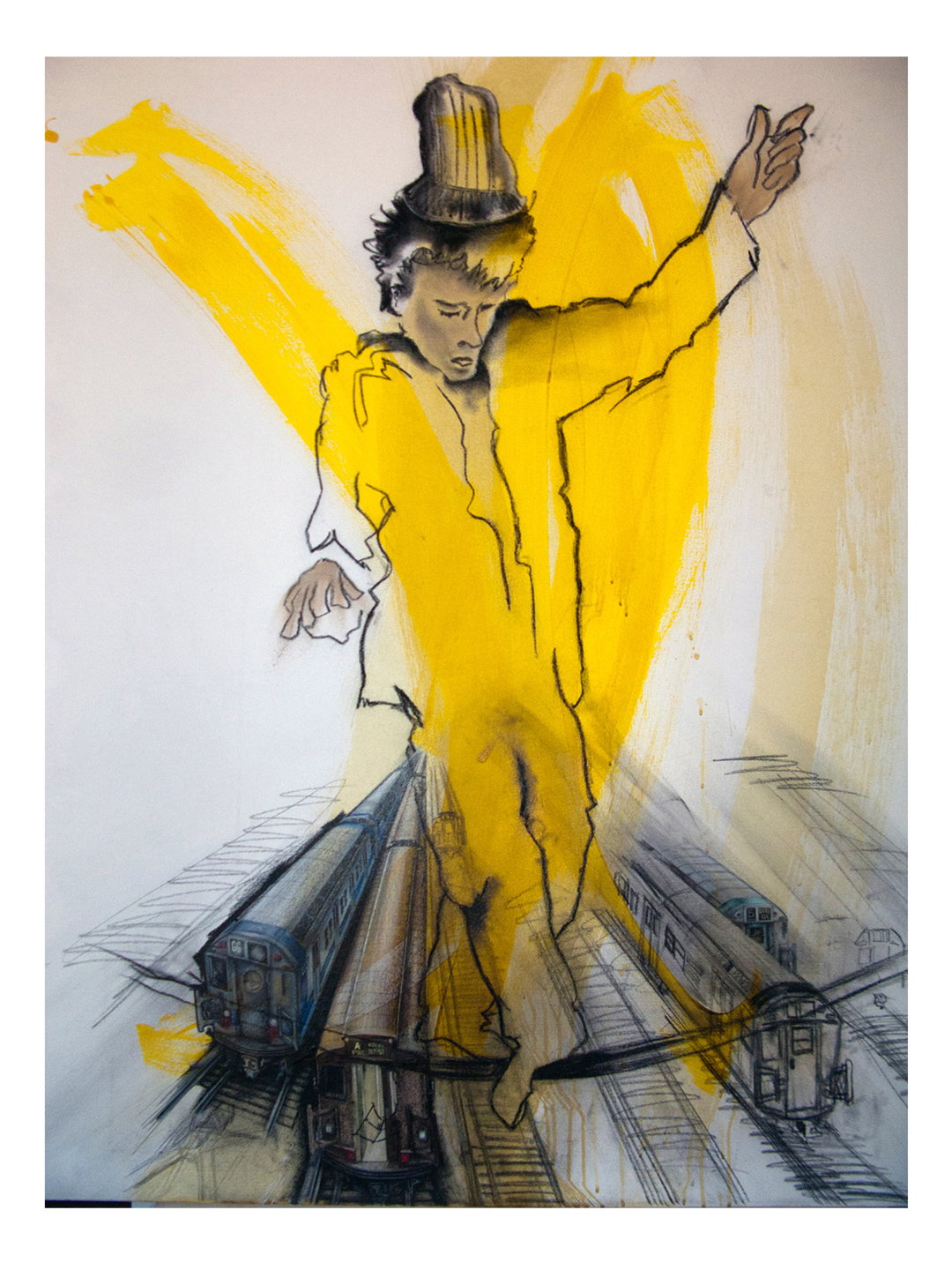
Lee Quiñones [kwi-nohn] (b. 1960) is one of several artists rising from the NYC subway graffiti movement. Born in Puerto Rico and raised in Lower East Side Manhattan, Lee was constantly drawing since the age of five and started with graffiti in 1974. By 1976, Lee was a legend, working in the shadow, leaving huge pieces of art across the subway system. His style is rooted in popular culture, often with political messages. Along with Keith Haring and Jean-Michel Basquiat, Lee Quiñones was one of the innovators of New York’s street-art movement and is considered the single most influential artist to emerge from the graffiti era.
As a subway graffiti artist, Lee almost exclusively painted whole cars (all together about 125), and he was a major contributor to the first-ever whole-train. In November 1976, ten subway cars were painted with a range of colorful murals and set a new benchmark for the scale of graffiti works. Quiñones often added poetic messages in his pieces such as: ‘Graffiti is art and if art is a crime, please God, forgive me.’ He was one of the first street artists to transition fine art. The 1979 exhibition of his canvases at Claudio Bruni’s Galleria Medusa in Rome introduced street art to the rest of the world.
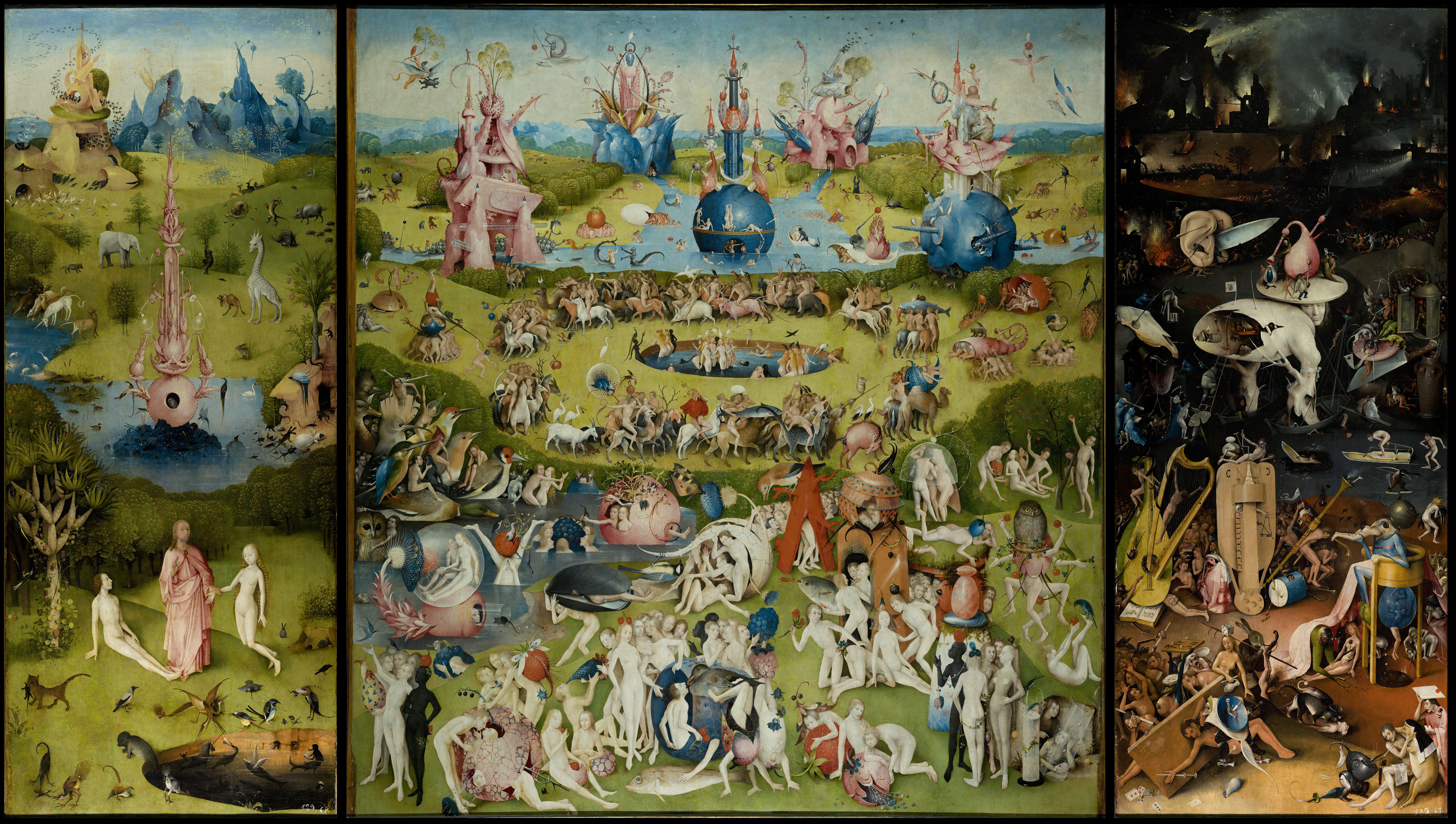
Hieronymus Bosch (c. 1450 – 1516) was an Early Netherlandish painter. His work is known for its use of fantastic imagery to illustrate moral and religious concepts and narratives. Little is known of his life or training. He left behind no letters or diaries, and nothing is known of his personality or his thoughts on the meaning of his art. Bosch produced several triptychs, panel paintings which are divided into three sections, which are hinged together and folded.
Among his most famous is ‘The Garden of Earthly Delights,’ which depicts paradise with Adam and Eve and many wondrous animals on the left panel, the earthly delights with numerous nude figures and tremendous fruit and birds on the middle panel, and hell with depictions of fantastic punishments of the various types of sinners on the right panel. When the exterior panels are closed the viewer can see, painted in grisaille (shades of grey), God creating the Earth.


 The Daily Omnivore