February 14, 2011

Jaron Lanier [lah-neer] (b. 1960) is an American computer scientist and artist. In the early 1980s he popularized the term ‘Virtual Reality’ (VR) for a field in which he was a pioneer. At that time, he founded VPL Research, the first company to sell VR products. His current appointments include Interdisciplinary Scholar-in-Residence, CET, UC Berkeley. In what is probably his most famous paper ‘One-Half of a Manifesto’ (Wired, 2000) Lanier opposes the prospect of so called ‘cybernetic totalism,’ which is ‘a cataclysm brought on when computers become ultra-intelligent masters of matter and life.’
Lanier’s position is that humans may not be considered to be biological computers, i.e., they may not be compared to digital computers in any proper sense, and it is very unlikely that humans could be generally replaced by computers easily in few decades, even economically. While processor performance increases according to Moore’s law, overall performance rises only very slowly. This is because our productivity in developing software increases only slightly, and software becomes more bloated and remains as error-prone as it ever was. He warns that the biggest problem of any theory is not that it is false, ‘but when it claims to be the sole and utterly complete path to understanding life and reality.’
Posted in Philosophy, Politics, Technology |
Leave a Comment »
February 14, 2011

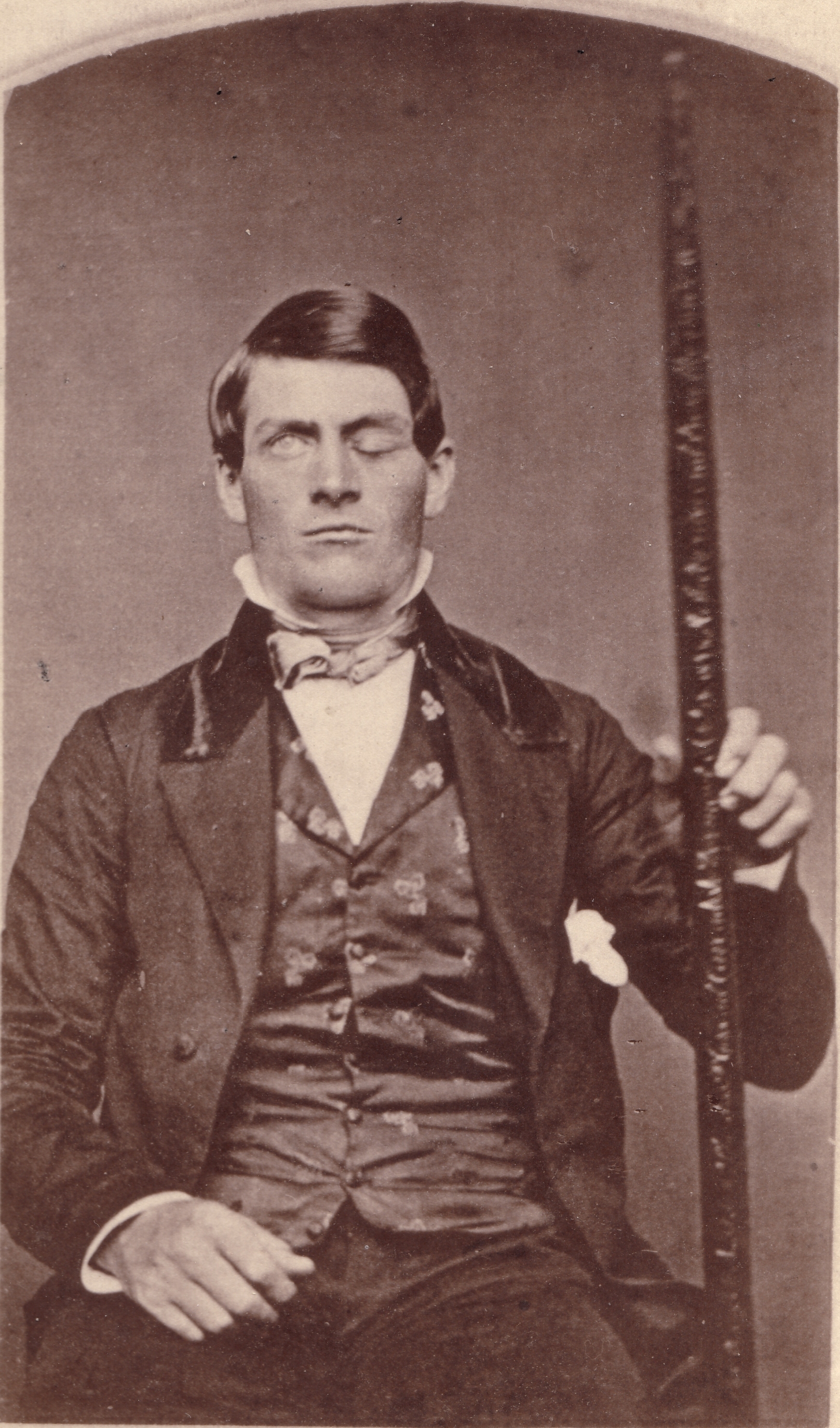
Phineas P. Gage (1823 – 1860) was an American railroad construction foreman now remembered for his improbable survival of an accident in which a large iron rod was driven completely through his head, destroying much of his brain’s left frontal lobe, and for that injury’s reported effects on his personality and behavior—effects so profound that friends saw him as ‘no longer Gage.’
Long called ‘the American Crowbar Case, Phineas Gage influenced 19th-century discussion about the brain, particularly debate on cerebral localization (determination of areas of the cortex involved in performance of certain functions) and was perhaps the first case suggesting that damage to specific regions of the brain might affect personality and behavior.
Posted in Health, Science |
Leave a Comment »
February 14, 2011

Emily Post (1872 – 1960) was an American author on etiquette. She wrote in various styles, including humorous travel books, early in her career. In 1922 her book Etiquette (full title Etiquette in Society, in Business, in Politics, and at Home) was a best seller, and updated versions continued to be popular for decades. In 1946, she founded The Emily Post Institute which continues her work. She died in 1960 in her New York City apartment at the age of 87.
Today, The Emily Post Institute, located in Burlington, Vermont, provides etiquette experts and advice to news outlets and other corporations. The authors at the Emily Post Institute write books and columns, conduct seminars and workshops, give speeches, and act as spokespeople for select corporations. They give media interviews each year on a variety of topics. Emily Post’s name has become synonymous, at least in North America, with proper etiquette and manners. Nearly half a century after her death, her name is still used in titles of etiquette books.
Posted in Language, Money |
Leave a Comment »
February 11, 2011

Mitch Hedberg (1968 – 2005) was an American stand-up comedian known for his surreal humor and unconventional comedic delivery. His comedy typically featured short, sometimes one-line jokes, mixed with absurd elements and non sequiturs.
Hedberg’s comedy and on-stage persona gained him a cult following, with audience members sometimes shouting out the punchlines to his jokes before he could finish them.
read more »
Posted in Art, Humor |
Leave a Comment »
February 11, 2011

Karl Pilkington (b. 1972) is an English author and former radio producer. He is best known for producing and co-presenting The Ricky Gervais Show on Xfm London between 2001 and 2005; and for the subsequent podcast series and HBO animated television series. He was also the subject of the Sky1 travel series, An Idiot Abroad, which was also presented in the United States on the Science Channel. The New York Times ran an article about The Ricky Gervais Show describing Pilkington’s behaviour as a well-executed deadpan routine.
Posted in Art, Humor |
Leave a Comment »
February 10, 2011

Lina Medina (b. 1933) is the youngest confirmed mother in medical history, giving birth at the age of five years, seven months and 21 days. She now lives in Lima, Peru. Medina’s son weighed 2.7 kg (6.0 lb; 0.43 st) at birth and was named Gerardo after her doctor. Gerardo was raised believing that Medina was his sister, but found out at the age of 10 that she was his mother. He grew up healthy but died in 1979 at the age of 40 of a bone marrow disease. Medina never revealed the father of the child nor the circumstances of her impregnation. Her father was arrested on suspicion of rape and incest, but was later released due to lack of evidence.
Although the case was called a hoax by some, a number of doctors over the years have verified it based on biopsies, X rays of the fetal skeleton in utero, and photographs taken by the doctors caring for her. Extreme precocious puberty in children 5 or under is very uncommon; pregnancy and delivery by a child this young remains extremely rare. Extreme precocious puberty is treated to suppress fertility, preserve growth potential, and reduce the social consequences of full sexual development in childhood.
Posted in Science, Sex |
Leave a Comment »
February 10, 2011

FM-2030 (1930 – 2000) was a transhumanist author, born Fereidoun M. Esfandiary in Brussels to an Iranian diplomat. He became notable in 1989 with the book ‘Are You a Transhuman?: Monitoring and Stimulating Your Personal Rate of Growth in a Rapidly Changing World.’ He also wrote a number of works of fiction under his original name. He changed his name to FM-2030 to reflect the hope and belief that he would live to celebrate his 100th birthday in 2030, and more importantly, to break free of the widespread practice of naming conventions that he saw as rooted in a collectivist mentality, and existing only as a relic of humankind’s tribalistic past. He viewed traditional names as almost always stamping a label of collective identity – varying from gender, to nationality – on the individual.
Many of FM-2030’s predictions about social trends from the 1970s through the early 21st century proved remarkably prescient. He argued that the inherent dynamic of the modern globalizing civilization would bring such changes about despite the best efforts of conservative elites to enforce traditional beliefs. He predicted in vitro fertilization and correcting genetic flaws in 1977; in 1980, he predicted teleconferencing, telemedicine, and teleshopping. He taught at The New School, UCLA, and Florida International University. He worked as a corporate consultant for Lockheed and J.C. Penney. He was a lifelong vegetarian and said he would not eat anything that had a mother. He died from pancreatic cancer and was placed in cryonic suspension at the Alcor Life Extension Foundation in Arizona, where his body remains today.
Posted in Art, Philosophy, Technology |
Leave a Comment »
February 9, 2011

Patricia Piccinini (born in 1965 in Freetown, Sierra Leone) is an Australian artist and hyperrealist sculptor. Her art work came to prominence in Australia in the late 1990s.
Her major artworks often reflect her interests in issues such as bioethics, biotechnologies and the environment. Other Australian artists who work in a similar idiom are Martine Corompt, Sam Jinks and Ron Mueck.
Posted in Art, Money, Politics |
Leave a Comment »
February 8, 2011

Bo Burnham (b. 1990) is an American comedian and musician. He performs satirical songs with a politically incorrect slant, and rose to fame on YouTube.
Posted in Art, Humor |
1 Comment »
February 7, 2011

Andreas Gursky (b. 1955) is a German visual artist known for his enormous architecture and landscape color photographs, some ten feet or more wide, and most employing a high point of view. As of early 2007, Gursky holds the record for highest price paid at auction for a single photographic image. His print 99 Cent II, Diptych, sold for GBP 1.7 million (USD $3.3 million) at Sotheby’s, London. Before the 1990s, Gursky did not digitally manipulate his images.
In the years since, Gursky has been frank about his reliance on computers to edit and enhance his pictures, creating an art of spaces larger than the subjects photographed. Visually, Gursky is drawn to large, anonymous, man-made spaces—high-rise facades at night, office lobbies, stock exchanges, the interiors of big box retailers (See his print 99 Cent II Diptychon). His style is described by art critics as enigmatic and deadpan. There is little to no explanation or manipulation on the works. His photography is straightforward.
Posted in Art, Money, Technology |
Leave a Comment »
February 1, 2011

Ronald Jenkees is an American composer and musician best known for his YouTube keyboard performances. He has released two independent albums: the self-titled Ronald Jenkees (2007), and Disorganized Fun (2009).
Posted in Art, Technology |
Leave a Comment »
January 31, 2011

Christian Louboutin (b. 1964) is a footwear designer who launched his line of high-end women’s shoes in France in 1991. Since 1992, his designs have incorporated the shiny, red-lacquered soles that have become his signature. In 2007 Louboutin filed an application for U.S. trademark protection of this red sole design.
Louboutin received inspiration for his lethal-looking stilettos from an incident that occurred in his early 20s. He had visited a museum and noticed that there was a sign forbidding women wearing sharp stilettos from entering for fear of damage to the extensive wood flooring. This image stayed in his mind, and he later used this idea in his designs. ‘I wanted to defy that,’ Louboutin has said. ‘I wanted to create something that broke rules and made women feel confident and empowered.’
Posted in Art, Money |
Leave a Comment »




 The Daily Omnivore