March 2, 2011
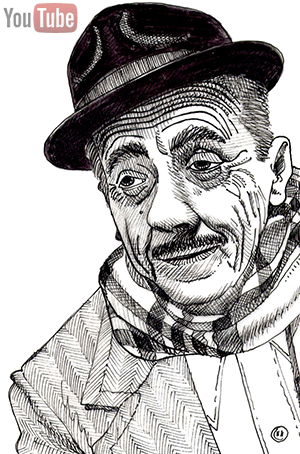
Adoniran Barbosa (1910 – 1982) was a famous Brazilian traditional samba singer and composer. The themes of his songs are drawn from the life of low-wage urban workers, the unemployed and the vagabonds. His first big hit was Saudosa Maloca (‘Shanty of Fond Memories,’ 1951), where three homeless friends recall with nostalgia their improvised shanty, which was torn down by the landowner to make room for a building. His next hit ‘Joga a Chave’ (‘Throw me the Doorkey,’ 1952) was inspired by his own frequent experiences of arriving late at home and finding the door locked by his wife, Matilde.
In his ‘Trem das Onze’ (‘The 11 PM Train,’ 1964), the protagonist explains to his lover that he cannot stay any longer because he has to catch the last train to the Jaçanã suburb, and besides his mother will not sleep before he arrives. Unlike the samba songs of the previous decades, which generally used the formal Portuguese of the educated class, Adoniran’s lyrics are a realistic record of the informal speech of São Paulo’s lower classes. He once said ‘I only write samba for the common people. That is why I write lyrics in ‘wrong’ Portuguese, because that is how the common people speak.’
Posted in Art, World |
Leave a Comment »
March 2, 2011

Eliot Lipp is a Los Angeles based electronic music artist. He made a name for himself in the genre of electro when his work was picked up by Scott Herren of Prefuse 73 (Warp Records). His most recent project is a collaboration with Leonardo Ciccone (also known as Leo 123) called ‘Dark Party.’
Posted in Art, Technology |
Leave a Comment »
March 1, 2011

Com Truise is the stage name of Seth Haley, an American electronic musician originally from Oneida, New York, and later, Princeton, New Jersey. The name is a spoonerism of Tom Cruise. Originally an Art Director, he turned in his resignation prior to his first release as Com Truise. Prior to this, Seth Haley was a Drum and Bass DJ until he fell into the 80’s style that he is known for today.
His synthesizer-heavy production work, influenced by 1980s musical styles, was first offered on the ‘Cyanide Sisters’ EP, which was initially a free download from the AMDISCS label and was reissued digitally by Ghostly International. A remix of his appeared on the ‘Tron: Legacy Reconfigured’ album soon after. In 2011 he released his first full-length album, ‘Galactic Melt.’ Haley also performs with a live drummer, Rory O’Connor.
Posted in Art, Technology |
Leave a Comment »
February 28, 2011

Herman’s Hermits is an English pop band, formed in Manchester in 1963. For a brief time the group rivalled the Beatles on the charts, and was the top-selling pop act in the U.S. in 1965. The group’s manager and producer, Mickie Most (who controlled the band’s output), emphasized a simple, non-threatening and clean-cut image, although the band originally played R&B numbers. This helped Herman’s Hermits become hugely successful in the mid-1960s but hampered the band’s creativity, relegating Noone, Hopwood, Leckenby and Green’s original songs to quickly recorded B-sides and album cuts.
Their first hit was a cover of Earl Jean’s ‘I’m Into Something Good’ (written by Gerry Goffin and Carole King), which reached No. 1 in the UK Singles Chart and No. 13 in the US in 1964. They never topped the British charts again, but had two US Billboard Hot 100 No. 1’s with ‘Mrs. Brown, You’ve Got a Lovely Daughter’ and ‘I’m Henry the Eighth, I Am’ (a British music hall song dating from 1911). These songs were aimed at a US fan-base, with Peter Noone exaggerating his Manchester accent; the band was not fond of either song and they were never released as singles in Britain.
Posted in Art, Money |
Leave a Comment »
February 24, 2011

Cibo Matto (meaning ‘crazy food’ in Italian) was a New York City-based band formed by two Japanese women, Yuka Honda and Miho Hatori, in 1994. The lyrics in their songs are primarily concerned with food and their sound has been described as a combination of Jazz, Hip-Hop, Brazilian music, African Drumming, and Disco samples. While the two founding members of the group are Japanese expatriates, they are not especially popular in Japan; the group did not gain nearly as large a following in Japan as it did in the United States.
Posted in Art |
Leave a Comment »
February 24, 2011

The Go! Team are an English sextet. They combine indie rock and garage rock with a mixture of blaxploitation and Bollywood soundtracks, double dutch chants, old school hip hop and distorted guitars similar to the style of Sonic Youth. Their songs are a mix of live instrumentation and samples from various sources. The band’s vocals vary between performances: while live vocals are handled mostly by Ninja (with Tsuchida and Fukami-Taylor also singing some solos), vocals on record consist of sampled and guest voices, not just Ninja’s.
Posted in Art |
Leave a Comment »
February 24, 2011

Miike Snow are a Swedish indie pop band formed in 2007. The band consists of producing team Christian Karlsson and Pontus Winnberg, also known as Bloodshy & Avant. The name ‘Miike Snow’ is said to have come from one of their friends called Mike Snow, with the spelling of ‘Miike’ coming from the Japanese film director Takashi Miike.
Posted in Art |
Leave a Comment »
February 23, 2011


Nasser Bouzida (also known as The Bongolian) is a member of Big Boss Man, an electric funk quartet formed in the U.K. in 1998. The original lineup was and still is Bouzida on organs, percussion and occasional vocals, Scott Milsom on the bass guitar, Trevor Harding on the electric guitar and Nick Nicholls on drums.
Posted in Art |
Leave a Comment »
February 22, 2011
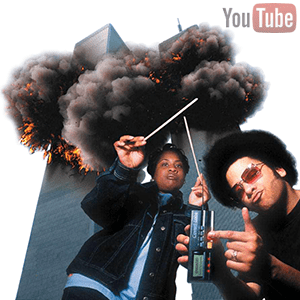
The Coup is a political hip hop group based in Oakland, California. It formed as a three-member group in 1992 with emcees Boots Riley and E-Roc along with DJ Pam the Funkstress. E-Roc left on amicable terms after the group’s second album. The duo is politically Marxist in its music and aligns itself with other radical hip-hop groups such as Dead Prez. The group’s music is characterized by electronic sounds and bass-driven backbeats overlaid by humorous, cynical and sometimes violent lyrics criticizing capitalism, American politics, patriarchal exploitation, and police brutality, among other things.
In Novemeber 2001, The Coup released ‘Party Music’ to widespread praise and condemnation. The original album cover art depicted Pam and Boots standing in front of the twin towers of the World Trade Center as they are destroyed by huge explosions, and Riley is pushing the button on a guitar tuner. The cover art was finished in June 2001. In response to the uncanny similarity of the artwork with the WTC attack of 9/11, the album release was held back until alternative cover art could be prepared.
Posted in Art, Money, Politics |
Leave a Comment »
February 16, 2011

The Octopus Project is an American indietronica band based in Austin, Texas, active since 1999. Its unique sound, blending pop and experimental elements, is a combination of digital and electronic sounds and noises (including drum machine, keyboard, synthesizers and other devices) and analog equipment (including guitars and live drums). Its music is mostly instrumental.
Posted in Art |
Leave a Comment »
February 8, 2011

Bo Burnham (b. 1990) is an American comedian and musician. He performs satirical songs with a politically incorrect slant, and rose to fame on YouTube.
Posted in Art, Humor |
1 Comment »
January 31, 2011

Ennio [en-yo] Morricone [mor-ee-cone-ay] (b. 1928) is an Italian composer and conductor, considered one of the most prolific and influential film composers of his era. He is well-known for his long-term collaborations with international acclaimed directors such as Sergio Leone, Brian De Palma, Barry Levinson, and Giuseppe Tornatore.
He wrote the characteristic film scores of Leone’s Spaghetti Westerns A Fistful of Dollars (1964), For a Few Dollars More (1965), The Good, the Bad and the Ugly (1966) and Once Upon a Time in the West (1968). In the 80s, Morricone composed the scores for John Carpenter’s horror movie The Thing (1982), Leone’s Once Upon a Time in America (1984), Roland Joffé’s The Mission (1986), Brian De Palma’s The Untouchables (1987) and Giuseppe Tornatore’s Cinema Paradiso (1988).
Posted in Art, Money |
Leave a Comment »


 The Daily Omnivore