January 26, 2011
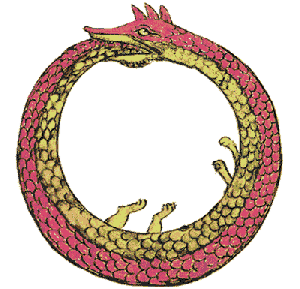
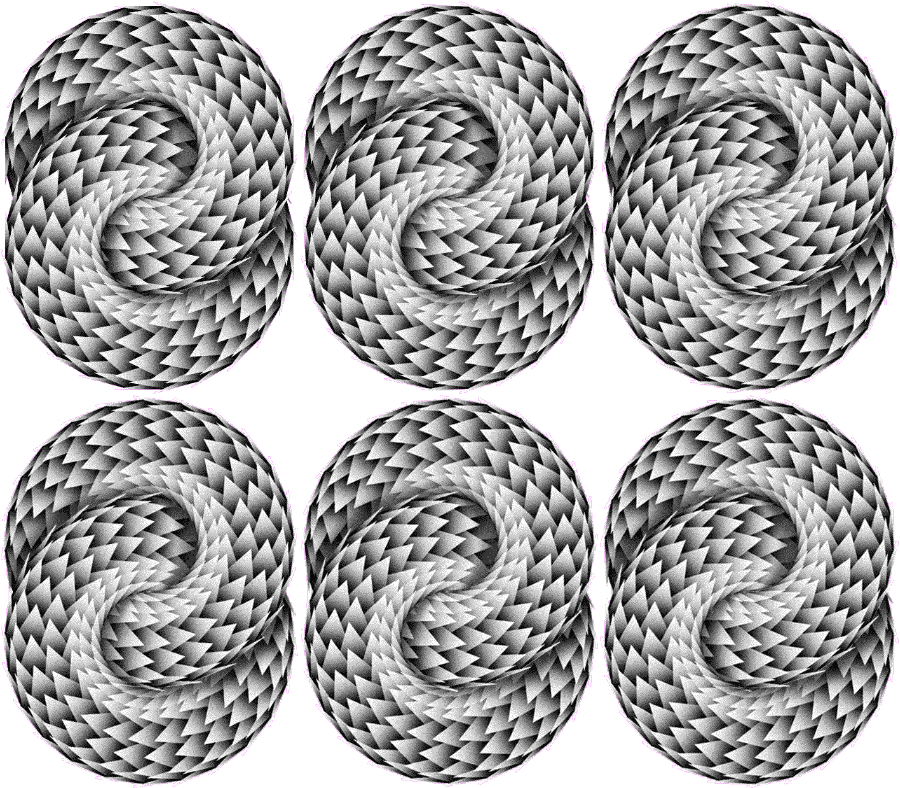
The Ouroboros [or-oh-bohr-ohs] is an ancient symbol depicting a serpent or dragon eating its own tail, which often represents self-reflexivity or cyclicality, especially in the sense of something constantly re-creating itself, the eternal return, and other things perceived as cycles that begin anew as soon as they end (compare with phoenix). It can also represent the idea of primordial unity related to something existing in or persisting before any beginning with such force or qualities it cannot be extinguished.
The ouroboros has been important in religious and mythological symbolism, but has also been frequently used in alchemical illustrations, where it symbolizes the circular nature of the alchemist’s opus. It is also often associated with Gnosticism, and Hermeticism. The earliest known representation of the Ouroboros is contained in the Egyptian Book of the Netherworld. The self-begetting sun god Atum is said to have ascended from chaos-waters with the appearance of a snake, the animal renewing itself every morning, and the deceased wishes to turn into the shape of the snake Sato (‘son of the earth’), the embodiment of Atum.
Posted in Art, Language, Philosophy |
1 Comment »
December 20, 2010
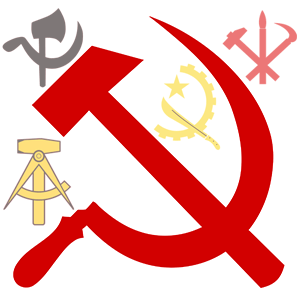
The hammer and sickle is a part of communist symbolism and its usage indicates an association with Communism, a Communist party, or a Communist state. It features a hammer and a sickle overlapping each other. The two tools are symbols of the industrial proletariat and the peasantry; placing them together symbolizes the unity between industrial and agricultural workers. This emblem was conceived during the Bolshevik Revolution. It is best known from having been incorporated into the red flag of the Soviet Union, along with the Red Star.
read more »
Posted in Money, Politics, World |
Leave a Comment »
October 10, 2010
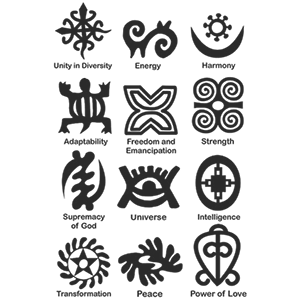
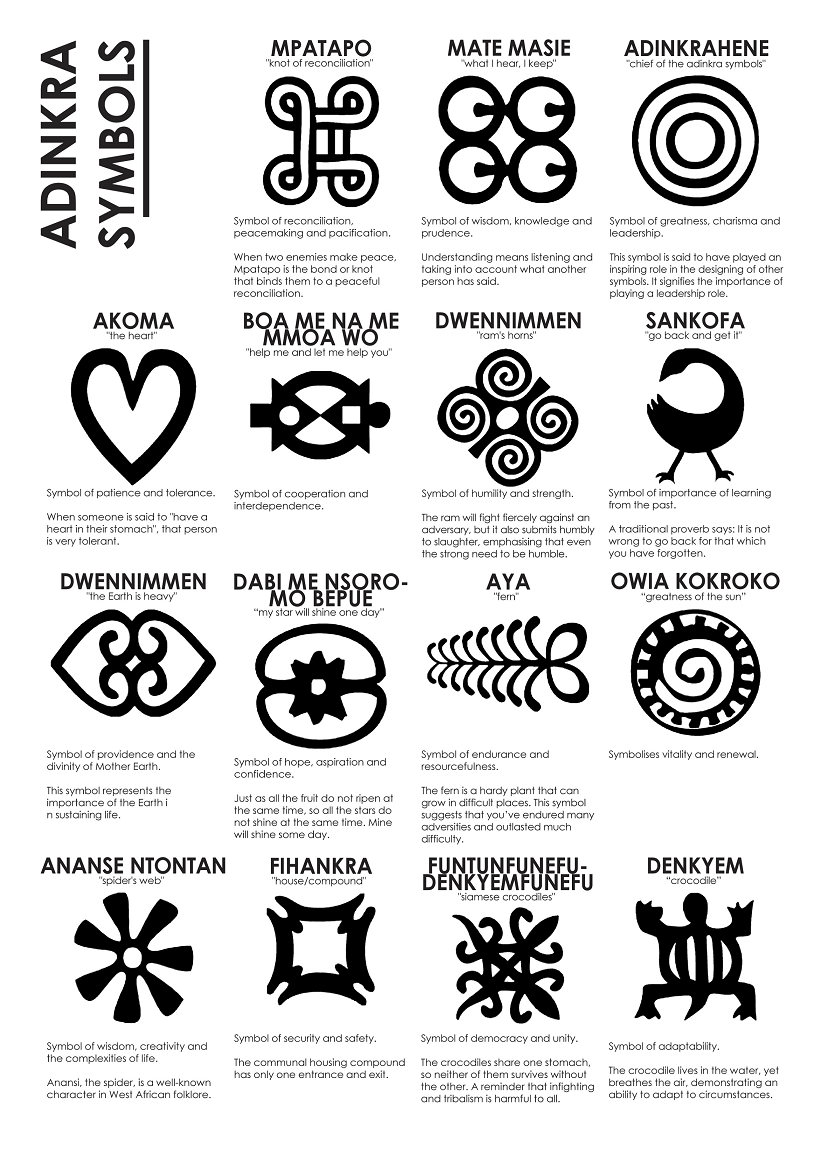
Adinkra [oon-din-krah] are visual symbols, originally created by the Akan of Ghana and the Gyaman of Cote d’Ivoire in West Africa, that represent concepts or aphorisms.
Adinkra are used on fabric, walls, in pottery, woodcarvings and logos. Fabric adinkra are often made by woodcut sign writing as well as screen printing. They also can be used to communicate evocative messages that represent parts of their life or those around them.
Posted in Art, Philosophy, World |
3 Comments »
July 17, 2010


The Eye of Providence, or the all-seeing eye of God, is a symbol showing an eye often surrounded by rays of light or a glory and usually enclosed by a triangle. It is sometimes interpreted as representing the eye of God watching over humankind. Imagery of an all-seeing eye can be traced back to Egyptian mythology and the Eye of Horus. It also appears in Buddhism, where Buddha is also regularly referred to as the ‘Eye of the World,’ and is represented as a trinity in the shape of a triangle known as the Tiratna, or Triple Gem. In Medieval and Renaissance European iconography, the Eye (often with the addition of an enclosing triangle) was an explicit image of the Christian Trinity.
Posted in Art, Philosophy |
Leave a Comment »
July 17, 2010

The rod of Asclepius [uh-sklee-pee-uhs] is an ancient symbol associated with astrology, the Greek god Asclepius, and with medicine and healing. It consists of a serpent entwined around a staff. The name of the symbol derives from its early and widespread association with Asclepius, the son of Apollo, who was a practitioner of medicine in ancient Greek mythology. Hippocrates himself was a worshipper of Asclepius.
Posted in Health, Language |
Leave a Comment »
July 17, 2010

The caduceus [kuh-doo-see-uhs] is a herald’s staff, a symbolic object representing Hermes (or the Roman Mercury), and by extension trades, occupations or undertakings associated with the god. It is today typically depicted as a short staff entwined by two serpents in the form of a double helix, and is sometimes surmounted by wings. The caduceus is sometimes used as a symbol of medicine and/or medical practice, especially in North America, due to widespread confusion with the traditional medical symbol, the rod of Asclepius, which has only a single snake and no wings.
Posted in Health, Language |
Leave a Comment »


 The Daily Omnivore