March 2, 2011

Pleo is an animatronic dinosaur toy designed to emulate the appearance and behavior of a week-old baby Camarasaurus. It was designed by Caleb Chung, the co-creator of the Furby.
Chung selected this species of dinosaur because its body shape, stocky head, and relatively large cranium made it ideal for concealing the sensors and motors needed for lifelike animation. Each Pleo ‘learns’ from its experiences and environment through a sophisticated artificial intelligence and develops an individual personality.
Posted in Games, Money, Technology |
Leave a Comment »
February 11, 2011
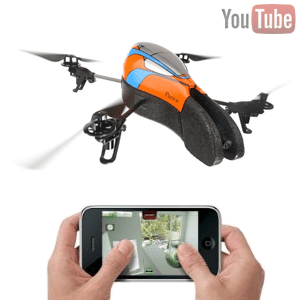
The Parrot AR.Drone is a RC quadricopter with cameras attached to it built by French wireless products manufacturer Parrot. It is designed to be controllable with an iPhone, iPad, or an iPod Touch. Parrot demos the device with 2 games, a virtual combat called ‘DRONE WAR’ with solo and multiplayer mode and a ‘ROBOT’ solo game demo against a virtual Robot. Parrot has launched ARdrone.org Open API game development platform, to gather game studios and developers. It sells for around $300 on Amazon.com.
Posted in Games, Money, Technology |
Leave a Comment »
February 10, 2011

Nickelodeon compounds refers to a number of molding substances for children’s play that were created and sold by the children’s television channel Nickelodon and toy company Mattel in the 1990s. Like most molding compounds, they could be kept in their container to retain plasticity, or molded and allowed to harden overnight. They featured a wide variety of compounds with different attributes. The first compound, whose idea was taken from the show ‘You Can’t Do That on Television,’ was Nickelodeon ‘Slime,’ first manufactured in the 1980s.
The most popular compound, ‘Gak,’ was inspired by the game show ‘Double Dare.’ It made a ‘fart’ noise when squeezed into its clear, star-shaped container. In 1994 ‘Floam,’ originally called ‘bubble-gak,’ a compound composed of microbeads in a foam-like substance, was released. ‘Smud’ was much like Play-Doh, but slicker and would not dry out if left out of its container. ‘Skweeez’ was also like Play-Doh but had a more Marshmallow-like feel. ‘Gooze’ was similar to ‘Gak’ but more watery. ‘Sqand,’ or ‘Magic sand,’ begins as ordinary sand, but is dyed and coated in a hydrophobic substance.
Posted in Humor, Money, Technology |
Leave a Comment »
February 3, 2011

Bang snaps are a type of small novelty firework sold as a trick noisemaker. They consist of a small amount of gravel or coarse sand impregnated with a minute quantity (~.08 milligrams) of silver fulminate high explosive and twisted in a cigarette paper to produce a shape resembling a teardrop with a tail. When stepped on, ignited, or thrown on a hard surface, the friction-sensitive silver fulminate detonates, producing a sharp salute similar to that of a cap gun. Despite producing a legitimate (albeit tiny) high-explosive detonation, the extremely high mass ratio of gravel to explosive acts as a buffer to ensure that the devices produce only the audible ‘crack’ of the supersonic shock wave.
They are incapable of producing physical damage, even if discharged directly against skin, and the detonation frequently fails to even break the thin paper holding the ingredients. The explosion is also too weak to propel the gravel any distance, which usually falls to the ground. This makes them safe for use as a children’s toy, for which purpose they have been widely sold across the world since the 1950s. Currently the only US jurisdiction which restricts the use and sale of bang snaps is the state of New Jersey, which bans all forms of consumer pyrotechnics including sparklers. Other states impose the same age restrictions on purchasing bang snaps as that of permitted fireworks, usually 17 or 18.
Posted in Humor, Technology |
Leave a Comment »
January 10, 2011
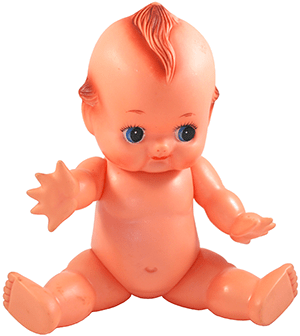

Kewpie dolls and figurines are based on illustrations by Rose O’Neill that appeared in Ladies’ Home Journal in 1909. The small dolls were extremely popular in the early 1900s; they were often awarded as a carnival prize and collected. They were first produced in Ohrdruf, a small town in Germany, then famous for its toy-manufacturers. Their name is derived from ‘cupid,’ the Roman god of beauty and non-platonic love.
The early dolls, especially signed or ceramic, are highly collectible and worth thousands of dollars. The time capsule at the 1939 New York World’s Fair contained a Kewpie doll. The Kewpie doll was mentioned in Anne Frank’s diary. She received one on her first St. Nicholas Day in the Annex from Miep and Bep. The dolls are also mentioned in Steinbeck’s Of Mice and Men.
Posted in Games, Money |
Leave a Comment »
December 23, 2010
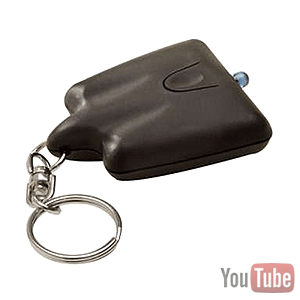
TV-B-Gone is a type of simple universal remote control device for turning off a large majority of the current available brands of television sets. It was created to allow people in a public place to turn off nearby television sets, presumably because the broadcast was distracting them from other activities. Its inventor has referred to it as ‘an environmental management device.’
The device is part of a key-chain, and, like other remote devices, is battery-powered. Although it can require up to 69 seconds for the device to find the proper code for a particular television receiver, the most popular televisions turn off in the first few seconds. During the 2008 Consumer Electronics Show, some individuals from gadget blog, Gizmodo brought a TV-B-Gone remote control and shut off many display monitors at booths and during demos affecting several companies. These actions caused the individual from Gizmodo to be banned for life from future CES events.
Posted in Humor, Technology |
Leave a Comment »
December 9, 2010

A combination puzzle, also known as a sequential move puzzle or twisty puzzle, is a puzzle which consists of a set of pieces which can be manipulated into different combinations by a group of operations. The puzzle is solved by achieving a particular combination starting from a random (scrambled) combination. Often, the solution is required to be some recognizable pattern such as ‘all like colors together’ or ‘all numbers in order’. The most famous of these puzzles is the original Rubik’s Cube, invented in 1974 by Hungarian sculptor and professor of architecture Ernő Rubik.
There are many different variations including cubes with up to seven layers: the 2×2×2 (Pocket/Mini Cube), 3×3×3 cube (Rubik’s Cube), the 4×4×4 (Rubik’s Revenge/Master Cube), and the 5×5×5 (Professor’s Cube), the 6×6×6 (V-Cube 6), and 7×7×7 (V-Cube 7). The E-cube is an electronic variant of the 3x3x3 cube, made with RGB LEDs and switches. In addition to cubes, combination puzzles are available in various other geometric shapes, including a tetrahedron (Pyraminx), octahedron (Skewb Diamond), dodecahedron (Megaminx), and icosahedron (Dogic). There are also puzzles that change shape such as Rubik’s Snake and the Square One.
Posted in Games |
1 Comment »
September 20, 2010


A Munny doll is a designer toy from the American company Kidrobot. It is a blank figure the owner can decorate using pens, pencils, markers, paint, and other supplies. A Munny doll is made out of vinyl and has movable joints. The first doll was white, and has since been available in other colors such as black, pink, blue, and phosphorescent green. The figure is housed in a box which includes 4 random accessories such as a carrot or a hat.
Posted in Art, Money |
Leave a Comment »
September 14, 2010

Silly Bandz are a brand of silicone rubber bands formed into shapes including animals, objects, and letters. They are distributed by BCP Imports and are normally worn as bracelets. The original shaped silicone rubber bands were created in 2002 by a Japanese design team who wanted to introduce a more environmentally-sustainable rubber band as an office product.
Robert Croak, owner of Toledo, Ohio-based BCP Imports (known for distributing the Livestrong wristbands), encountered the bands on a business trip and decided to re-purpose them as a toy by making them larger and thicker, and marketing them as a kids’ fashion accessory. The first Silly Bandz sets were sold online in November 2008, and by April of 2010 they were most popular toys sold on Amazon.com.
Posted in Money |
Leave a Comment »
August 3, 2010
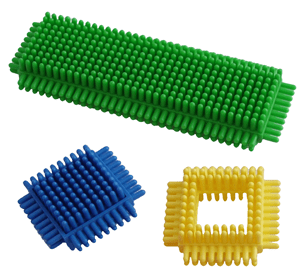
Stickle Bricks are a construction toy primarily intended for toddlers invented by Denys Fisher. The brand is owned by Hasbro and they are currently manufactured by Flair Leisure Products plc. An individual stickle brick is a colourful plastic shape a few centimeters long which has a brush of small plastic fingers on one or more edges. The fingers of adjacent stickle bricks can interlock, allowing them to be joined in various ways. Several companies manufacture similar toys, not all of them compatible. Names for these toys include Nopper, Bristle Blocks, Fun Bricks, Clipo, Krinkles and Thistle Blocks.
Posted in Games |
1 Comment »




 The Daily Omnivore