January 21, 2012

Soulwax, headed by David and Stephen Dewaele, are an alternative rock/electronic band from Ghent, Belgium. They were first noticed after the release of their album ‘Much Against Everyone’s Advice.’ But after that the Dewaeles started focusing on their other projects such as The Flying Dewaele Brothers and 2manydjs, but also hosting a show on Belgian television, ‘Alter8.’ Other than the Dewaele brothers, Soulwax also includes bassist Stefaan Van Leuven and drummer Steve Slingeneyer. The 2004 album ‘Any Minute Now’ spawned three singles in ‘E Talking,’ ‘NY Excuse,’ and the title track. ‘E Talking’s’ music video was controversial and restricted to post-watershed broadcast on music television channels (typically late at night). Set in London’s Fabric nightclub, everyone in the video is depicted as being on a different drug, from A-Z (including popular drug nicknames).
The duo has also produced a number of official and unofficial remixes, including ‘Daft Punk Is Playing At My House’ and ‘Get Innocuous!’ by LCD Soundsystem, ‘Robot Rock’ by Daft Punk and ‘DARE’ by Gorillaz. David and Stephen are friends of artists Tiga, LCD Soundsystem and Whomadewho. The only official compilation ‘As Heard on Radio Soulwax Pt. 2,’ was released in 2002 and is composed of 45 tracks the Dewaele brothers were able to clear the rights from. They originally requested rights for 187 tracks and got clearances for 114 of them. 62 were refused and 11 remained untraceable.
Posted in Art |
Leave a Comment »
January 17, 2012

Traffic waves, also called stop waves or traffic shocks, are travelling disturbances in the distribution of cars on a highway. Traffic waves usually travel backwards in relation to the motion of the cars themselves, or ‘upstream.’ The waves can also travel downstream, however, more commonly become ‘pinned’ to a single spot on the road, as a soliton (solitary wave). Traffic waves are a type of traffic jam. A deeper understanding of traffic waves is a goal of the physical study of traffic flow, in which traffic itself can often be seen using techniques similar to those used in fluid dynamics.
It has been said that by knowing how traffic waves are created, drivers can sometimes reduce their effects by increasing vehicle headways and reducing the use of brakes, ultimately alleviating traffic congestion for everyone in the area.
Posted in Science |
Leave a Comment »
January 16, 2012

Wakamaru is a Japanese domestic robot made by Mitsubishi Heavy Industries, primarily intended to provide companionship to elderly and disabled people. The robot is yellow, 1m tall, and weighs 30 kilograms. It has two arms and its flat, circular base has a diameter of 45 cm. The first hundred went on sale in 2005, for USD $14,000. Wakamaru runs a Linux operating system on multiple microprocessors.
It can connect to the Internet, and has limited speech (in both male and female voices) and speech recognition abilities. Functions include reminding the user to take medicine on time, and calling for help if it suspects something is wrong. Wakamaru was the childhood name of Minamoto no Yoshitsune, a 12th century Japanese general.
Posted in Health, Technology, World |
1 Comment »
January 16, 2012

Paro is a therapeutic robot baby harp seal, intended to be very cute and to have a calming effect on and elicit emotional responses in patients of hospitals and nursing homes, similar to Animal-Assisted Therapy. It was designed by Takanori Shibata of the Intelligent System Research Institute of Japan’s AIST beginning in 1993. It was first exhibited to the public in late 2001 and handmade versions have been sold commercially since 2004.
Paro is based on harp seals Shibata saw in Canada, where he also recorded their cries that Paro uses. The robot has tactile sensors and responds to petting by moving its tail and opening and closing its eyes. It also responds to sounds and can learn a name. It can show emotions such as surprise, happiness and anger. It produces sounds similar to a real baby seal and (unlike a real baby seal) is active during the day and goes to sleep at night.
Posted in Health, Technology, World |
Leave a Comment »
January 15, 2012

Major Lazer is a collaborative musical project from DJ/Producers Diplo and Switch. Made up of DJs Diplo and Switch, the two were introduced after working with M.I.A..
The duo’s first album ‘Guns Don’t Kill People… Lazers Do’ was released in 2009, on Downtown Records. It was recorded in Jamaica at Tuff Gong Studios. Vocalists such as Santigold, Vybz Kartel, Ward 21, Busy Signal, Nina Sky, Amanda Blank, Mr. Vegas, Turbulence, Mapei, T.O.K, Prince Zimboo, Leftside and others contribute guest vocals to the album, as well as additional production from Afrojack and Crookers.
Posted in Art |
Leave a Comment »
January 15, 2012

Kavinsky, real name Vincent Belorgey (b. 1977), is a French electro house artist, and has released three EPs on the Record Makers label: ‘Teddy Boy’ in 2006, ‘1986’ a year later, and ‘Nightcall’ in 2010. His work has been remixed by SebastiAn and others. In addition to his music career he has also appeared in several films including ‘Steak,’ directed by longtime friend Mr. Oizo. The SebastiAn remix of ‘Testarossa Autodrive’ off the ‘1986’ EP is featured in the video game ‘Grand Theft Auto IV.’
Kavinsky’s fellow producer Surkin once jokingly claimed in an interview that Kavinsky was his father. There has been a long running joke since. Kavinsky’s production style is very reminiscent of film soundtracks of the 1980s. He has also been compared to many similar French house artists including Daft Punk and Danger. Kavinsky’s single ‘Nightcall’ was featured in the opening credits of the film ‘Drive.’
Posted in Art |
Leave a Comment »
January 14, 2012

Larry Levan (1954 – 1992) was a DJ best known for his decade-long residency at the New York City night club Paradise Garage, which has been described as the prototype of the modern dance club. He developed a cult following who referred to his sets as ‘Saturday Mass.’ Influential US DJ François Kevorkian credits Levan with introducing the dub aesthetic into dance music. Along with Kevorkian, Levan experimented with drum machines and synthesizers in his productions and live sets, ushering in an electronic, post-disco sound that presaged the ascendence of house music.
Born, Lawrence Philpot, Levan was openly gay and got his start alongside DJ Frankie Knuckles at the Continental Baths, as a replacement for the DJ from The Gallery, Nicky Siano. Levan’s DJing style was influenced by Siano’s eclectic style, and by The Loft’s David Mancuso, who briefly dated Levan in the early 1970s. As Knuckles was still trying to make his way in the New York club scene, Levan became a popular attraction perhaps due to his ‘diva persona,’ which he developed in the city’s notoriously competitive black drag ‘houses.’
read more »
Posted in Art |
Leave a Comment »
January 11, 2012
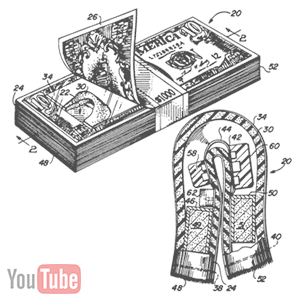
A dye pack is a radio-controlled incendiary device used by some banks to preemptively foil a bank robbery by causing stolen cash to be permanently marked with red dye shortly after a robbery. In most cases, a dye pack is placed in a hollowed-out space within a stack of banknotes, usually $10 or $20 bills. This stack of bills looks and feels similar to a real one, with new technology allowing for the manufacturing of flexible dye packs which are difficult to detect by handling the stack.
When the marked stack of bills is not used, it is stored next to a magnetic plate near a bank cashier, in standby or safe mode, ready to be handed over to a potential robber by a bank employee. When it is removed from the magnetic plate, the pack is armed, and once it leaves the building and passes through the door frame, a radio transmitter located at the door will trigger a timer (typically 10 seconds), after which the dye pack will explode and release an aerosol (sometimes tear gas, but usually of Disperse Red 9, a dye used in smoke grenades) intended to permanently stain and destroy the stolen money and mark the robber’s body with a bright red color. The chemical reaction causing the explosion of the pack and the release of the dye creates high temperatures of about 400 degrees Fahrenheit which further discourages a criminal from touching the pack or removing it from the bag or getaway vehicle.
Posted in Money, Politics, Technology |
Leave a Comment »
January 11, 2012

The New York Pizza Connection, or Pizza Principle, is a humorous but generally historically accurate ‘economic law’ proposed by native New Yorker Eric M. Bram. He noted in 1980 that from the early 1960s the price of a slice of pizza ‘matched, with uncanny precision, the cost of a New York City Subway ride.’ The term ‘Pizza Connection’ referring to this phenomenon was coined in early 2002 by ‘New York Times’ columnist Clyde Haberman. He predicted the cost of a slice of pizza would increase by as high as two dollars in midtown Manhattan.
In 2003 ‘The New Yorker’ magazine proclaimed the validity of the Pizza Connection (which they renamed the pizza principle) in accurately predicting the rise of the subway fare to $2.00 the week before. They also quoted Mr. Bram (by then a patent attorney) as warning that since the New York City Transit Authority had announced the discontinuation of the subway token itself in favor of the variable-fare cost MetroCard, the direct correlation between the cost of an off-the-street slice of cheese pizza and the cost of a subway token might not continue to hold. However, in 2005, and again in 2007, Haberman noted the price of a slice was again rising, and, citing the Pizza Connection, worried that the subway fare might soon rise again. The fare did indeed rise to $2.25 in 2009 and again in 2011 to $2.50.
Posted in Food, Humor, Money |
Leave a Comment »
January 4, 2012

Fatima Al Qadiri (b. 1981) is music producer born in Senegal and raised in Kuwait during the Gulf War, who now resides in Brooklyn.
She previously released an EP under the name Ayshay, featuring spectral chanting of traditional Islamic songs in Arabic.
Posted in Art |
Leave a Comment »
January 2, 2012

‘I Can’t Go for That (No Can Do)‘ is a 1981 song recorded by Daryl Hall and John Oates. It was the fourth number-one hit single of their career and second hit single from their album ‘Private Eyes.’ It features Charles DeChant on saxello. Daryl Hall sketched out the basic song one evening at a music studio in New York City in 1981 after a recording session for the ‘Private Eyes’ album. Hall began to play a bass line on a Korg organ, and sound engineer Neil Kernon recorded the result. Hall then came up with a guitar riff, which he and Oates worked on together. The next day, Hall and Sara Allen worked on the lyrics.
Thanks to heavy airplay on urban contemporary radio stations, it topped the U.S. R&B chart, a rare feat for a non-African American act. According to the Hall and Oates biography, Hall, upon learning that it had gone to number one wrote in his diary, ‘I’m the head soul brother in the U.S. Where to now?’ Also according to Hall, during the recording of ‘We Are the World,’ Jackson approached him and admitted to lifting the bass line for ‘Billie Jean’ from ‘I Can’t Go For That (No Can Do).’ Hall says that he told Jackson that he had lifted the bass line from another song himself, and that it was ‘something we all do.’
Posted in Art |
Leave a Comment »
January 1, 2012

The Singing Ringing Tree is a wind powered sound sculpture resembling a tree set in the landscape of the Pennine mountain range overlooking Burnley, in Lancashire, England. Completed in 2006, it is part of the series of four sculptures within the Panopticons arts and regeneration project created by the East Lancashire Environmental Arts Network (ELEAN). The project was set up to erect a series of 21st-century landmarks, or Panopticons (structures providing a comprehensive view), across East Lancashire as symbols of the renaissance of the area.
Designed by architects Mike Tonkin and Anna Liu of Tonkin Liu, the Singing Ringing Tree is a 3 meter tall construction comprising pipes of galvanised steel which harness the energy of the wind to produce a slightly discordant and penetrating choral sound covering a range of several octaves. Some of the pipes are primarily structural and aesthetic elements, while others have been cut across their width enabling the sound. The harmonic and singing qualities of the tree were produced by tuning the pipes according to their length by adding holes to the underside of each.
Posted in Art, World |
Leave a Comment »


 The Daily Omnivore