July 30, 2011
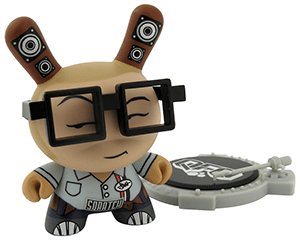
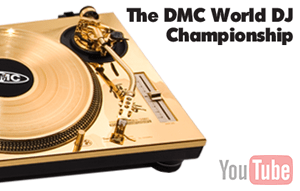
Turntablism is the art of manipulating sounds and creating music using phonograph turntables and a DJ mixer. The word ‘turntablist’ was coined in 1995 by DJ Babu to describe the difference between a DJ who just plays records, and one who performs by touching and moving the records, stylus and mixer to manipulate sound. The new term co-occurred with a resurgence of the art of hip hop style DJing in the 1990s.
Composer John Oswald described the art: ‘A phonograph in the hands of a ‘hiphop/scratch’ artist who plays a record like an electronic washboard with a phonographic needle as a plectrum, produces sounds which are unique and not reproduced — the record player becomes a musical instrument.’
read more »
Posted in Art, Games, Technology |
Leave a Comment »
July 29, 2011
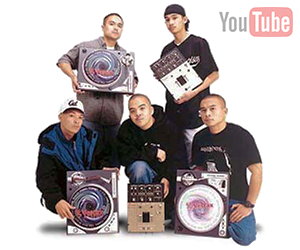

The Invisibl Skratch Piklz were a group of Filipino American turntablists. The members of the group were originally hip-hop DJs, who were among the pioneers of the turntablism movement in the 1990s; turntablists create musical pieces by mixing samples from records, by using multiple turntables as instruments.
The group started in 1989 as Shadow of the Prophet, with DJ Q-bert, Mix Master Mike, and DJ Apollo, who left the group in 1993.
read more »
Posted in Art, Games, Technology |
Leave a Comment »
July 29, 2011

Grace Jones (b. 1948) is a Jamaican-American singer, model and actress. She secured a record deal with Island Records in 1977, which resulted in a string of dance-club hits. In the late 1970s, she adapted the emerging electronic music style and adopted a severe, androgynous look with square-cut hair and angular, padded clothes. Jones is a contralto, the deepest female classical singing voice. Although her image became equally as notable as her voice, she is a highly stylized vocalist. She sings in two modes: in her monotone speak-sing as in songs such as and in an almost-soprano mode in songs such as ‘La Vie en rose’ and ‘Slave to the Rhythm.’ Her voice spans two and a half octaves.
In 1981, her ‘Pull Up to the Bumper’ became a Top 5 single on the US R&B chart. Jones is also an actress. Her acting occasionally overshadowed her musical output in America; but not in Europe, where her profile as a recording artist was much higher. She appeared in some low-budget films in the 1970s and early 1980s. Her work as an actress in mainstream film began in the 1984 fantasy-action film ‘Conan the Destroyer’ alongside Arnold Schwarzenegger, and the 1985 James Bond movie ‘A View to a Kill.’
read more »
Posted in Art, World |
Leave a Comment »
July 29, 2011


The Melbourne Shuffle (also known as Rocking ) is a rave and club dance that originated in the late 1980s in the underground rave music scene in Melbourne, Australia. The basic movements in the dance are a fast heel-and-toe action with a style suitable for various types of electronic music. Some variants incorporate arm movements. People who dance the shuffle are often referred to as rockers, due in part to the popularity of shuffling to rock music in the early 1990s.
In the late ’80s, the Melbourne Shuffle began to emerge as a distinct dance, incorporating more hand movement than its predecessor, Stomping, which in turn originated from Celtic and Malaysian folk dances. The clog and sword dance can easily be matched to some earlier experimental rave and club dance moves that evolved into Stomping.
read more »
Posted in Art, Games, World |
Leave a Comment »
July 29, 2011


Berry Gordy, Jr. (b. 1929) is an American record producer, and the founder of the Motown record label, which played an important role in the racial integration of popular music. Motown achieved a crossover success. In the 1960s, Motown and its soul-based subsidiaries were the most successful proponents of what came to be known as The Motown Sound, a style of soul music with a distinct pop influence.
The Motown Sound typically used tambourines to accent the back beat, prominent and often melodic electric bass-guitar lines, distinctive melodic and chord structures, and a call-and-response singing style that originated in gospel music. Pop production techniques such as the use of orchestral string sections, charted horn sections, and carefully arranged background vocals were also used. Complex arrangements and elaborate, melismatic vocal riffs were avoided. Motown producers believed steadfastly in the ‘KISS principle’ (keep it simple, stupid).
read more »
Posted in Art, Money |
Leave a Comment »
July 26, 2011


Dub is a genre of music which grew out of 1960’s reggae. Music in this genre consists predominantly of instrumental remixes of existing recordings which have been manipulated and reshaped, usually by removing the vocals, and emphasizing the drum and bass elements (this stripped down track is sometimes referred to as a ‘riddim’). Other techniques include dynamically adding extensive echo, reverb, panoramic delay, and occasional dubbing of vocal or instrumental snippets from the original version or other works. Dub also sometimes features electronically generated sound effects, or the use of distinctive instruments such as the melodica by artists such as Augustus Pablo.
Dub was pioneered by Osbourne ‘King Tubby’ Ruddock, Lee ‘Scratch’ Perry, Errol Thompson and others in the late 1960s. Similar experiments with recordings at the mixing desk outside of the dancehall environment were also done by producers Clive Chin and Herman Chin Loy. These producers, especially Ruddock and Perry, looked upon the mixing desk as an instrument, manipulating tracks to come up with something new and different. Dub has influenced many genres of music, including punk, hip hop, disco, house, and trip hop, and has become a basis for jungle/drum’n’bass and dubstep music.
read more »
Posted in Art, Language, World |
Leave a Comment »
July 26, 2011

A dubplate is an acetate disc — usually 12, 10, or 7 inches in diameter — used in mastering studios for quality control and test recordings before proceeding with the final master, and subsequent pressing of the record to be mass-produced on vinyl. The ‘dub’ in dubplate is an allusion to the plate’s use in ‘dubbing’ or ‘doubling’ the original version of a track. In music, dubbing is copying of audio recordings from one medium to another.
The name dubplate also refers to an exclusive, ‘one-off’ disc recording pioneered by reggae sound systems but also used by drum and bass and other dance music artists, DJs and sound systems. These dubplates will often be unreleased recordings (which may or may not end up being made available to the general public). They are often used as a market research tool to assess the probable sales of a song once it’s released, as they are far cheaper to produce than a pressed vinyl record. However, because they have a limited life-span they can only be used about fifty times.
Posted in Art, Language, Technology |
Leave a Comment »
July 26, 2011

Biophilia is the musical project and forthcoming eighth full-length studio album from Icelandic singer Björk. The album is ‘partly recorded’ on an iPad and will be released in the form of a series of apps. Biophilia will be the world’s ‘first app album’ in collaboration with Apple. Björk has described the project as a multimedia collection ‘encompassing music, apps, internet, installations, and live shows.’ Scott Snibbe, an interactive artist was commissioned by Björk in the summer of 2010 to produce the app, as well as the images for the live shows (which will combine his visuals with National Geographic imagery, mixed live from iPads on the stage).
For the song, ‘Virus,’ the app will feature a close-up study of cells being attacked by a virus to represent what Snibbe calls: ‘A kind of a love story between a virus and a cell. And of course the virus loves the cell so much that it destroys it.’ The interactive game challenges the user to halt the attack of the virus, although the result is that the song will stop if the player succeeds. In order to hear the rest of the song, the players will have to let the virus take its course. Using some artistic license, the cells will also mouth along to the chorus. Björk is determined to fuse different elements together, be it juxtaposing a female choir from Greenland with the bleeps and glitches of electronic music pioneers Matmos during the Vespertine tour, or meshing soaring strings and jagged beats on ‘Homogenic,’ that ‘helps explain the power and success of Björk’s collaborations.’
Posted in Art, Games, Technology |
Leave a Comment »
July 25, 2011

Wave Twisters (2001) is an animated film, also known as the first turntablism-based musical. It is based on DJ Q-Bert’s album of the same name. The film is entirely scripted to match the DJ Q-Bert recording. As such, it can seem a little disjointed at times. It was produced digitally using Adobe After Effects and a relatively small team of animators. Buckethead makes a short appearance in the film as well, near the beginning.
A crew of heroes is determined to save the lost arts of Hip Hop. Break Dancing, Graffiti, MCing, and DJing from total extinction. The lost arts are being oppressed throughout inner-space by lord Ook and his evil minions the Chinheads. The dental commander Dr. Julio Azul DDS, assumed to be secretary Honey Drips, Dental Hygienist/Robot Rubbish, and Grandpa have a series of adventures, synced to the music. Armed with the ancient relic known as the Wave Twister (a small turntable/wristwatch, the only weapon powerful enough to defeat their enemies), they travel to the far ends of inner-space for a final confrontation with the sinister army of oppressors. The film ends with the team teaching the liberated the lost fundamentals of hip hop.
Posted in Art, Humor, Technology |
Leave a Comment »
July 24, 2011

God Helmet refers to an experimental apparatus used in neuroscience, primarily in the field of neurotheology (the study of correlations of neural phenomena with subjective experiences of spirituality). Originally called the ‘Koren helmet’ after its inventor Stanley Koren, it was conceived to study creativity and the effects of subtle stimulation of the temporal lobes. Reports by participants of a ‘sensed presence’ brought public attention to the device. The apparatus, placed on the head of an experimental subject, generates weak fluctuating (i.e. ‘complex’) magnetic fields. These fields are approximately as strong as those generated by a land line telephone handset or an ordinary hair dryer, but far weaker than that of an ordinary fridge magnet.
Michael Persinger, a Canadian neuroscientist, has published extensively about the effects on the human brain of the ‘complex’ magnetic fields generated by the God helmet and similar devices. Many subjects have reported ‘mystical experiences and altered states’ while wearing the God Helmet.
read more »
Posted in Health, Philosophy, Technology |
1 Comment »
July 24, 2011
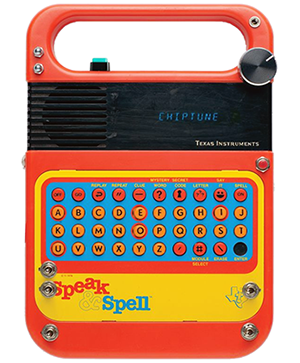
Circuit bending is the creative customization of the circuits within electronic devices such as low voltage, battery-powered guitar effects, children’s toys, and small digital synthesizers to create new musical or visual instruments and sound generators.
Emphasizing spontaneity and randomness, the techniques of circuit bending have been commonly associated with noise music, though many more conventional contemporary musicians and musical groups have been known to experiment with ‘bent’ instruments. Circuit bending usually involves dismantling the machine and adding components such as switches and potentiometers (control knobs) that alter the circuit.
read more »
Posted in Art, Games, Technology |
Leave a Comment »
July 23, 2011

Kid Carpet, real name Ed Patrick, is a musician from Bristol, England. His music has been described as ‘kiddy disco punk’ and ‘shit-hop,’ as it is recorded in his home studio using instruments such as samplers, Casio keyboards, and various children’s toys including plastic Fisher-Price guitars and Tamagotchi innards.
Posted in Art, Humor, Technology |
Leave a Comment »


 The Daily Omnivore