April 7, 2011

A wave-disk engine is an innovative internal combustion engine design being worked on by teams at Michigan State University and Warsaw Institute of Technology led by Norbert Müller. The first prototype was demonstrated in March 2011. The wave-disk engine has no valves, pistons or gear trains but utilizes a rotating disk to produce shock waves that compress an air fuel mixture. As the burning mixture expands it pushes against curved blades set into the rotor disk causing it to spin. The turning of the disk itself opens and closes inlet and outlet ports at appropriate times to introduce the air/fuel mixture and exhaust the combustion products.
It potentially shows savings in weight and better energy efficincy compared to normal internal combustion engine designs. Combustion engines are not very efficient, turning only 15% to 20% of the gasoline into propulsion. The rest of the energy in the gasoline is lost as waste heat. Wave disk engines promises to be 3.5x more efficient, 20% lighter, 30% cheaper to manufacture, and reduce emissions by 90 percent.
Posted in Money, Technology |
Leave a Comment »
April 7, 2011
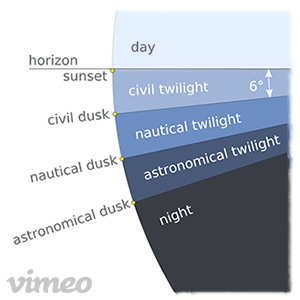
The Belt of Venus or Venus’s Girdle is the Victorian-era name for an atmospheric phenomenon seen at sunrise and sunset. Shortly after sunset or shortly before sunrise, the observer is, or is very nearly, surrounded by a pinkish glow or antitwilight arch that extends roughly 10°–20° above the horizon.
Often, the glow is separated from the horizon by a dark layer, the Earth’s shadow or ‘dark segment.’ The Arch’s light rose (pink) color is due to backscattering of reddened light from the rising or setting Sun. A very similar effect can be seen during a total solar eclipse.
Posted in Language, Science |
Leave a Comment »
April 7, 2011

The blue hour comes from the French expression l’heure bleue, which refers to the period of twilight each morning and evening where there is neither full daylight nor complete darkness. The time is considered special because of the quality of the light at this time of day. The phrase is also used to refer to Paris immediately prior to World War I, which was considered to be a time of relative innocence.
In English culture the term was used to describe the period of inactivity and uselessness a drinker encounters when Pubs and other licensed premises have closed after the lunch-time session (typically 15:30 hrs) and will not open for the evening session until (typically 18:30 hrs).
Posted in Art, Drugs, Language |
Leave a Comment »
April 7, 2011
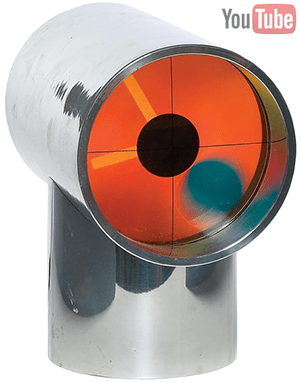
The Aurora Clock has been in production for over 40 years. There are continuously changing colors and surprising color ‘shifts’ when the secondhand disk overlaps the minute & hour hands, and the colors change depending on your viewing angle. The color changes have to do with polarized light and a phenomenon called bi-refractance. Vectors of light are being rotated as they pass through each material which is very different from color filtering.
The first Aurora clocks were made by Rathcon and called the Spectrum. Then they were manufactured by Kirsch-Hamilton. Next, in the late 80’s, Hampton Haddon had a version made in Japan, but abandoned the clock around 1991. In 1993 we at ChronoArt started manufacturing Luminas (a different polarized light clock) and then a year later started also manufacturing new Auroras.
Posted in Art, Technology |
Leave a Comment »
April 7, 2011
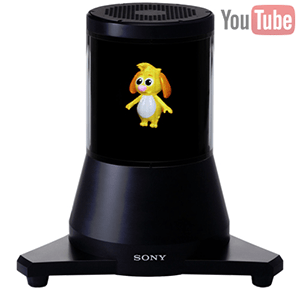
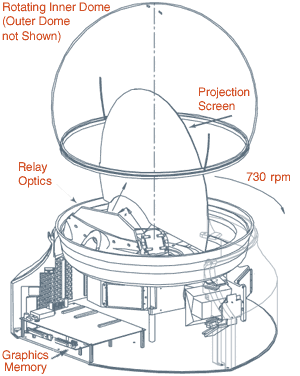
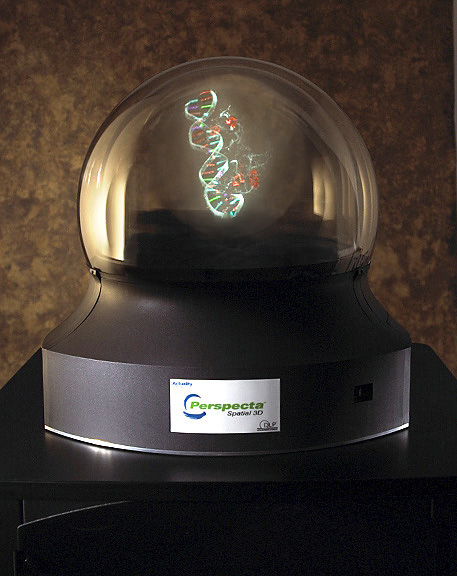
A volumetric [vol-yuh-me-trik] display is a device that forms a visual representation of an object in three physical dimensions, as opposed to the planar image of traditional screens that simulate depth through a number of different visual effects. One definition offered by pioneers in the field is that volumetric displays create 3-D imagery via the emission, scattering, or relaying of illumination from well-defined regions in (x,y,z) space. Though there is no consensus among researchers in the field, it may be reasonable to admit holographic and highly multiview displays to the volumetric display family if they do a reasonable job of projecting a three-dimensional light field within a volume.
Although first postulated in 1912, and a staple of science fiction, volumetric displays are still under development, and have yet to reach the general population. With a variety of systems proposed and in use in small quantities — mostly in academia and various research labs — volumetric displays remain accessible only to academics, corporations, and the military.
Posted in Money, Technology |
Leave a Comment »
April 6, 2011

Laurence Tureau, known as Mr. T (b. 1951), is an American actor known for his roles as B. A. Baracus in the 1980s television series The A-Team, as boxer Clubber Lang in the 1982 film Rocky III.
Mr. T is known for his trademark African Mandinka warrior hairstyle, his gold jewelry, and his tough-guy image. In 2006 he starred in the reality show ‘I Pity the Fool,’ shown on TV Land, the title of which comes from his catchphrase from the film Rocky III.
read more »
Posted in Art, Money |
Leave a Comment »
April 5, 2011

Byron ‘Buster’ Bluth is a fictional character on the US sitcom, ‘Arrested Development.’ He is the youngest son of George Sr. and Lucille, though it is later revealed that his biological father is actually George Sr.’s identical twin brother Oscar (the two share obvious personality traits and a mutual habit for awkwardly giving people shoulder massages). Buster is portrayed by Tony Hale.
Buster is a professional student, having completed coursework in cartography, Native American tribal ceremonies, 18th century agrarian business principles, and archaeology. Archival footage indicates his participation in various university medical studies, such as sleep deprivation studies. As the baby of the family, he idolizes his brothers Gob and Michael.
read more »
Posted in Art, Humor |
Leave a Comment »
April 5, 2011


Neurosis [noo-roh-sis] is a class of functional mental disorders involving distress but neither delusions nor hallucinations, whereby behavior is not outside socially acceptable norms. Those suffering from it are said to be neurotic. The term essentially describes an ‘invisible injury’ and the resulting condition. The American Diagnostic and Statistical Manual of Mental Disorders (DSM) has eliminated the category of ‘Neurosis,’ reflecting a decision by the editors to provide descriptions of behavior as opposed to hidden psychological mechanisms as diagnostic criteria.
Neurosis should not be mistaken for psychosis, which refers to loss of touch with reality, or neuroticism, a fundamental personality trait characterized by an enduring tendency to experience negative emotional states.
read more »
Posted in Health, Language, Science |
Leave a Comment »
April 4, 2011

Neuroplasticity [noor-oh-pla-stis-i-tee] refers to the ability of the brain to change as a result of one’s experience, that the brain is ‘plastic’ and ‘malleable.’ The discovery of this feature of the brain is rather modern; the previous belief amongst scientists was that the brain does not change after the critical period of infancy.
Substantial changes occur in the lowest neocortical processing areas, changes that can profoundly alter the pattern of neuronal activation in response to experience. According to the theory of neuroplasticity, experience can actually change both the brain’s physical structure (anatomy) and functional organization (physiology) from top to bottom.
Posted in Health, Science |
Leave a Comment »
April 4, 2011


Gorillaz is a musical project created in 1998 by Damon Albarn of Blur and Jamie Hewlett, co-creator of ‘Tank Girl.’ The Gorillaz have an extensive fictional universe depicting a ‘virtual band’ of cartoon characters composed of four animated members: 2D (lead vocalist, keyboard), Murdoc Niccals (bass guitar), Noodle (guitar, keyboard, and occasional vocals) and Russel Hobbs (drums and percussion). The music is a collaboration between various musicians, Albarn being the only permanent contributor.
Their style is a composition of multiple musical genres, with a large number of influences including: dub, hip hop, alternative rock, electronic and pop music. The trio of musicians behind Gorillaz’ first incarnation included Damon Albarn, Del the Funkee Homosapien, and Dan the Automator, who had previously worked together on the track ‘Time Keeps on Slipping’ for Deltron 3030’s eponymous debut album. The song can be seen as the genesis of the musical style that continued into Gorillaz’ first album.
Posted in Art, Humor, Money |
Leave a Comment »
April 4, 2011

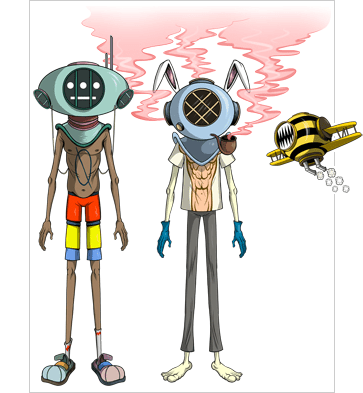
Deltron 3030 is an alternative hip hop supergroup composed of producer Dan the Automator, rapper Del tha Funkee Homosapien and DJ Kid Koala. Their work features many other artists as well, all taking on various futuristic pseudonyms. The group’s debut album Deltron 3030, released in 2000, is a concept album set in the year 3030 that tells of the fight by Deltron Zero (Del’s alter ego) against huge corporations that rule the universe.
The lyrics were written in less than two weeks and are characterized by extravagant allusions to futuristic outer-space themes in the tradition of Afrofuturist works by Sun Ra and George Clinton. Many samples originated with the contemporary French classical composer William Sheller. Del tha Funkee Homosapien’s lyrics veer from serious social commentary to humor to epic sci-fi battles, while producer Dan the Automator creates an eerie and dense atmosphere. Following the release of the album, all three members worked on the Gorillaz’ self-titled debut album. Deltron 3030’s second album will be titled Deltron Event II. Production began in 2006 and is still in progress.
Posted in Art, Money, Technology |
Leave a Comment »
April 4, 2011

Deltron 3030 is the debut album by hip hop supergroup Deltron 3030. Released in 2000, it is a rap opera concept album set in a dystopian year 3030.
The album follows Deltron Zero’s fight against an oppressive government and powerful corporations, while also battling to be the Galactic Rhyme Federation Champion. Del tha Funkee Homosapien’s lyrics veer from serious social commentary to humor to epic sci-fi battles, while producer Dan the Automator creates an eerie and dense atmosphere.
Posted in Art, Money, Technology |
Leave a Comment »



 The Daily Omnivore