March 12, 2014

Surgeon Simulator 2013, a humorous medical sim, was initially created in a 48-hour period for the 2013 ‘Global Game Jam’ (the four developers spent an additional 48 days building the commercial version). The game is played in first-person perspective. A mouse is used to control the surgeon’s hand (holding the right button rotates the hand; the left button grabs items). Gameplay consists of various surgical procedures, for example a heart transplant. Extra modes are available after completion of the early operations, such as performing an operation in a moving ambulance with surgical instruments bouncing around at random, and operating in outer space where instruments float.
Reception for the game has been positive, with critics stating that although the game was hard to control, this difficulty was ‘part of the appeal.’ Ars Technica commented upon the narrator’s voice over, saying that it ‘belies the ridiculousness that unfolds as he flops and flails his way through surgery.’ ‘Rock, Paper, Shotgun, praised the game’s humor and fun, and said ”Surgeon Simulator 2013′ is not a brilliant game. But it is a brilliant joke. In the form of a game. It’s an idea that is a clean magnitude of awesome above 90% of what will be released this year because it is so absurd.’
Posted in Games, Health, Humor |
Leave a Comment »
March 6, 2014

Beyond the Black Rainbow is a 2010 Canadian science fiction film written and directed by Panos Cosmatos in his feature film debut. The films begins in the 1960s, as Dr. Arboria founds the Arboria Institute, a New Age research facility dedicated to finding a reconciliation between science and spirituality, allowing human beings to move into a new age of perpetual happiness.
In the 1980s, Arboria’s work has been taken over by his protégé, Dr. Barry Nyle. Outwardly a charming, handsome scientist, Nyle is in fact a psychopath who has been keeping Elena, a teenage girl, captive in an elaborate prison/hospital beneath the Institute. Elena demonstrates psychic capabilities, which Nyle can suppress, using a glowing, prism-like device.
read more »
Posted in Art, Drugs, Philosophy |
Leave a Comment »
March 4, 2014

Psychoactive toads are amphibians from which psychoactive substances from the family of bufotoxins can be derived. The skin and poison of Bufo alvarius (Colorado River toad or Sonoran Desert toad) contain 5-MeO-DMT and bufotenin, which both belong to the family of hallucinogenic tryptamines. The skin or poison of the toads may produce psychoactive effects when ingested. To obtain the psychoactive substances the toxin of psychoactive toads is commonly milked from their poison glands. The milking procedure does not harm the toad — it consists of stroking the animal under its chin to initiate the defensive poison response.
Once the liquid toxin has been collected and dried, it can be used for its psychedelic effects. The toad takes about a month to refill its poison glands. Rumors dating from the 1970s claimed that groups of hippies, some including teenagers, were licking the psychoactive toads to get high. Albert Most, founder of the Church of the Toad of Light and a proponent of recreational use of Bufo alvarius poison, published a booklet titled ‘Bufo alvarius: The Psychedelic Toad of the Sonoran Desert’ in 1983 which explained how to extract and smoke the secretions.
Posted in Drugs, Science |
1 Comment »
March 1, 2014


Carbon fiber is a material consisting of long thing fibers about 5–10 μm in diameter (about half the width of a human hair) and composed mostly of carbon atoms. When used in a composite material it has the highest compressive strength of any reinforcing material, and it has a high strength to weight ratio and low coefficient of thermal expansion. The density of carbon fiber is also much lower than the density of steel.
Carbon fiber reinforced polymer (carbon fiber combined with a plastic resin and wound or molded) is very strong, but extremely rigid and somewhat brittle. However, carbon fibers are also composed with other materials, such as with graphite to form carbon-carbon composites, which have a very high heat tolerance.
read more »
Posted in Science, Technology |
Leave a Comment »
February 28, 2014

A comic strip is a sequence of drawings arranged in interrelated panels to display brief humor or form a narrative, often serialized, with text in balloons and captions. Throughout the 20th century and into the 21st, these were published in newspapers, with horizontal strips printed in black-and-white in daily newspapers, while Sunday newspapers offered longer sequences in special color comics sections.
Strips are written and drawn by a comics artist or cartoonist. As the name implies, comic strips can be humorous (for example, ‘gag-a-day’ strips such as ‘Blondie’ or ‘Marmaduke’). Starting in the late 1920s, comic strips expanded from their mirthful origins to feature adventure stories, as seen in ‘Popeye,’ ‘Captain Easy,’ ‘Buck Rogers,’ ‘Tarzan,’ and ‘The Adventures of Tintin.’ Soap-opera continuity strips such as ‘Judge Parker’ and ‘Mary Worth’ gained popularity in the 1940s. All are called, generically, comic strips, though cartoonist Will Eisner has suggested that ‘sequential art’ would be a better name.
read more »
Posted in Art |
Leave a Comment »
February 26, 2014

The Discreet Charm of the Bourgeoisie (‘Le Charme discret de la bourgeoisie’) is a 1972 surrealist film directed by Luis Buñuel and written by Jean-Claude Carrière in collaboration with the director. The narrative concerns a group of upper-middle-class people attempting — despite continual interruptions — to dine together.
The film consists of several thematically linked scenes: five gatherings of a group of bourgeois friends, and the four dreams of different characters. The beginning of the film focuses on the gatherings, while the latter part focuses on the dreams, but both types of scenes are intertwined. There are also scenes involving other characters, such as two involving a Latin American female terrorist from the fictitious Republic of Miranda. The film’s world is not logical: the bizarre events are accepted by the characters, even if they are impossible or contradictory.
read more »
Posted in Art, Money, World |
Leave a Comment »
February 26, 2014

The Jerky Boys is an American comedy act from Queens, New York, whose routine consists of prank telephone calls and other related skits. The act was started in 1989 by childhood friends Johnny Brennan and Kamal Ahmed (who left in 2000).
The calls were made by ringing up unsuspecting recipients, or in response to classified advertisements placed in local New York-based newspapers. Each call was made in character, usually with over the top voices influenced by the duo’s family members.
read more »
Posted in Humor |
1 Comment »
February 26, 2014

The Tube Bar prank calls are a series of prank calls made in the mid-1970s to the Tube Bar in Jersey City, in which pranksters would ask the proprietor of the bar if they could speak to a fictitiously named customer. The fictitious names given by the pranksters were pun-like/homophones for other—oftentimes more offensive—phrases. Recordings of the calls were circulated widely on duped cassette tapes and may have been the inspiration for a running gag in ‘The Simpsons.’
John Elmo and Jim Davidson, later known collectively as ‘Bum Bar Bastards,’ would call the Tube Bar, operated by heavyweight boxer Louis ‘Red’ Deutsch, asking for customers such as ‘Pepe Roni’ (pepperoni), ‘Hal Ja-Like-a-Kick’ (how’d you like a kick), ‘Phil My-Pockets’ (fill my pockets), ‘Al Coholic’ (alcoholic), and ‘Mike Hunt’ (my cunt). Most of the time, Deutsch would call out the names.
read more »
Posted in Humor, Language |
Leave a Comment »
February 25, 2014

Robert H. Lustig is an American pediatric endocrinologist at the University of California, San Francisco (UCSF) where he is a Professor of Clinical Pediatrics. He practices in the field of neuroendocrinology, with an emphasis on the regulation of energy balance by the central nervous system. He also has a special interest in childhood obesity.
Lustig came to public attention through his efforts to establish that fructose can have serious deleterious effects on human (especially children’s) health if consumed excessively. In 2009, he delivered a lecture called ‘Sugar: The Bitter Truth’ that spread virally on YouTube, in which he calls fructose a ‘poison’ and equates its metabolic effects with those of ethanol.
read more »
Posted in Food, Health |
Leave a Comment »
February 19, 2014
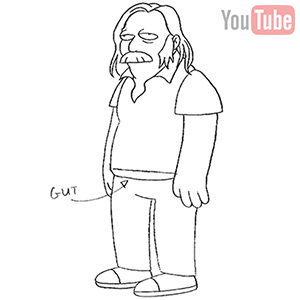
John Swartzwelder (b. 1950) is an American comedy writer and novelist, best known for his work on the animated television series ‘The Simpsons,’ as well as a number of novels. He is credited with writing the largest number of ‘Simpsons’ episodes by a large margin (59 full episodes, with contributions to several others). Swartzwelder was one of several writers recruited to show from the pages of George Meyer’s ‘Army Man’ magazine (a short-lived comedy periodical published in the late 1980s; Meyer would also go on to become an acclaimed ‘Simpsons’ writer).
Swartzwelder has been animated in the background of several episodes of ‘The Simpsons.’ His animated likeness closely resembles musician David Crosby, which prompted Matt Groening to state that anytime that David Crosby appears in a scene for no apparent reason, it is really John Swartzwelder. Additionally, Matt Groening has stated that the recurring character ‘Herman Hermann’ (the owner of Herman’s Military Antiques) was originally physically based on Swartzwelder–with the exception of his one arm.
read more »
Posted in Art, Humor, Language |
Leave a Comment »
February 15, 2014

A holodeck, in the fictional ‘Star Trek’ universe, is a simulated reality facility located on starships and starbases. It first appeared in the pilot episode of ‘Star Trek: The Next Generation,’ ‘Encounter at Farpoint,’ although a conceptually similar ‘recreation room’ appeared in an episode of ‘Star Trek: the Animated Series’ in 1974. In the timeline of the fictional universe, the concept of a holodeck was first shown to humans in an encounter with the Xyrillian race in the ‘Star Trek: Enterprise’ episode ‘Unexpected.’
The holodeck is depicted as an enclosed room in which objects and people are simulated by a combination of transported matter, replicated matter, tractor beams, and shaped force fields onto which holographic images are projected. Most holodeck programs shown in the episodes run in first person ‘subjective mode,’ in which the user actively interacts with the program and its characters. The user may also employ third-person ‘objective mode,’ in which he or she is unseen by program characters.
read more »
Posted in Art, Technology |
1 Comment »
February 7, 2014

In psychology, sublimation [suhb-luh-mey-shuhn] is a mature type of defense mechanism where socially unacceptable impulses or idealizations are consciously transformed into socially acceptable actions or behavior, possibly resulting in a long-term conversion of the initial impulse. Sigmund Freud believed that sublimation was a sign of maturity (indeed, of civilization), allowing people to function normally in culturally acceptable ways.
He defined sublimation as the process of deflecting sexual instincts into acts of higher social valuation, being ‘an especially conspicuous feature of cultural development; it is what makes it possible for higher psychical activities, scientific, artistic or ideological, to play such an important part in civilised life.’ Sublimation is when displacement ‘serves a higher cultural or socially useful purpose, as in the creation of art or inventions.’ Psychoanalysts often refer to it as the only truly successful defense mechanism.
read more »
Posted in Health, Philosophy, Sex |
1 Comment »


 The Daily Omnivore