
Travis Rice (b. 1982) is a professional snowboarder who grew up and currently resides by Jackson Hole Mountain Resort. He is known for being the ‘Paul Revere’ of the big mountain freestyle movement.
Everything is Interesting
Travis Rice (b. 1982) is a professional snowboarder who grew up and currently resides by Jackson Hole Mountain Resort. He is known for being the ‘Paul Revere’ of the big mountain freestyle movement.
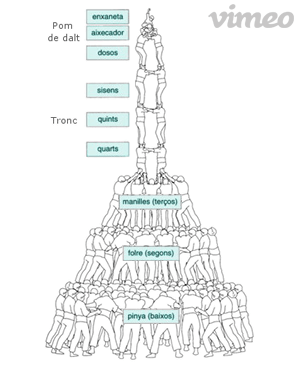
A castell is a human tower built traditionally in festivals at many locations within Catalonia, Spain. At these festivals, several ‘colles castelleres’ or teams often succeed in building and dismantling a tower’s structure.
The tradition of building castells originated in Valls, near the city of Tarragona, in the southern part of Catalonia towards the end of the 18th century. Later it developed a following in other regions of Catalonia and, since 1981, when the first castell of 9 levels of the 20th century was built.

The Octopus Project is an American indietronica band based in Austin, Texas, active since 1999. Its unique sound, blending pop and experimental elements, is a combination of digital and electronic sounds and noises (including drum machine, keyboard, synthesizers and other devices) and analog equipment (including guitars and live drums). Its music is mostly instrumental.

Alphaville: Une étrange aventure de Lemmy Caution (Alphaville: A Strange Adventure of Lemmy Caution) is a 1965 black-and-white French science fiction film directed by Jean-Luc Godard. It combines the genres of dystopian science fiction and film noir (stylish Hollywood crime dramas, particularly those that emphasize cynical attitudes and sexual motivations). Although set far in the future on another planet, there are no special effects or elaborate sets; instead, the film was shot in real locations in Paris, the night-time streets of the capital becoming the streets of Alphaville, while modernist glass and concrete buildings represent the city’s interiors.
Expatriate American actor Eddie Constantine plays Lemmy Caution, a trenchcoat-wearing secret agent. Constantine had already played this or similar roles in dozens of previous films; the character was originally created by British pulp novelist Peter Cheyney. However, in Alphaville, director Jean-Luc Godard moves Caution away from his usual twentieth century setting, and places him in a futuristic sci-fi dystopia, the technocratic dictatorship of Alphaville.

Jean-Luc Godard (b. 1930) is a French-Swiss filmmaker. He is often identified with the group of filmmakers known as the Nouvelle Vague, or ‘French New Wave.’ Many of his films challenge the conventions of traditional Hollywood cinema as well as the French equivalent. He is often considered the most extreme or radical of the New Wave filmmakers. His films express his political ideologies as well as his knowledge of film history. In addition, Godard’s films often cite existentialism as he was an avid reader of existential and Marxist philosophy.
His radical approach in movie conventions, politics and philosophies made him the most influential filmmaker of the French New Wave, inspiring directors as diverse as Quentin Tarantino, Martin Scorsese, Bernardo Bertolucci, Paul Thomas Anderson, Arthur Penn, Hal Hartley, Richard Linklater, Gregg Araki, John Woo, Mike Figgis, Robert Altman, Steven Soderbergh, Richard Lester, Jim Jarmusch, Rainer Werner Fassbinder, Brian De Palma, Wim Wenders, Oliver Stone and Ken Loach.

The ‘Amen break‘ was a brief drum solo performed in 1969 by G. C. Coleman in the song ‘Amen, Brother’ performed by the 1960s funk and soul outfit The Winstons. It gained fame from the 1980s onwards when four bars (5.2 seconds) sampled from the drum-solo (or imitations thereof) became very widely used as sampled drum loops in hip hop and other music. The full song is an up-tempo instrumental rendition of Jester Hairston’s ‘Amen,’ which he wrote for the Sidney Poitier film Lilies of the Field (1963) and which was subsequently popularized by The Impressions in 1964.
The Winstons’ version was released as a B-side of the 45 RPM 7-inch vinyl single ‘Color Him Father’ in 1969 on Metromedia. The Amen Break was used extensively in early hiphop and sample-based music, and became the basis for drum-and-bass and jungle music—’a six-second clip that spawned several entire subcultures.’


Borscht Belt, or Jewish Alps, is a colloquial term for the mostly defunct summer resorts of the Catskill Mountains in upstate New York that were a popular vacation spot for New York City Jews from the 1920s through the 1960s. The name comes from borscht, a beet soup that is popular in many Central and Eastern European countries and was brought from these regions by Ashkenazi Jewish and Slavic immigrants to the United States, where it remains a popular dish in these ethnic communities as well.
read more »

A neti pot is a device used for irrigating the nasal passages. Typically it has a spout attached near the bottom, sometimes with a handle on the opposite side. Neti pots flush out the nasal cavities by using gravity to draw the flow of saline. Some modern variants available from pharmacies are made of flexible plastic and can be compressed to exert additional pressure. In recent years alternative strategies have been developed, including bulb syringes in which the flow is created by squeezing a bulb and more advanced ‘pulsatile devices’ which mechanically pump the saline.
The use of a neti pot requires mixing up a saline solution that will be poured through the nasal passages. A typical saline solution is a mixture of around 500 ml of water with 5 g of salt. Sodium bicarbonate is sometimes added. The neti pot used with a saline solution has been shown to be an effective treatment for hay fever, sinusitis, and other nasal conditions. The origins of nasal irrigation are understood to be in the ancient Hindu practice of Ayurveda whose roots are traced to the Vedas.
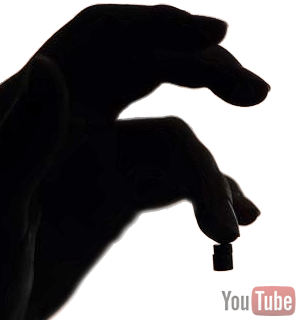
Magnetic implants are an experimental process in which small magnets are placed under the skin, allowing objects to be magnetically attached to the body, and also enables the wearer to sense electromagnetic fields. They have been used for several years in dentistry and re-constructive surgery, but their use by the body modification community is recent. Having magnets implanted under the skin allows the wearer to attach magnetic items to the outside of the skin, and also enables the wearer to sense electromagnetic fields.
Samppa, a a body modification artist, implanted magnets in himself and close friends in the late 1990’s, but they weren’t very strong and were only capable of picking up small items. Jesse Jarrell and Steve Haworth developed small and powerful neodymium magnets encapsulated in silicone. The procedure is still experimental, and complications are common, including rupturing of the silicone shell.

The Geneva drive is a gear mechanism that translates a continuous rotation into an intermittent rotary motion. The rotating drive wheel has a pin that reaches into a slot of the driven wheel advancing it by one step. The drive wheel also has a raised circular blocking disc that locks the driven wheel in position between steps. The name derives from the device’s earliest application in mechanical watches, Switzerland and Geneva being an important center of watchmaking. The geneva drive is also commonly called a Maltese cross mechanism due to the visual resemblance.
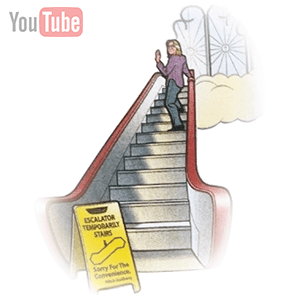
Mitch Hedberg (1968 – 2005) was an American stand-up comedian known for his surreal humor and unconventional comedic delivery. His comedy typically featured short, sometimes one-line jokes, mixed with absurd elements and non sequiturs.
Hedberg’s comedy and on-stage persona gained him a cult following, with audience members sometimes shouting out the punchlines to his jokes before he could finish them.
read more »

Karl Pilkington (b. 1972) is an English author and former radio producer. He is best known for producing and co-presenting The Ricky Gervais Show on Xfm London between 2001 and 2005; and for the subsequent podcast series and HBO animated television series. He was also the subject of the Sky1 travel series, An Idiot Abroad, which was also presented in the United States on the Science Channel. The New York Times ran an article about The Ricky Gervais Show describing Pilkington’s behaviour as a well-executed deadpan routine.


 The Daily Omnivore