November 18, 2010
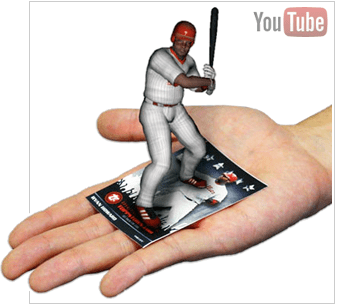

Augmented reality (AR) refers to a display in which simulated imagery, graphics, or symbology is superimposed on a view of the surrounding environment. It is related to a more general concept called mediated reality in which a view of reality is modified (possibly even diminished rather than augmented) by a computer. The term is believed to have been coined in 1990 by Thomas Caudell, an employee of Boeing at the time.
read more »
Posted in Technology, War |
Leave a Comment »
November 18, 2010

The Buddhabrot is a special rendering of the Mandelbrot set which, when traditionally oriented, resembles to some extent certain depictions of the Buddha. The rendering technique was discovered and later described in a 1993 Usenet post to sci.fractals by Melinda Green. Previous researchers had come very close to finding the precise Buddhabrot technique. In 1988 Linas Vepstas relayed similar images to Cliff Pickover for inclusion in Pickover’s forthcoming book Computers, Pattern, Chaos, and Beauty.
Posted in Art, Technology |
Leave a Comment »
November 18, 2010
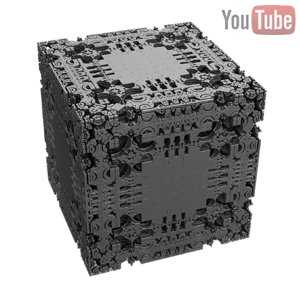
The Mandelbrot [man-del-brot] set is a mathematical fractal named after Benoît Mandelbrot, who studied and popularized it. When computed and graphed it displays an elaborate boundary which, being a fractal, does not simplify at any given magnification, meaning it shows more intricate detail the closer one looks or magnifies the image, usually called ‘zooming in.’
The Mandelbrot set has become popular outside mathematics both for its aesthetic appeal and for being a complicated structure arising from a simple definition, and is one of the best-known examples of mathematical visualization. Many mathematicians, including Mandelbrot, communicated this area of mathematics to the public.
Posted in Art, Technology |
1 Comment »
November 17, 2010

Numbers stations are shortwave radio stations of uncertain origin. They generally broadcast artificially generated voices reading streams of numbers, words, letters (sometimes using a spelling alphabet), tunes or Morse code. They are in a wide variety of languages and the voices are usually female, though sometimes male or children’s voices are used. Numbers stations appear and disappear over time (although some follow regular schedules), and their overall activity has increased slightly since the early 1990s.
Evidence supports popular assumptions that the broadcasts are used to send messages to spies. This usage has not been publicly acknowledged by any government that may operate a numbers station, but in 1892, the United States tried the Cuban Five for spying for Cuba. The group had received and decoded messages that had been broadcast from a Cuban numbers station. In 2009, the United States charged Walter Kendall Myers with conspiracy to spy for Cuba and receiving and decoding messages broadcast from a numbers station operated by the Cuban Intelligence Service.
Posted in Politics, Technology, War |
Leave a Comment »
November 17, 2010

A pyramid scheme is a non-sustainable business model that involves promising participants payment primarily for enrolling other people into the scheme, rather than from any real investment or sale of products or services to the public. Pyramid schemes are a form of fraud. Pyramid schemes are illegal in many countries and have existed for at least a century, some with variations to hide their true nature.
Posted in Money, Politics |
Leave a Comment »
November 17, 2010


Multi-level marketing (MLM) is a marketing strategy in which the sales force is compensated not only for sales they personally generate, but also for the sales of others they recruit, creating a downline of distributors and a hierarchy of multiple levels of compensation. Other terms for MLM include network marketing, direct selling, and referral marketing. Although the products and company are supposed to be marketed directly to consumers and potential business partners by means of relationship referrals and word of mouth marketing, critics have charged that most MLMs are pyramid schemes.
MLM companies have been a frequent subject of criticism as well as the target of lawsuits. Criticism has focused on their similarity to illegal pyramid schemes, price-fixing of products, high initial start-up costs, emphasis on recruitment of lower-tiered salespeople over actual sales, encouraging if not requiring salespeople to purchase and use the company’s products, potential exploitation of personal relationships which are used as new sales and recruiting targets, complex and sometimes exaggerated compensation schemes, and cult-like techniques which some groups use to enhance their members’ enthusiasm and devotion. Not all MLM companies operate the same way, and MLM groups have persistently denied that their techniques are anything but legitimate business practices.
Posted in Money, Politics |
Leave a Comment »
November 17, 2010

Luna, also called the ‘Stafford Giant,’ is a 600 to 1000-year-old redwood tree in Humboldt County, California, that activist Julia Butterfly Hill lived in for 738 days beginning in 1997. The name Luna was given to it in 1997 by a group of Earth First! members, who built a small platform from salvaged wood to serve as a tree-sit platform. Hill occupied the tree in order to save the grove from being clear-cut by the Pacific Lumber Company. Although many refer to the tree as ‘she,’ giant redwoods produce both male and female cones, and technically are neither male nor female, but monoecious.
In November of 2000, an unknown vandal used a chainsaw to cut halfway through the tree. Civil engineer Steve Salzman designed a system to help the tree withstand the extreme windstorms which frequent the Northern California hillside, at speeds which peak between 60 and 100 miles per hour. Tree climbers installed a steel cable ‘collar’ around Luna’s main trunk 100 feet above the ground. Four cables radiate from this collar and are attached with turnbuckles to four remote anchor points 100-150 feet away.
Posted in Politics |
Leave a Comment »
November 15, 2010
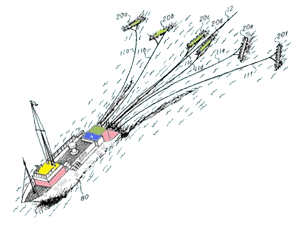

A paravane [par-uh-veyn], also called a water kite, is a towed winged (hydrofoiled) underwater object. Paravanes have applications in sport or commercial fishing, marine exploration, and defense. Navies equip paravanes with cable cutters to sever moored mines, and explosive paravanes are essentially towable mines. Commercial fishers use paravanes to tow bait and lead fish into trolling nets. Paravanes are also used for sampling water chemistry, taking seismic readings, and mapping marine geography.
Human-on-board paravanes are used to transport explorers, scuba divers, and spear-fishers. Foilboards used for recreation are also a type of water kite. Early work in coupling water kites was done by the late J.C. Hagedoorn, a geophysics professor at Delft University. His system coupled manned parafoils with water kites he named ‘hapas.’ Later experimenters also used the terminology ‘chien de mer’ (French for ‘sea dog’).
Posted in Language, Technology |
Leave a Comment »
November 15, 2010

A foilboard or hydrofoil board is a surfboard with a hydrofoil that extends below the board into the water. Laird Hamilton, a prominent figure in the invention of tow-in surfing (the use of a jet ski to tow the rider into a wave), is credited with popularizing the foilboard. Mango Carafino, a big wave tow surfing athlete and water sport instructor from the Hawaiian Island of Maui, is the leading developer of the hydrofoil board design for stand-up hydro foil boarding applications.
The stand-up design allows the rider to glide with the moving wave and eliminates the effects of choppy or rough conditions. Kite surfing with a foilboard allows the rider to angle higher into the wind than on traditional boards which ride on the surface of the water. As a result of reduced friction, hydrofoils can attain high speeds and lift at lower speeds compared to conventional designs. In addition to surfboards, hydrofoils have been employed on wakeboards, skis, seat towers, and windsurfers.
Posted in Games |
Leave a Comment »
November 11, 2010

The Lamborghini Countach was a mid-engined sports car produced by Italian automaker Lamborghini from 1974 to 1990. A total of 2,042 cars were built during the Countach’s sixteen year lifetime: Its design both pioneered and popularized the wedge-shaped, sharply angled look popular in many high performance sports cars. The ‘cabin-forward’ design concept, which pushes the passenger compartment forward in order to accommodate a larger engine, was also popularized by the Countach.
The word ‘countach’ is an exclamation of astonishment in the local Piedmontese language — generally used by men on seeing an extremely beautiful woman. The Countach name stuck when Nuccio Bertone first saw ‘Project 112’ in his studio. The prototype was introduced to the world at the 1971 Geneva Motor Show. Most previous and subsequent Lamborghini car names were associated with bulls and bullfighting.
Posted in Language, Technology, World |
Leave a Comment »
November 9, 2010

Easter eggs are hidden messages, in-jokes or features in things like video games, web sites, DVDs and other media. For example, the HP 54622D, a professional oscilloscope, has an ‘Asteroids’ clone called ‘Rocks’ that can be accessed by entering a secret sequence of buttons. Google Maps contains an easter egg whereby a user asking for directions from Japan to China would be directed to jetski across the Pacific Ocean.
read more »
Posted in Games, Humor, Technology |
Leave a Comment »
November 9, 2010
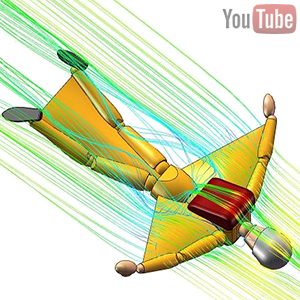
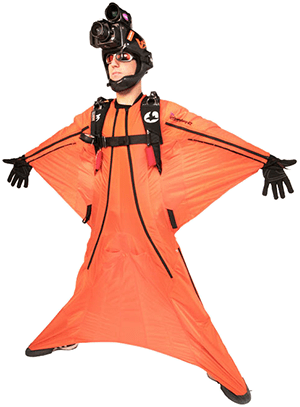
Wingsuit flying is the sport of flying the human body through the air using a special jumpsuit, called a wingsuit, which adds surface area to the human body to create lift. The wingsuit creates the surface area with fabric between the legs and under the arms. A wingsuit may be referred to as a birdman suit or squirrel suit. A wingsuit flight ends with a parachute opening, so a wingsuit can be flown from any point that provides sufficient altitude to glide through the air, such as skydiving aircraft or BASE jumping exit points, and to allow a parachute to deploy. In the mid-1990s, French skydiver Patrick de Gayardon developed a wingsuit that had unparalleled safety and performance. Unfortunately, de Gayardon died on April 13, 1998 while testing a new modification to his parachute container in Hawaii; his death is attributed to a rigging error which was part of the new modification rather than a flaw in the suit’s design.
In early 1998, Tom Begic, a BASE jumper from Australia, built and flew his own wingsuit based on a photograph of Patrick de Gayardon and his ideas. The suit was developed to assist Begic in capturing freefall footage of BASE jumpers while jumping the high cliffs of Europe. The benefits of the suit included: reduced freefall descent rates, increased freefall times, greater maneuverability around other jumpers and objects whilst in freefall, the potential to jump off sites around the world that were not possible without wingsuits, and the ability to accelerate away from underhung walls much more quickly.
Posted in Games |
Leave a Comment »



 The Daily Omnivore