November 9, 2010

Speedflying (also known as speedriding) is a form of snowkiting, which is an outdoor winter sport where people uses kite power to glide on snow or ice. The sport is similar to kitesurfing, but with the footwear used in snowboarding or skiing. In the early days of snowkiting, foil kites were the most common type; nowadays some kitesurfers use their water gear such as inflatable kites. Snowkiting differs from other alpine sports in that it is possible for the snowkiter to travel uphill and downhill with any wind direction.
Snowkiting is becoming increasingly popular in places often associated with skiing and snowboarding, such as Russia, Canada, Iceland, France, Switzerland, Austria, Norway, Sweden and the Northern and Central United States. The sport is becoming more diverse as adventurers use kites to travel great distances and sports enthusiasts push the boundaries of freestyle, big air and back country exploration Riders can reach speeds over 90 miles per hour; descending from the top of Mont Blanc to the valley floor in Chamonix, 12,000 feet below takes about 10 minutes.
Posted in Games |
Leave a Comment »
November 7, 2010

An orrery [awr-uh-ree] is a mechanical device that illustrates the relative positions and motions of the planets and moons in the solar system in a heliocentric model. They are typically driven by a clockwork mechanism with a globe representing the Sun at the centre, and with a planet at the end of each of the arms. The first modern orrery was built circa 1704 by George Graham and Thomas Tompion. Eisinga’s ‘Planetarium’ (actually, an orrery) was built from 1774 to 1781 by Eise Eisinga in his home in Franeker, in the Netherlands. It displays the planets across the width of a room’s ceiling, and has been in operation almost continually since it was created.
According to Cicero, the Greek philosopher Posidonius constructed an orrery that exhibited the diurnal motions of the sun, moon, and the five known planets. Cicero’s account was written in the first century BCE. The Antikythera mechanism is one of the first orreries. It is an ancient mechanical calculator designed to calculate astronomical positions. It was discovered in an ancient shipwreck off the Greek island of Antikythera, between Kythera and Crete, and has been dated to about 150-100 BC. Technological artifacts of similar complexity would not be common for a thousand years.
Posted in Technology |
Leave a Comment »
November 4, 2010

Cindy Jackson (b. 1959) is listed in the Guinness World record book for having had more cosmetic surgery procedures than anyone else in the world. She set the record in 2000 and is still the official record holder to date.
Since 1988 she has had 52 cosmetic procedures, including several facelifts, two nose operations, two eye lifts, knee, waist, abdomen and thigh liposuction, jaw surgery, lip and cheek implants, chemical peels, chin bone reduction. Others were non-surgical, including Radiesse injections, hand rejuvenation, Voluma treatments and permanent make-up.
Posted in Health, Money, Technology |
Leave a Comment »
November 4, 2010
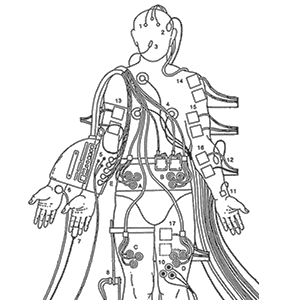
Stelarc (Stelios Arkadiou) is a Greek-Australian performance artist whose works focuses heavily on extending the capabilities of the human body. As such, most of his pieces are centred around his concept that the human body is obsolete. He is currently a visiting Professor in the School of Arts at Brunel University, West London.
In 2007, Stelarc had a cell-cultivated ear surgically attached to his left arm. In 2005, MIT Press published ‘Stelarc: The Monograph’ which is the first extensive study of his prolific work.
Posted in Art, Science, Technology |
Leave a Comment »
November 4, 2010
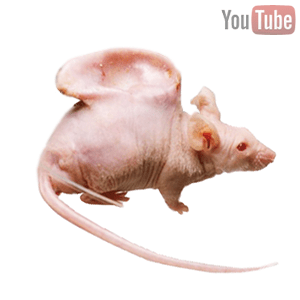
The Vacanti mouse was a laboratory mouse that had what looked like a human ear grown on its back. The ‘ear’ was actually an ear-shaped cartilage structure grown by seeding cow cartilage cells into a biodegradable ear-shaped mold. The earmouse, as it became known as, was created by Dr. Charles Vacanti, an anesthesiologist at the University of Massachusetts and Dr. Linda Griffith-Cima, an assistant professor of chemical engineering at M.I.T. in 1995.
Posted in Health, Science, Technology |
Leave a Comment »
November 4, 2010

Master Shake is a fictional character on Adult Swim’s television series, Aqua Teen Hunger Force. Like the other main characters, Meatwad and Frylock, Master Shake originally appeared in the Space Ghost Coast to Coast episode ‘Baffler Meal,’ and then made his first official appearance in the show’s first episode, ‘Rabbot’ Voice actor Dana Snyder provides Shake’s voice throughout the entire series. Master Shake lives next door to Carl Brutananadilewski in a suburban neighborhood in New Jersey with his roommates, Meatwad and Frylock. He spends most of his time watching TV, causing mischief, talking about women, sex, breasts, and porn.
He is also fond of playing cruel pranks on Meatwad. In ‘Video Ouija’ Shake commits suicide just so he can haunt Meatwad through his new video game. In ‘Reedickyoulus’ Shake kills Meatwad’s innocent kitten, in a microwave, just to upset Meatwad. His behavior is highly irregular, blaming others for his numerous mistakes, antagonizing Meatwad for pleasure, putting material goods above necessities, concocting poor lies to cover and justify his actions even when caught red-handed, and having an overall lack of empathy and regard for the safety of others. Shake has no official power, except his ability to shoot a substance from his straw, and almost every thing he throws to the ground explodes.
Posted in Art, Humor |
Leave a Comment »
November 3, 2010

A bucket bong, also called a gravity bong, is a method of consuming cannabis. The smoke in a gravity bong never actually passes through the water as it would in an ordinary bong. The water is used to draw the smoke into the container by pulling up, creating a change in air pressure. The smoke is then pushed into the mouth of the user by pushing down causing air compression.
Posted in Drugs, Technology |
Leave a Comment »
November 3, 2010

The DARPA PowerSwim program is developing a human-powered swimming device for use by combat and reconnaissance swimmers. The device uses the same oscillating foil approach to swimming that is exhibited by many fish and aquatic birds. This propulsion approach is more than 80-percent efficient in conversion of human motions to forward propulsion. Typical recreational swim fins are no more than 15-percent efficient in their conversion of human exertion to propulsive power, and freestyle swimming converts only 3-percent.
Posted in Technology, War |
Leave a Comment »
November 2, 2010

Copyleft is a play on the word copyright to describe the practice of using copyright law to offer the right to distribute copies and modified versions of a work and requiring that the same rights be preserved in modified versions of the work.
In other words, copyleft is a general method for making a program (or other work) free, and requiring all modified and extended versions of the program to be free as well. It is a a form of licensing and can be used to maintain copyright conditions for works such as computer software, documents, music and art.
Posted in Money, Politics |
Leave a Comment »
October 30, 2010

Dock Ellis (1945 – 2008) was a Major League Baseball player who pitched for the Pittsburgh Pirates, among other teams. His best season was 1971, when he won 19 games for the World Series champion Pirates and was the starting pitcher for the National League in the All-Star Game. However, he is perhaps best remembered for throwing a no-hitter in 1970 and later stating that he had done it while under the influence of LSD.
read more »
Posted in Drugs, Games, Humor |
Leave a Comment »
October 28, 2010

The Mimic Octopus is a species of octopus that has a strong ability to mimic other creatures. It grows up to 60 cm (2 feet) in length. Its normal coloring consists of brown and white stripes or spots. Living in the tropical seas of South East Asia, it was not discovered officially until 1998, off the coast of Sulawesi. The octopus mimics the physical likeness and movements of more than fifteen different species, including sea snakes, lionfish, flatfish, brittle stars, giant crabs, sea shells, stingrays, flounders, jellyfish, sea anemones, and mantis shrimp. It accomplishes this by contorting its body and arms, and changing color.
Although all octopuses can change color and texture, and many can blend with the sea floor, appearing as rocks, the mimic octopus is the first octopus species ever observed to impersonate other animals. Based on observation, the mimic octopus may decide which animal to impersonate depending on local predators. For example, when the octopus was being attacked by damselfish, it often mimics a banded sea snake, a damselfish predator. The octopus impersonates the snake by turning black and yellow, burying six of its arms, and waving its other two arms in opposite directions. The mimic octopus is often confused with Wunderpus photogenicus, another recently discovered species. The Wunderpus can be distinguished by the pattern of strong, fixed white markings on its body.
Posted in Science |
Leave a Comment »
October 28, 2010

Funky Forest: The First Contact, also known as Naisu no mori is a 2005 Japanese movie written and directed by Katsuhito Ishii, Hajimine Ishimine and Shunichiro Miki. The movie is a collection of several surreal, non-sequitur shorts. Dance numbers, pillow fights, animation, comedy, and science fiction all combine to create a unique and disorienting viewing experience featuring such highlights as an absurdist tribute to David Cronenberg, an ass-television, and a girl who fires lasers from her forehead in order to battle a floating space blob which emits spinning, spherical projectiles.
Posted in Art, Humor, World |
Leave a Comment »


 The Daily Omnivore