October 13, 2010

Controllerism is the art and practice of using musical software controllers (e.g. MIDI) to build upon, mix, scratch, remix, effect, modify, or otherwise create music, usually by a DJ or ‘Controllerist.’ Often on the side of Virtuoso performance art, Controllerism is also a nod to traditional musicianship and instrumental-ism paired with modern computer sequencing software such as Ableton Live and Native Instruments Traktor.
However a working knowledge of Scale and Chords is not necessarily required as the performers typically focus their efforts more on sequencing events, software effect and instrument manipulations using buttons, knobs, faders, keys, foot switches and pedals than on instrumental notes played in real time. The term was coined by musician Matt Moldover in 2007 and popularized by DJ Ean Golden to describe the process while paying homage to and giving respect to the art of turntablism.
Posted in Art, Technology |
Leave a Comment »
October 13, 2010

A minuet [min-yoo-et] is a social dance of French origin for two people, usually in 3/4 time. The word was adapted from Italian minuetto and French menuet, meaning small, pretty, delicate, a diminutive of menu, from the Latin minutus. At the period when it was most fashionable it was slow, soft, ceremonious, and graceful. The name is also given to a musical composition written in the same time and rhythm, but when not accompanying an actual dance the pace was quicker. As the other dances that made up a Baroque suite dropped out of use, the minuet retained its popularity.
Posted in Art, Language, World |
Leave a Comment »
October 12, 2010

The Turk was a fake chess-playing machine constructed in the late 18th century. From 1770 until its destruction by fire in 1854, it was exhibited by various owners as an automaton. Constructed and unveiled in 1770 by Wolfgang von Kempelen (1734–1804) to impress the Empress Maria Theresa, the mechanism appeared to be able to play a strong game of chess against a human opponent. The Turk was in fact a mechanical illusion that allowed a human chess master hiding inside to operate the machine.
With a skilled operator, the Turk won most of the games played during its demonstrations around Europe and the Americas for nearly 84 years, playing and defeating many challengers including statesmen such as Napoleon Bonaparte and Benjamin Franklin. Although many had suspected the hidden human operator, the hoax was initially revealed only in the 1820s by the Londoner Robert Willis.
Posted in Games, Humor, Technology |
1 Comment »
October 10, 2010

Stanley is an autonomous vehicle created by Stanford University’s Stanford Racing Team in cooperation with the Volkswagen Electronics Research Laboratory (ERL). It competed in, and won, the 2005 DARPA Grand Challenge, earning the Stanford Racing Team the 2 million dollar prize. Stanley’s descendant ‘Junior’ placed second in the 2007 DARPA Urban Challenge. Stanley is based on a diesel engined Volkswagen Toureg, Junior on a Passat. The Stanford Racing Team chose the Touareg for its ‘drive by wire’ control system which could be adapted to run directly from an on-board computer.
To navigate, Stanley used five roof mounted LIDAR units to build a 3-D map of the environment, supplementing the position sensing GPS system. An internal guidance system utilizing gyroscopes and accelerometers monitored the orientation of the vehicle and also served to supplement GPS and other sensor data. Additional guidance data was provided by a video camera used to observe driving conditions out to eighty meters (beyond the range of the LIDAR) and to ensure room enough for acceleration. Stanley also had sensors installed in a wheel well to record a pattern imprinted on the tire and to act as an odometer in case of loss of signal (such as when driving through a tunnel). Using the data from this sensor, the on-board computer can extrapolate how far it has traveled since the signal was lost.
Posted in Technology |
Leave a Comment »
October 10, 2010

The lion’s mane jellyfish (Cyanea capillata) is the largest known species of jellyfish. Its range is confined to the cold waters of the Arctic, northern Atlantic, and northern Pacific Oceans, seldom found farther south than 42°N latitude. Similar jellyfish, which may be the same species, are known to inhabit seas near Australia and New Zealand. The largest recorded specimen found, washed up on the shore of Massachusetts Bay in 1870, had a bell (body) with a diameter of 2.3 m (7 feet 6 inches) and tentacles 36.5 m (120 feet) long.
Posted in Science |
Leave a Comment »
October 9, 2010

Abelardo is a green, full-bodied Muppet parrot who appears on Plaza Sésamo, the Mexican co-production of Sesame Street. He joined the cast in 1981 and soon became the show’s most recognizable figure. Abelardo also guest starred on the American Sesame Street on May 5, 1997 as part of the Cinco de Mayo celebration. On the Mexican show, he occasionally keeps contact with his cousin Big Bird via letters and video-chatting.
His character was originally a a tall orange-and-yellow scaled dragon which had a soft, gentle voice and a very particular way of talking, making pauses after every sentence. His favorite treat were pumpkin seeds or ‘semillas de calabaza’ which in Mexico are a very popular snack, also known as ‘Pepitas.’ In later seasons Abelardo the Dragon was replaced by Serapio Montoya, a large parrot-like character with a strong resemblance to Big Bird, of whom he is a cousin. However, children and others continued to refer to Serapio as ‘Abelardo’ and therefore his name was later changed to Abelardo Montoya. The reason the dragon character was dismissed when the series was re-launched in 1982, remains unexplained.
Posted in Education, World |
Leave a Comment »
October 1, 2010

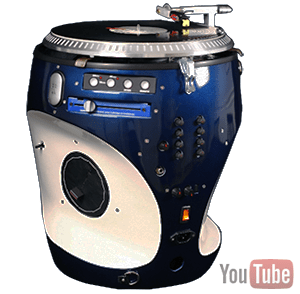
The Scratchophone is a portable scratch instrument, featuring a turntable, a special tonearm, scratch mixer, and a pair of speakers, a battery, and a harness. They are hand-made in Quebec, Canada and feature a direct drive Numark turntable, a 2-channel Vestax mixer, and a Stanton cartdidge needle. It sells for $2,179.99.
Posted in Art, Money, Technology |
Leave a Comment »
September 30, 2010
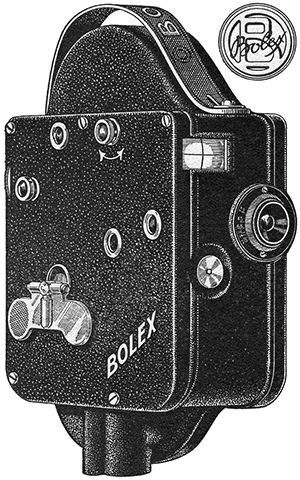

Bolex is a Swiss company that manufactures motion picture cameras and lenses. The most notable products of which are in the 16 mm and Super 16 mm formats. The Bolex was initially founded by Ukranian engineer and inventor Jacques Bogopolsky in the 1940s. Bolex is derived from his name. He had previously designed cameras for Alpa. Bolex cameras were particularly important for early television news, nature films, documentaries and the avant garde, and are still favoured by many animators today.
Some later models are electrically powered, the majority of those manufactured since the 1930s use a spring-wound clockwork. The 16 mm spring-wound Bolex is a popular introductory camera in film schools. Today, the Bolex factory in Switzerland continues to produce new 16mm and Super 16 film cameras and also can convert Bolex H16 reflex models to super 16mm.
Posted in Art, Technology, World |
1 Comment »
September 27, 2010


Superflat is a postmodern art movement, founded by Japanese artist Takashi Murakami, which is influenced by manga and anime. Superflat is used by Murakami to refer to various flattened forms in Japanese graphic art, animation, pop culture and fine arts, as well as the ‘shallow emptiness of Japanese consumer culture.’ A self-proclaimed art movement, it was a successful piece of niche marketing, a branded art phenomenon designed for Western audiences.
Murakami defines Superflat in broad terms, so the subject matter is very diverse. Often the works take a critical look at the consumerism and sexual fetishism that is prevalent in post-war Japanese culture. One target of this criticism is lolicon art, which is satirized by works such as those by Henmaru Machino. These works are an exploration of otaku sexuality through grotesque and/or distorted images. Other works are more concerned with a fear of growing up. For example, Yoshitomo Nara’s work often features playful graffiti on old Japanese ukiyo-e executed in a childish manner. And some works focus on the structure and underlying desires that comprise otaku and overall post-war Japanese culture.
Posted in Art, World |
Leave a Comment »
September 24, 2010

Minecraft is a ‘sandbox game’ where players mine and build in a randomly generated 3D world. Hostile monsters roam the environment at night, forcing players to build fortifications. Mining uncovers ores in the ground, which can be crafted into useful items such as chests, minecarts and tracks, and buckets. There are also plants and animals, which can be farmed and hunted for other resources. The game features a free classic mode where players have unlimited resources, and is available as an alpha release for €9.95. As of September 23rd 2010, it has surpassed 760,000 registered users and 208,000 purchases.
It is currently in development by Markus Persson, aka ‘Notch.’ The gameplay is inspired by Dwarf Fortress, RollerCoaster Tycoon, Dungeon Keeper, and especially Infiniminer. Players must devise methods of building functional and navigable structures that can withstand the nightly assault from various monsters. The player’s short reach and short jumping ability forces players to plan structures carefully, lest they trap themselves or fall to their death during construction. More advanced players can create complex traps and mechanisms using the game physics as well as primitive electrical circuits and logic gates.
Posted in Games, Money |
Leave a Comment »
September 22, 2010

Sky burial or ritual dissection was once a common funerary practice in Tibet wherein a human corpse is cut in specific locations and placed on a mountaintop, exposing it to the elements (or the mahabhuta) and animals – especially to birds of prey. The location of the sky burial preparation and place of execution are called charnel grounds. In Tibet the practice is known as jhator, which literally means, ‘giving alms to the birds.’
The majority of Tibetans adhere to Buddhism, which teaches rebirth. There is no need to preserve the body, as it is now an empty vessel. Birds may eat it, or nature may let it decompose. So the function of the sky burial is simply the disposal of the remains. In much of Tibet the ground is too hard and rocky to dig a grave, and with fuel and timber scarce, a sky burial is often more practical than cremation.
Posted in Death, Philosophy, World |
Leave a Comment »
September 20, 2010
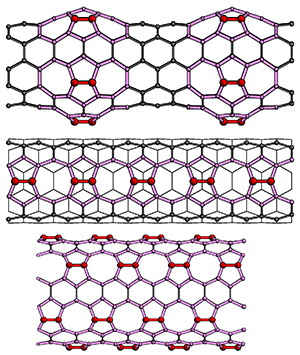
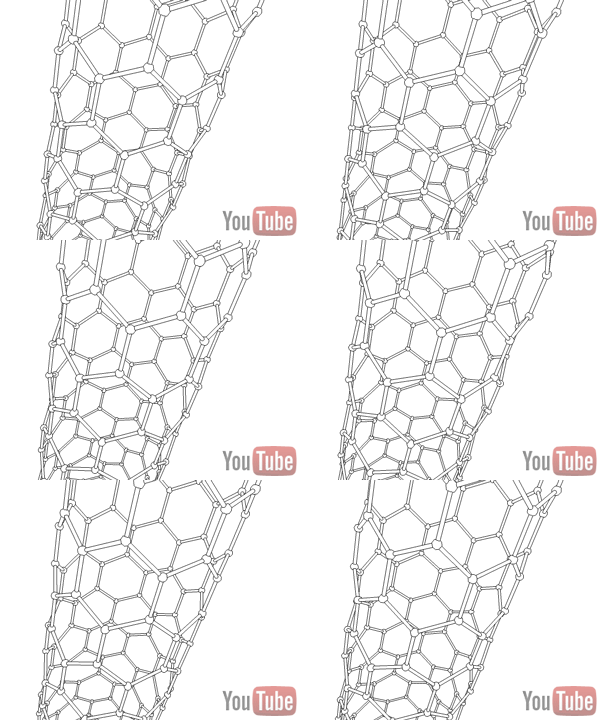
Carbon nanotubes are a molecular configuartion (or allotrope) of carbon with a cylindrical structure. Nanotubes have been constructed with length-to-diameter ratio of up to 132,000,000:1, which is significantly larger than any other material. These cylindrical carbon molecules have novel properties which make them potentially useful in many applications in nanotechnology, electronics, optics, and other fields of materials science, as well as potential uses in architectural fields. They exhibit extraordinary strength and unique electrical properties, and are efficient thermal conductors.
Nanotubes are members of the fullerene structural family, which also include spherical buckyballs. The ends of a nanotube may be capped with a hemisphere of the buckyball structure. Their name is derived from their size, since the diameter of a nanotube is on the order of a few nanometers (approximately 1/50,000th of the width of a human hair), while they can be up to 18 centimeters in length.
Posted in Technology |
Leave a Comment »




 The Daily Omnivore