February 19, 2013

Live insect jewelry refers to jewelry, made from living creatures- usually bejeweled, large insects- which is worn as a fashion accessory. The use of insects as live jewelry has existed for many centuries, with the Egyptians believed to have been the first to have worn insects as jewelry. Ancient Egyptian soldiers commonly wore scarab beetles into battle as the beetles were considered to have supernatural powers of protection against enemies.
Although live jewelry has featured in Mayan cultural traditions for many centuries, it was not until the 1980s that the Mexican Maquech Beetle, a sub-species of the Zopherus beetle, achieved mainstream popularity as live jewelry. The Maquech Beetle is a large, docile, wingless insect which is decorated with gold and semi-precious gemstones and is attached to a decorative safety pin by a chain leash.
read more »
Posted in Money, Politics, World |
Leave a Comment »
February 18, 2013

‘Harlem Shake‘ is a song recorded by American DJ and producer Baauer. It was released as a free digital download by Mad Decent imprint label Jeffree’s in 2012. The song incorporates samples of growling-lion sounds and Plastic Little’s 2001 song ‘Miller Time,’ specifically its line ‘then do the Harlem shake.’
In 2013, a user-submitted video set to ‘Harlem Shake’ became a viral hit on YouTube. The song features an undulating synth, harsh snares, and a mechanical bassline. It is categorized by Resident Advisor’s Andrew Ryce as a hip hop and bass song, while David Wagner of ‘The Atlantic’ describes its music as trap, a sub-genre with stylistic origins in EDM and Southern hip hop.
read more »
Posted in Art, Games, Humor |
Leave a Comment »
January 31, 2013

Strategies for Engineered Negligible Senescence (SENS) is the term coined by British biogerontologist Aubrey de Grey for the diverse range of regenerative medical therapies, either planned or currently in development, for the periodical repair of all age-related damage to human tissue with the ultimate purpose of maintaining a state of negligible senescence in the patient, thereby postponing age-associated disease for as long as the therapies are reapplied.
The term ‘negligible senescence’ was first used in the early 1990s by professor Caleb Finch to describe organisms such as lobsters and hydras, which do not show symptoms of aging. The term ‘engineered negligible senescence’ first appeared in print in Aubrey de Grey’s 1999 book ‘The Mitochondrial Free Radical Theory of Aging,’ and was later prefaced with the term ‘strategies’ in the article ‘Time to Talk SENS: Critiquing the Immutability of Human Aging.’
read more »
Posted in Death, Health |
Leave a Comment »
January 30, 2013

Susan P. Crawford (b. 1963) is a professor at the Benjamin N. Cardozo School of Law. She has served as President Barack Obama’s Special Assistant for Science, Technology, and Innovation Policy (2009) and is a columnist for ‘Bloomberg View.’
She is a former Board Member of ICANN (which regulates the Internet), the founder of OneWebDay (an annual day of Internet celebration and awareness held on September 22), and a legal scholar. Her research focuses on telecommunications and information law.
read more »
Posted in Money, Politics, Technology |
Leave a Comment »
January 22, 2013

A microexpression is a brief, involuntary facial expression made in reaction to an emotion. They usually occur in high-stakes situations, where people have something to lose or gain. Microexpressions occur when a person is consciously trying to conceal all signs of how he or she is feeling, or when a person does not consciously know how he or she is feeling. Unlike regular facial expressions, it is difficult to hide microexpression reactions. Microexpressions express the seven universal emotions: disgust, anger, fear, sadness, happiness, surprise, and contempt.
Nevertheless, in the 1990s, pyschologist Paul Ekman expanded his list of basic emotions, including a range of positive and negative emotions not all of which are encoded in facial muscles. These emotions are amusement, contempt, embarrassment, excitement, guilt, pride, relief, satisfaction, pleasure, and shame. They are very brief in duration, lasting only 1/25 to 1/15 of a second.
read more »
Posted in Health, Politics, Science |
1 Comment »
January 21, 2013

Escape From Tomorrow is a 2013 American fantasy-horror film. It is the debut film of writer-director Randy Moore, and stars Roy Abramsohn as a man having increasingly disturbing experiences and visions during the last day of a family vacation to the Walt Disney World theme park. After its premiere at the 2013 Sundance Film Festival, it became one of the most popular films there.
The film gained national media attention because Moore and his cast and crew made most of it on location at both Disney World and Disneyland without the consent or apparently even the awareness of The Walt Disney Company, which owns and operates both parks and has a reputation for being fiercely protective of its intellectual property. They used guerilla filmmaking techniques such as keeping their scripts on their iPhones to avoid attracting attention, and shooting on handheld video cameras similar to those used by the park’s many visitors. After principal photography was complete, Moore was so determined to keep the project a secret from Disney that he edited it in South Korea, and Sundance similarly declined to discuss the film in detail before it was shown.
Posted in Art, Money |
Leave a Comment »
January 10, 2013

The half-life of knowledge is the amount of time that has to elapse before half of the knowledge in a particular area is superseded or shown to be untrue. The concept is attributed to Fritz Machlup (1962). For example, Donald Hebb estimated the half-life of psychology to be five years.
The half-life of knowledge differs from the concept of half-life in physics in that there is no guarantee that the truth of knowledge in a particular area of study is declining exponentially. In addition, knowledge can not be quantified and falsification of a doctrine is hardly comparable to exponential decay process that atomic nuclei go through.
Posted in Education, Science |
Leave a Comment »
January 10, 2013

The method of loci [loh-sahy] (plural of Latin ‘locus’ for ‘place’ or ‘location’), also called the ‘memory palace,’ is a mnemonic device introduced in ancient Roman and Greek rhetorical treatises. The items to be remembered in this mnemonic system are mentally associated with specific physical locations. It relies on memorized spatial relationships to establish, order and recollect memorial content.
The method of loci is also commonly referred to as the journey method. In basic terms, it is a method of memory enhancement which uses visualization to organize and recall information. Many memory contest champions claim to use this technique in order to recall faces, digits, and lists of words. These champions’ successes have little to do with brain structure or intelligence, but more to do with their technique of using regions of their brain that have to do with spatial learning. Those parts of the brain that contribute most significantly to this technique include the medial parietal cortex, retrosplenial cortex, and the right posterior hippocampus.
read more »
Posted in Education, Health |
1 Comment »
January 9, 2013

Mount Kimbie is a British electronic music duo consisting of Dominic Maker and Kai Campos. They formed the group in London in 2008 and released their debut album ‘Crooks & Lovers’ in 2010 in the UK to critical acclaim. Mount Kimbie are currently working on their second album which will be released on Warp Records. Arguably responsible for the term ‘post-dubstep,’ the duo has released a series of EPs and their highly praised debut album.
‘The Guardian’ described the pair as ‘leading an exploratory breakaway from bass-heavy dubstep towards a lighter, hazier style of electronica rich with drowsy ambience and chopped-up found sounds.’ The pair are closely linked to friend, producer and ‘BBC Sound of’ 2011 runner-up, James Blake. He has collaborated with them live and lent his skills to the remixing of ‘Maybes,’ as well as contributing elements to ‘Crooks & Lovers.’
read more »
Posted in Art |
Leave a Comment »
January 7, 2013

The Up Series is a series of documentary films produced by Granada Television that have followed the lives of fourteen British children since 1964, when they were seven years old. The documentary has had eight episodes spanning 49 years (one episode every seven years) and the documentary has been broadcast on both ITV and BBC.
The children were selected to represent the range of socio-economic backgrounds in Britain at that time, with the explicit assumption that each child’s social class predetermines their future. Every seven years, the director, Michael Apted, films material from those of the fourteen who choose to participate.
read more »
Posted in Art, Money, Science |
Leave a Comment »
January 1, 2013
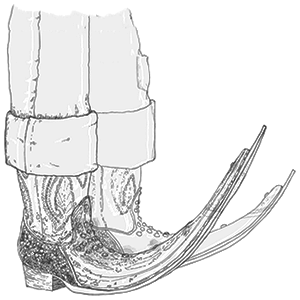
Mexican pointy boots (botas picudas mexicanas) are a style of pointed fashion boots made with elongated toes. The boots are said to have originated in Matehuala in the Mexican state of San Luis Potosí. The came to popularity at the same time as ‘tribal guarachero’ music (‘a mixture of Pre-Columbian and African sounds mixed with fast cumbia bass and electro-house beats’). and the boots have become a preferred footwear for the all-male troupes that dance to the tribal music. They are made by elongating normal boots by as much as 5 feet (1.5 m), causing the toes to curl up toward the knees. Decorative alterations incorporate paint and sequins and can go as far as adding flashing LED lights, disco balls and even mirrors.
Boys and men that wear the pointy boots have formed all-male troupes to compete in danceoffs at local nightclubs to tribal music. Participants in the contests spend weeks choreographing their dance moves and fabricating their outfits which commonly include ‘matching western shirts and skinny jeans to accentuate their footwear.’ In Matehuala, prize money ranges from $100 to $500. The prize often includes a bottle of whiskey. The dance troupes have reportedly become so popular that they are being ‘hired to dance at weddings, for quinceañeras, celebrations of the Virgin of Guadalupe, bachelorette parties, and even rosary ceremonies for the dead.’
Posted in Art, Humor, World |
Leave a Comment »
December 20, 2012

Affective computing is the study and development of systems and devices that can recognize, interpret, process, and simulate human affects.
It is an interdisciplinary field spanning computer sciences, psychology, and cognitive science, which originated at MIT with Rosalind Picard’s 1995 paper on affective computing. A motivation for the research is the ability to simulate empathy. The machine should interpret the emotional state of humans and adapt its behavior to them, giving an appropriate response for those emotions.
read more »
Posted in Health, Language, Technology |
Leave a Comment »


 The Daily Omnivore