
Like skydiving, space diving refers to the act of jumping from a plane, balloon, or spacecraft in outer space and falling to Earth’s atmosphere before parachuting to a landing. Depending on one’s definition of ‘space,’ the only historical case of a human intentionally space diving from the stratosphere is Joseph Kittinger, who jumped from a helium balloon at the height of 100,000 feet (approximately 30 kilometers).
Higher jumps from mesosphere or thermosphere have yet to be successfully performed, though Orbital Outfitters is working to create a suit that will enable safe space diving. Space diving from beyond the stratosphere has been imagined in various fictional contexts.
read more »
September 30, 2012
Space Diving
September 20, 2012
Positive Psychology
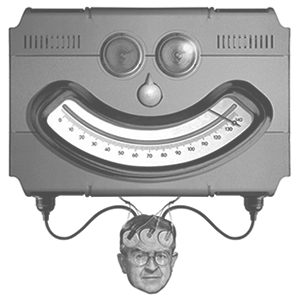
Positive psychology is a recent branch of psychology whose purpose was summed up in 1998 by psychologists Martin Seligman and Mihaly Csikszentmihalyi: ‘We believe that a psychology of positive human functioning will arise, which achieves a scientific understanding and effective interventions to build thriving individuals, families, and communities.’ Positive psychologists seek ‘to find and nurture genius and talent’, and ‘to make normal life more fulfilling,’ not simply to treat mental illness.
The field is intended to complement, not to replace traditional psychology. It does not seek to deny the importance of studying how things go wrong, but rather to emphasize the importance of using the scientific method to determine how things go right. This field brings attention to the possibility that focusing only on the disorder itself would result in a partial concept of the patient’s condition.
read more »
September 20, 2012
Optimism Bias

The optimism bias (also known as unrealistic or comparative optimism) is a bias that causes a person to believe that they are less at risk of experiencing a negative event compared to others. There are four factors that cause a person to be optimistically biased: their desired end state, their cognitive mechanisms, the information they have about themselves versus others, and overall mood.
The optimistic bias is seen in a number of situations. For example, people believing that they are less at risk of being a crime victim, smokers believing that they are less likely to contract lung cancer or disease than other smokers, first-time bungee jumpers believing that they are less at risk of an injury than other jumpers, or traders who think they are less exposed to losses in the markets.
read more »
September 13, 2012
Social Intuitionism

Social intuitionism is a movement in moral psychology that arose in contrast to more heavily rationalist theories of morality, like that of Lawrence Kohlberg. Kohlberg developed a stage theory of moral reasoning that he claimed accounts for people’s moral behavior. More sophisticated reasoning, he asserted, should lead one to more consistent moral action, because one realizes that moral principles are prescriptive in nature and so demand action from the self. NYU psychologist Jonathan Haidt greatly de-emphasizes the role of reasoning in reaching moral conclusions.
Haidt asserts that moral judgment is primarily given rise to by intuition with reasoning playing a very marginalized role in most of our moral decision-making. Conscious thought-processes serves as a kind of post hoc justification of our decisions. His main evidence comes from studies of ‘moral dumbfounding’ where people have strong moral reactions but fail to establish any kind of rational principle to explain their reaction. He suggests that we have affective heuristics (mental shortcuts) which are unconscious that generate our reactions to morally charged situations and our moral behavior. He suggests that if people reason about morality, it is independent of or at least processes causing moral decisions to be made.
August 9, 2012
The Ultimate Computer

‘The Ultimate Computer‘ is a season two episode of ‘Star Trek,’ first broadcast in 1968, written by D.C. Fontana, based on a story by Laurence N. Wolf and directed by John Meredyth Lucas. In the episode, a skeleton Enterprise crew are assigned to test a revolutionary computer system, the M-5, that is given total control of the ship. Designed by the brilliant Dr. Richard Daystrom (who’d also invented the currently used computer systems), the M-5 handles all ship functions without human assistance. While Captain Kirk and Chief Medical Officer Dr. McCoy are unhappy about the test, Science Officer Spock is impressed with M-5.
At first M-5 works well, performing ship functions more quickly and efficiently than a living crew. Later, M-5 exhibits quirks such as turning off power and life support to unoccupied parts of the ship. It draws increased power for unknown reasons. Daystrom maintains M-5 is working properly. In a drill, M-5 defends the Enterprise against mock attacks from starships Excalibur and Lexington. The Enterprise is declared the victor, prompting Commodore Wesley to call Kirk ‘Captain Dunsel.’ Spock explains the term is used by midshipmen at Starfleet Academy to describe a part serving no useful purpose. Kirk is visibly shaken by this.
read more »
July 31, 2012
Kinect


Kinect is a motion sensing input device released by Microsoft in 2010 for the Xbox 360 game console, and in 2012 for Windows PC. Based around a webcam-style add-on peripheral, it enables users to control and interact with software without the need to touch a game controller (through a natural user interface using gestures and spoken commands).
The project is aimed at broadening the Xbox 360’s audience beyond its typical gamer base. Kinect competes with the Wii Remote Plus and PlayStation Move with PlayStation Eye motion controllers for the Wii and PlayStation 3 home consoles, respectively. After selling a total of 8 million units in its first 60 days, the Kinect holds the Guinness World Record of being the ‘fastest selling consumer electronics device.’
read more »
July 31, 2012
SuperBall

A SuperBall or bouncy ball is a toy, invented in 1964 by chemist Norman Stingley by compressing a synthetic rubber material under high pressure. It is an extremely elastic ball made of Zectron, which contains the synthetic rubber polymer polybutadiene, as well as hydrated silica, zinc oxide, stearic acid, and other ingredients, vulcanized with sulfur at a temperature of 165 degrees Celsius and at a pressure of 3,500psi.
The Super Ball has an amazingly high coefficient of restitution. Dropped from shoulder level, balls snap nearly all the way back; thrown down by an average adult, it can leap over a three-story building. Toys similar to SuperBalls are more generally known as bouncy balls, a term which covers other more or less similar balls by different manufacturers with different formulations.
read more »
July 26, 2012
It Couldn’t Happen Here

It Couldn’t Happen Here is a 1988 musical film starring the British pop duo Pet Shop Boys and based around their music. It was originally conceived as an hour-long video based around their album ‘Actually,’ but it turned into a surreal full-scale feature film directed by Jack Bond and co-starring Barbara Windsor, Joss Ackland, Neil Dickson and Gareth Hunt. The original idea of making a film emerged from the band’s immense reluctance to go on tour.
The band hoped that a film would satisfy the fans’ demand to see them in live action. Neil Tennant subsequently commented that making the film made him realize one thing, that he couldn’t act. When the film premiered in London’s West End, a crowd of fans were standing outside the cinema, waiting for the duo to arrive. However, as both Neil and Chris approached the crowd, they went completely unnoticed thanks to their anonymous appearance, and managed to walk past them.
read more »
July 25, 2012
Truthiness

Truthiness is a quality characterizing a ‘truth’ that a person claims to know intuitively ‘from the gut’ or because it ‘feels right’ without regard to evidence, logic, intellectual examination, or facts. American television comedian Stephen Colbert coined the word in this meaning as the subject of a segment called ‘The Wørd’ during the 2005 pilot episode of his political satire program ‘The Colbert Report.’
By using this as part of his routine, Colbert satirized the misuse of appeal to emotion and ‘gut feeling’ as a rhetorical device in contemporaneous socio-political discourse. He particularly applied it to President George W. Bush’s nomination of Harriet Miers to the Supreme Court and the decision to invade Iraq in 2003. Colbert later ascribed truthiness to other institutions and organizations, including Wikipedia. Colbert has sometimes used a mock Latin version of the term, ‘Veritasiness.’
read more »
July 24, 2012
Projection Mapping

Projection mapping is a technology used to turn irregularly shaped objects into a display surface for projection. After the object is chosen or created, a virtual replica of the entire physical setup is created. A virtual model of the projection surface is created, and placed within a virtual environment. Coordinates need to be defined for where the object is placed in relation to the projector. Finally, the xyz orientation, position, and lens specification of the projector are adding to the virtual scene.
Video mapping first gained notoriety through guerilla advertising campaigns and video jockeys for electronic musicians. These advertising campaigns commonly used mapping techniques to project interactive scenes onto the sides of buildings. Common techniques for these performances included both 3-D mapping techniques and 3D projection to create the illusion of depth.
July 24, 2012
Prepared Piano

A prepared piano is a piano that has had its sound altered by placing objects (preparations) between or on the strings or on the hammers or dampers. The idea of altering an instrument’s timbre through the use of external objects has been applied to instruments other than the piano, including the guitar and harp. Richard Bunger wrote a book ‘The Well Prepared Piano’ in which he explains how John Cage prepared his pianos and even which pianos are suitable, because of the deviation of string lengths within different brands.
Bunger also clarifies why the preparations were done in such ways; in other words, which adaptation creates which sounds (harmonics obtained, timbrel effects, etc.). The timbre of the instrument changes dramatically when preparations are introduced. Much of the technique is related to the harmonic positions of the strings. For instance a preparation on 1/2 of the string length causes a different sound than on 1/3. The preparations don’t cause a random sound, as is often assumed.
read more »
July 17, 2012
Regenerative Brake
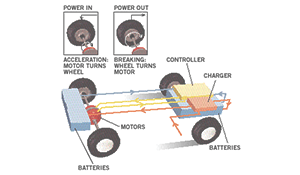

A regenerative brake is an energy recovery mechanism which slows a vehicle or object down by converting its kinetic energy into another form, which can be either used immediately or stored until needed. This contrasts with conventional braking systems, where the excess kinetic energy is converted to heat by friction in the brake linings and therefore wasted. The most common form of regenerative brake involves using an electric motor as an electric generator.
In electric railways the generated electricity is fed back into the supply system, whereas in battery electric and hybrid electric vehicles, the energy is stored in a battery or bank of capacitors for later use. Energy may also be stored mechanically via pneumatics, hydraulics, or the kinetic energy of a rotating flywheel.
read more »


 The Daily Omnivore