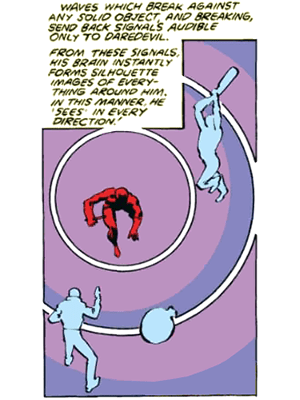
Human echolocation [ek-oh-loh-key-shuhn] is the ability of humans to detect objects in their environment by sensing echoes from those objects. This ability is used by some blind people to navigate within their environment. They actively create sounds, such as by tapping their canes, lightly stomping their foot or by making clicking noises with their mouths (however, because humans click with much lower frequencies and slower rates than other animals, only larger objects can be sensed). The principle is comparable to active sonar in submarines and to echolocation by bats and dolphins.
Vision and hearing are closely related in that they can process reflected waves of energy. Vision processes light waves as they travel from their source, bounce off surfaces throughout the environment and enter the eyes. Similarly, the auditory system processes sound waves as they travel from their source, bounce off surfaces and enter the ears. Both systems can extract a great deal of information about the environment by interpreting the complex patterns of reflected energy that they receive. In the case of sound, these waves of reflected energy are called ‘echoes.’



Leave a comment