February 3, 2011

Divination [div-uh-ney-shuhn] (from Latin divinare ‘to foresee,’ or ‘to be inspired by a god’) is an attempt to get information through rituals, omens or supernatural things. Divining the outcome of things has been done by many different methods, such as astrology, which attempts to predict the future based on the movement of celestial bodies. Divination is not supported by empirical evidence and is dismissed by the scientific community, as mere superstition.
In ancient Rome augers divined the future by the flight patterns of birds. Tarot and other forms of cartomancy divine cards. Palmistry is palm reading. Extispicy is a particularly old tradition where the future is divined from the entrails of scarified animals. Graphology makes predictions based on handwriting analysis, and numerology analyses number systems. Phrenology is a bygone system of ‘reading’ the shape of a person’s head.
Posted in Language, Philosophy |
Leave a Comment »
February 3, 2011

Vice is a free magazine and media conglomerate founded in Montreal and currently based in New York City. It is available in 19 countries. It supports itself primarily through advertising. Founded by Suroosh Alvi, Shane Smith, and Gavin McInnes, it was launched as the ‘Voice of Montreal’ in 1994 with government funding to provide work and a community service. When the editors wanted to break free of their commitments with the original publisher, Alix Laurent, they bought him out and changed the name to ‘Vice’ in 1996.
Vice’s content has shifted from dealing mostly with independent arts and pop cultural matters to covering more serious news topics, although both are often treated with the same spirit of blithe and caustic irreverence. Vice has championed the ‘Immersionist’ school of journalism, which it regards as something of a DIY antithesis to the big-office methods practiced by traditional news outlets. There have been issues dedicated to concerns facing Iraqi people, Native Americans, Russian people, people with mental disorders, and people with mental disabilities.
Posted in Art, Language, Money |
Leave a Comment »
February 3, 2011

Poken is a device that utilizes a proprietary Near Field Communication (NFC) technology to allow the exchange of online social networking data between two keychain accessories. The primary information exchanged via the poken is a ‘social business card,’ a digital replacement for a physical business card. By touching two devices together, a unique ID is exchanged that links to contact information on the Poken website. Users of the Poken website can use a ‘social dashboard’ to manage, and interact with their contacts.
Posted in Technology |
Leave a Comment »
February 3, 2011

Endorphins (‘endogenous morphine’) are proteins that are similar to opioids. They are hormones made by the endocrine system of many vertebrates. When they are released into the body, they cause a sense of well-being. They also act as analgesics, and are sometimes named ‘natural pain killers.’ Endorphins were first found in 1970s. They are produced by the pituitary gland and the hypothalamus during exercise, excitement, pain, consumption of spicy food, love and orgasm, and they resemble the opiates in their abilities to produce analgesia and a feeling of well-being. The sudden release of endorphins during strenuous exercise is sometimes called a ‘runner’s high.’
The term endorphin rush has been adopted in popular speech to refer to feelings of exhilaration brought on by pain, danger, or other forms of stress, supposedly due to the influence of endorphins. When a nerve impulse reaches the spinal cord, endorphins are released which prevent nerve cells from releasing more pain signals. Immediately after injury, endorphins allow animals to feel a sense of power and control over themselves that allows them to persist with activity for an extended time.
Posted in Drugs, Health, Science |
Leave a Comment »
February 3, 2011

Defenestration [dee-fen-uh-strey-shuhn] is the act of throwing someone or something out of a window. The term originates from two incidents in history, both occurring in Prague. In 1419, seven town officials were thrown from the Town Hall, precipitating the Hussite War. In 1618, two Imperial governors and their secretary were tossed from Prague Castle, sparking the Thirty Years War. These incidents, particularly in 1618, were referred to as the Defenestrations of Prague and gave rise to the term and the concept. The word comes from the Latin de- (down or away from) and fenestra (window or opening).
The act carries the connotation of forcibly or peremptorily removing an adversary, and the term is sometimes used in just that sense; it also suggests breaking the windows in the process (de- also means removal). Although defenestrations can be fatal due to the height of the window through which a person is thrown or throws oneself or due to lacerations from broken glass, the act of defenestration need not carry the intent or result of death. Self-defenestration (autodefenestration) is the act of jumping, propelling oneself, or causing oneself to fall, out of a window.
Posted in Language, War |
Leave a Comment »
February 2, 2011
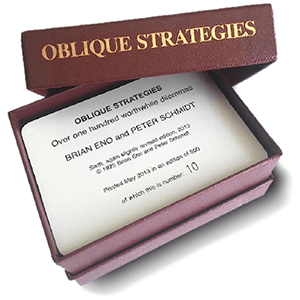
Oblique Strategies (subtitled ‘over one hundred worthwhile dilemmas’) is a set of published cards created by Brian Eno and Peter Schmidt first published in 1975, and is now in its fifth, open ended, edition. Each card contains a phrase or cryptic remark which can be used to break a deadlock or dilemma situation. Some are specific to music composition; others are more general. Examples include: Use an old idea / State the problem in words as clearly as possible / What would your closest friend do? / Are there sections? Consider transitions / Try faking it!
Posted in Humor, Language |
Leave a Comment »
February 2, 2011

Victory gardens, also called war gardens, were vegetable, fruit and herb gardens planted at private residences and public parks in United States, United Kingdom, Canada and Germany during World War I and World War II to reduce the pressure on the public food supply brought on by the war effort. In addition to indirectly aiding the war effort these gardens were also considered a civil ‘morale booster’ — in that gardeners could feel empowered by their contribution of labor and rewarded by the produce grown. This made victory gardens become a part of daily life on the home front.
Posted in Food, Money, War |
Leave a Comment »
February 2, 2011

Ironic processing is the psychological process whereby an individual’s deliberate attempts to suppress or avoid certain thoughts (thought suppression) render those thoughts more persistent.
read more »
Posted in Health, Science |
Leave a Comment »
February 2, 2011
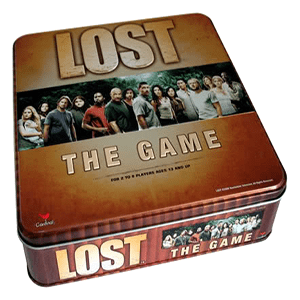
The Game is a mental game where the objective is to avoid thinking about The Game itself. Thinking about The Game constitutes a loss, which, according to the rules of The Game, must be announced each time it occurs. It is impossible to win The Game; players can only attempt to avoid losing for as long as they possibly can. The Game has been variously described as pointless and infuriating. There are three rules to The Game: Everyone in the world is playing The Game. You cannot not play The Game. Whenever one thinks about The Game, one loses.
Posted in Games, Humor |
Leave a Comment »
February 2, 2011
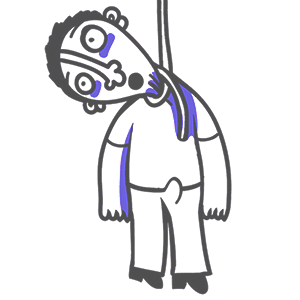
A death erection, angel lust, or terminal erection is a post-mortem erection, technically a priapism (prolonged involuntary erection), observed in the corpses of human males who have been executed, particularly by hanging. The phenomenon has been attributed to pressure on the cerebellum created by the noose. Spinal cord injuries are known to be associated with priapism. Other causes of death may also result in these effects, including fatal gunshot wounds to the brain, damage to major blood vessels, and violent death by poisoning. A postmortem priapism is an indicator that death was likely swift and violent.
Death by hanging, whether an execution or a suicide, has been observed to affect the genitals of both men and women. In women, the labia and clitoris will become engorged and there may be a discharge of blood from the vagina. In men, a more or less complete state of erection of the penis, with discharge of urine, mucus or prostatic fluid is a frequent occurrence – present in one case in three.
Posted in Death, Health, Sex |
Leave a Comment »
February 2, 2011
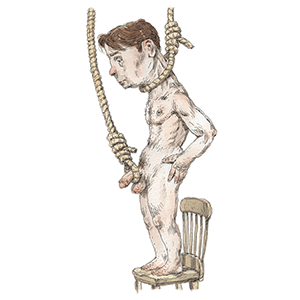
Erotic asphyxiation is the intentional restriction of oxygen to the brain for sexual arousal. It is also called asphyxiophilia, hypoxyphilia, or breath control play. Colloquially, a person engaging in the activity is sometimes called a ‘gasper.’
The carotid arteries (on either side of the neck) carry oxygen-rich blood from the heart to the brain. When these are compressed, as in strangulation or hanging, the sudden loss of oxygen to the brain and the accumulation of carbon dioxide can increase feelings of giddiness, lightheadedness, and pleasure, all of which will heighten sexual sensations.
read more »
Posted in Death, Health, Sex |
1 Comment »
February 2, 2011
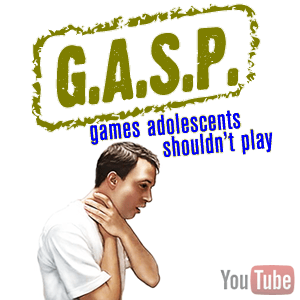
The fainting game refers to intentionally cutting off oxygen to the brain with the goal of inducing temporary syncope (loss of consciousness) and euphoria. There are two distinct methods used to achieve oxygen deprivation: strangulation and rapid breathing (self-induced hypocapnia). The fainting game is pursued primarily by children and teens to get a high without taking drugs. It is frequently confused with erotic asphyxiation, which is oxygen deprivation for sexual arousal.
The practice goes by many other names in different parts of the world, such as: Riding a Rocket, Airplaning, America Dream Game, Black Out Game, Breath Play, Bum Rushing, California Choke, California Headrush, Choking Out, Cloud Nine, Dying game, Dream Game, Elevator, Flatline Game, Funky Chicken, Harvey Wallbanger, Hyperventilation Game, Indian Headrush, Knockout Game, Pass-out Game, Natural High, Sleeper Hold, Space Cowboy, Space Monkey, Suffocation Roulette, Rising Sun, High Riser, Tingling Game, Trip to Heaven, Speed Dreaming, Wall-Hit, and Purple Dragon.
Posted in Health, Language, Sex |
Leave a Comment »




 The Daily Omnivore