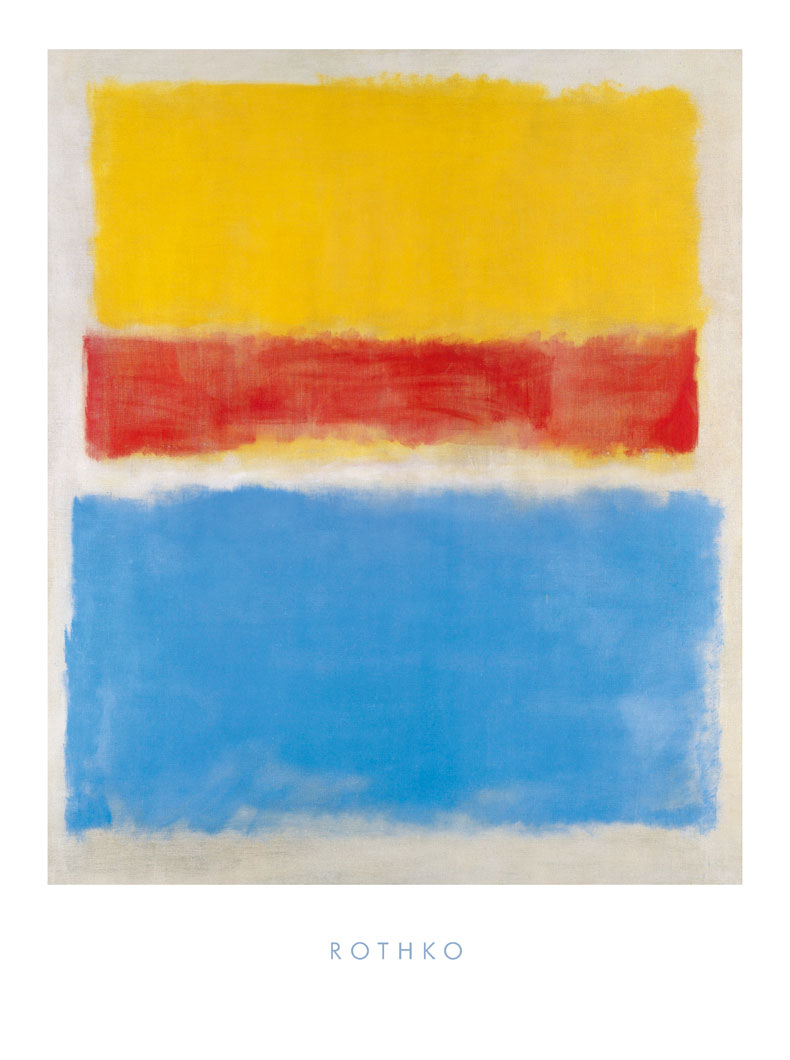
Mark Rothko (1903 – 1970) was a Latvian-born American painter. He is classified as an abstract expressionist, although he rejected the label, and even resisted classification as an ‘abstract painter.’ 1946 saw the creation of Rothko’s transitional ‘multiform’ paintings. He gradually transitioned from surrealistic, myth-influenced works of the early part of the decade to the highly abstract, Clyfford Still-influenced forms of pure color. For Rothko, these blurred blocks of various colors, devoid of landscape or human figure, let alone myth and symbol, possessed their own life force. They contained a ‘breath of life’ he found lacking in most figurative painting of the era.
He started with the application of a thin layer of binder mixed with pigment directly onto uncoated and untreated canvas on which he painted significantly thinned oils, creating a dense mixture of overlapping colors and shapes. His brush strokes were fast and light. Rothko used several original techniques that he tried to keep secret even from his assistants. Electron microscopy and ultraviolet analysis showed that he employed natural substances such as egg and glue, as well as artificial materials including acrylic resins, phenol formaldehyde, and modified alkyd. One of his objectives was to make the various layers of the painting dry quickly, without mixing of colors, such that he could soon create new layers on top of the earlier ones.


 The Daily Omnivore
Leave a comment