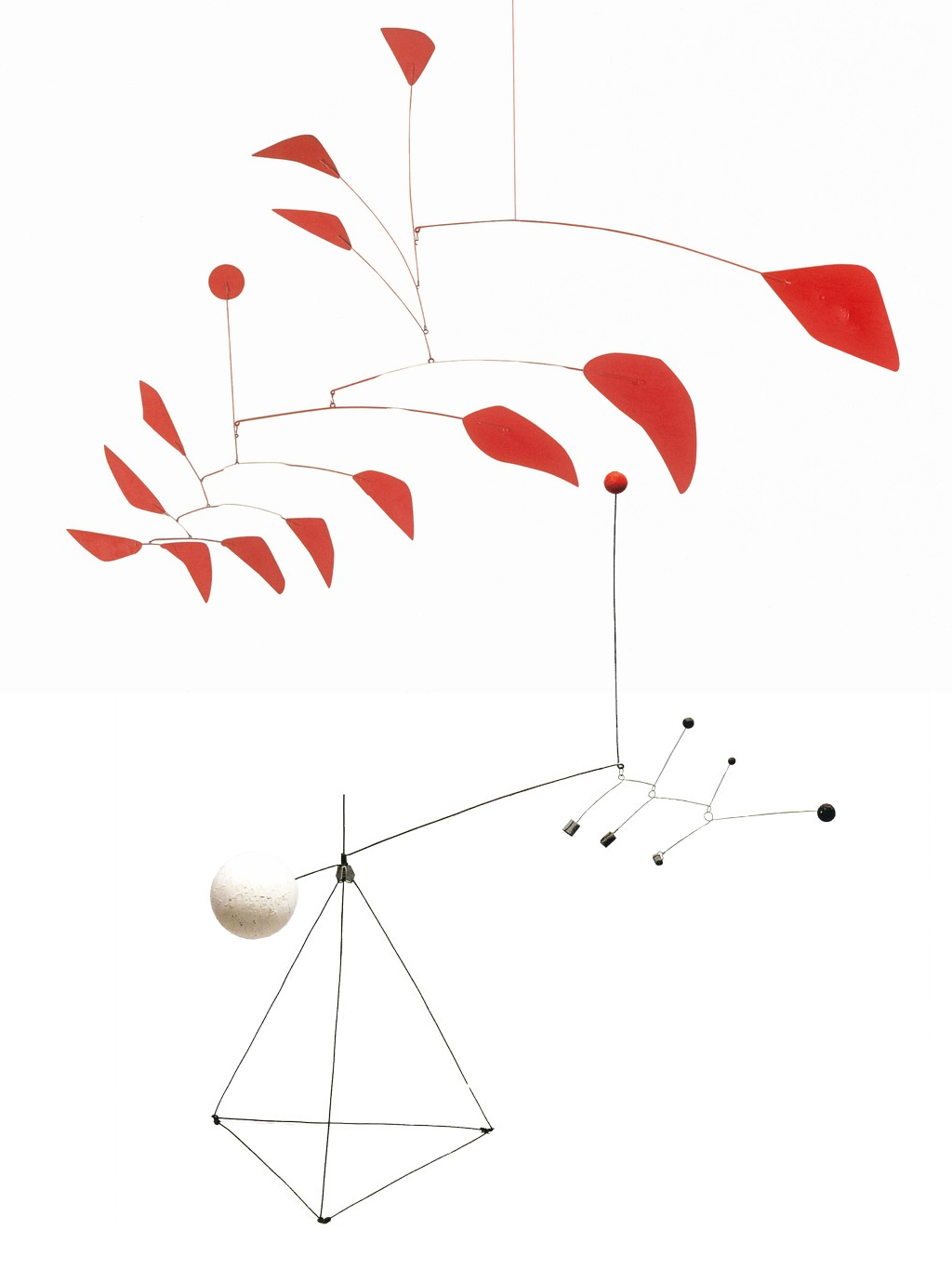
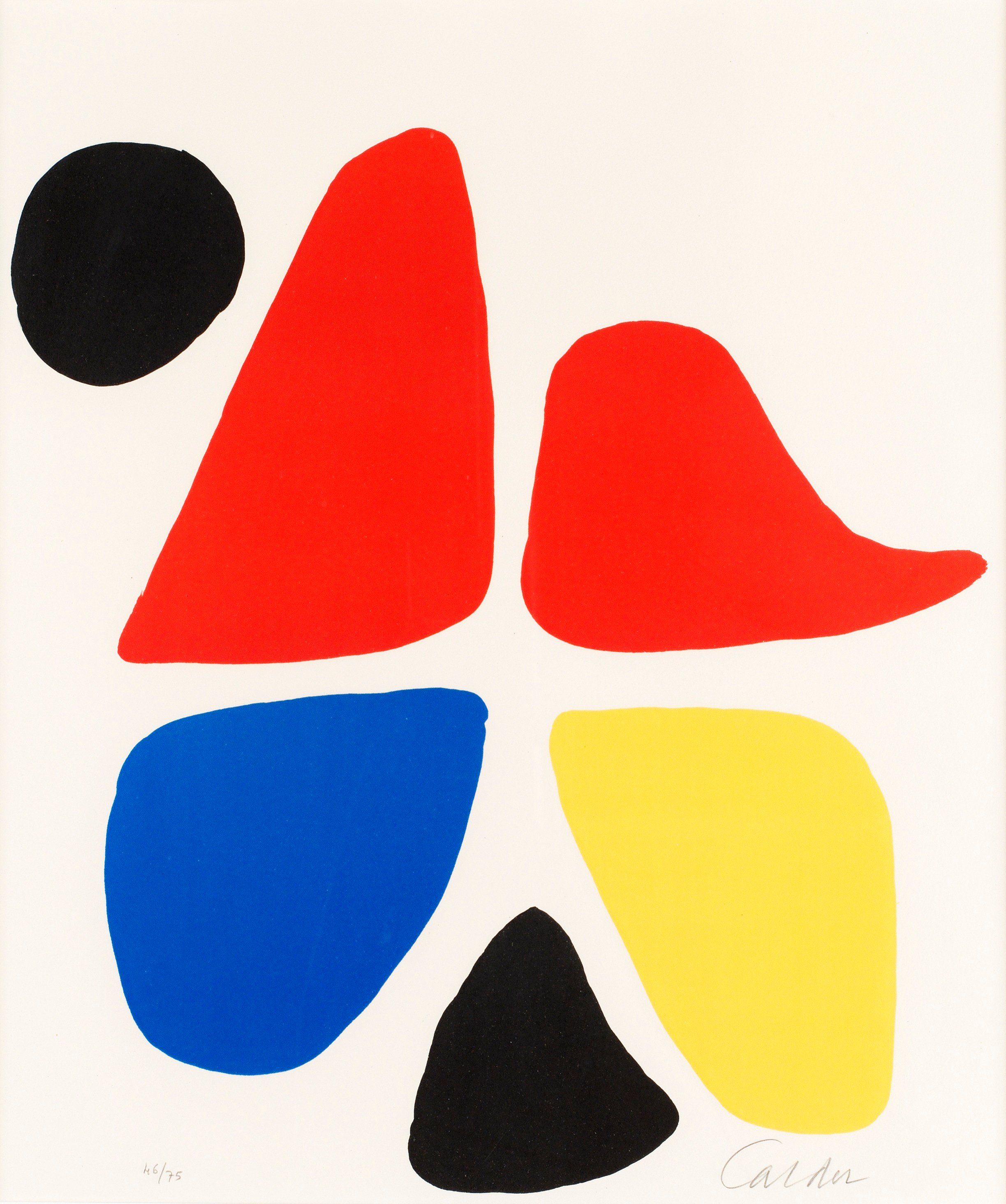
Alexander Calder [kawl-der] (1898 – 1976) was an American sculptor and artist most famous for inventing the mobile.
In addition to mobile and stabile sculpture, Alexander Calder also created paintings, lithographs, toys, tapestry, jewelry and household objects.
Calder was born in Pennsylvania, to Alexander Stirling Calder, a well-known sculptor who created many public installations, a majority of them in Philadelphia. Calder’s grandfather, sculptor Alexander Milne Calder, was born in Scotland and immigrated to Philadelphia in 1868, and is best-known for the colossal statue of William Penn on top of Philadelphia’s City Hall tower. In 1902, at the age of four, Calder posed nude for his father’s sculpture ‘The Man Cub,’ which is now located in the Metropolitan Museum of Art in New York City.
While a student, he worked for the National Police Gazette where, in 1925, one of his assignments was sketching the Ringling Brothers and Barnum and Bailey Circus. Calder became fascinated with the circus, a theme that would reappear in his later work.
In 1926, he moved to Paris where he established a studio in the Montparnasse Quarter. At the suggestion of a Serbian toy merchant, he began to make toys.
Later that year, Calder began to create his ‘Cirque Calder,’ a miniature circus fashioned from wire, string, rubber, cloth, and other found objects. Designed to fit into suitcases (it eventually grew to fill five), the circus was portable, and allowed Calder to hold performances on both sides of the Atlantic. He gave improvised shows, recreating the performance of a real circus. The original piece is kept at the Whitney Museum of American Art in New York City.
In 1927, Calder returned to the United States. He designed several kinetic wooden push and pull toys for children, which were mass-produced by the Gould Manufacturing Company, in Oshkosh, WI. His originals, as well as playable replicas, are on display in the Berkshire Museum in Pittsfield, Massachusetts.
While in Paris, Calder met and became friends with a number of avant-garde artists, including Joan Miró, Jean Arp, and Marcel Duchamp. A visit to Piet Mondrian’s studio in 1930 ‘shocked’ him into embracing abstract art.
The Cirque Calder can be seen as the start of Calder’s interest in both wire sculpture and kinetic art. He maintained a sharp eye with respect to the engineering balance of the sculptures and utilized these to develop the kinetic sculptures Duchamp would ultimately dub as ‘mobiles,’ a French pun meaning both ‘mobile’ and ‘motive.’
By the end of 1931, he moved on to more delicate sculptures which derived their motion from the air currents in the room. At the same time, Calder was also experimenting with self-supporting, static, abstract sculptures, dubbed ‘stabiles.’
During World War II, Calder attempted to join the Marines as a camofleur, but was rejected. Instead, he continued to sculpt, but a scarcity of metal led to him producing work in carved wood.
In the 1950s, Calder increasingly concentrated his efforts on producing monumental sculptures. Notable examples are ‘.125’ for JFK Airport in 1957, ‘La Spirale’ for UNESCO in Paris 1958 and ‘Man’ (‘L’Homme’), commissioned for Expo 67 in Montreal. Calder’s largest sculpture until that time, 20.5 meters high, was ‘El Sol Rojo,’ constructed for the 1968 Summer Olympics in Mexico City.
Calder created a sculpture called WTC Stabile (also known as Bent Propeller), which in 1971 was installed at the entrance of the World Trade Center’s North Tower. When Battery Park City opened, the sculpture was moved to Vesey and Church Streets. It stood in front of 7 World Trade Center when it was destroyed on September 11, 2001.
In addition to sculptures, Calder painted throughout his career, beginning in the early 1920s. By 1973, Braniff International Airways commissioned him to paint a full-size DC-8-62 as a ‘flying canvas.’ In 1975, Calder completed a second plane, this time a Boeing 727-227, as a tribute to the U.S. Bicentennial. In 1975, he was commissioned by BMW to paint a BMW 3.0 CSL which would come to be the first vehicle in the BMW Art Car Project.


 The Daily Omnivore
Leave a comment