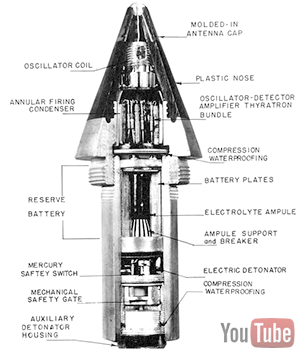
A proximity fuze is designed to detonate an explosive device automatically when the distance to target becomes smaller than a predetermined value or when the target passes through a given plane. A shell with a standard ‘contact fuze’ explodes upon impact, and a ‘time fuze’ after a specified number of seconds. A ‘proximity fuze,’ however uses a radio detection system, and explodes when within a certain distance from a target.
One of the first practical proximity fuzes was codenamed the ‘VT fuze,’ an acronym of ‘Variable Time fuze,’ as deliberate camouflage for its operating principle. The VT fuze concept in the context of artillery shells originated in the UK with British researchers (particularly Sir Samuel Curran) and was developed under the direction of physicist Merle A. Tuve at The Johns Hopkins University Applied Physics Lab. It is considered one of the most important technological innovations of World War II.


 The Daily Omnivore
Leave a comment