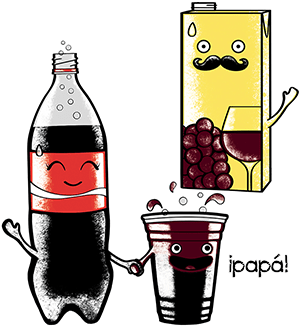
Kalimotxo [kal-ee-moht-cho] is a drink consisting of approximately 50% red wine and 50% cola-based soft drink.
read more »
Everything is Interesting
Kalimotxo [kal-ee-moht-cho] is a drink consisting of approximately 50% red wine and 50% cola-based soft drink.
read more »


The ARM is a computer instruction set architecture (ISA) developed by ARM Holdings. An instruction set is a list of all the instructions that a processor can execute (e.g. add, subtract, move, load, store, etc.). It was known as the Advanced RISC Machine, and before that as the Acorn RISC Machine. The ARM architecture is the most widely used ISA.
In 2005, about 98 percent of the more than one billion mobile phones sold each year used at least one ARM processor. ARM processors are used extensively in consumer electronics, including PDAs, mobile phones, digital media and music players, hand-held game consoles, calculators and computer peripherals such as hard drives and routers.

Silicon Fen (sometimes the Cambridge Cluster) is the name given to the region around Cambridge, England, which is home to a number of high-tech businesses, especially those related to software, electronics, and biotechnology. Many of these have connections with the University of Cambridge, and the area is now one of the most important technology centers in Europe. It is called ‘Silicon Fen’ by analogy with Silicon Valley in California, because it lies at the south of Fenland.
The so-called Cambridge phenomenon, giving rise to start-up companies in a town previously only having a little light industry in the electrical sector, is usually dated to the founding of the Cambridge Science Park in 1970 (an initiative of Trinity College that moved away from a traditional low-development policy for Cambridge). The area is known for a high degree of ‘networking,’ enabling people across the region to find partners, jobs, funding, and know-how. Organisations have sprung up to facilitate this process, for example the Cambridge Network.

The Kōreisha mark is a statutory sign in Japan which indicates ‘aged person at the wheel.’ The law decrees that when a person who is aged 70 and over drives a car and if his/her old age could affect the driving, he/she should endeavor to display this mark on both the front and rear of the car. Drivers aged 75 and over are obliged to display the mark.
Conversely, the green and yellow shoshinsha mark or wakaba mark denotes new drivers. Both marks are designed to warn other drivers that the marked driver is not very skilled, either due to inexperience or old age.


Kruder & Dorfmeister is an Austrian duo most known for their downtempo-dub remixes of pop, hip-hop and drum and bass songs. Their mixes are usually flavored with sampler-processed vocals, deep bassline dub, trip-hop elements, bossa grooves and smoothly-shaped echoes. Some of their better-known works include ‘High Noon,’ ‘Original Bedroom Rockers’ and remixes of Madonna’s ‘Nothing Really Matters,’ Depeche Mode’s ‘Useless,’ Count Basic’s ‘Speechless’ and Roni Size’s ‘Heroes.’
Many of their remixes are collected on the double album ‘The K & D Sessions.’ Although best known internationally for their remixing work, the duo gained their primary reputation in Europe for their live DJ performances and ‘DJ-Kicks’ album. Peter Kruder and Richard Dorfmeister have their own record studio, G Stone Recordings in Vienna, through which they release many of their own albums.

AdWords is Google’s main advertising product and main source of revenue. Google’s total advertising revenues were USD$28 billion in 2010. AdWords offers pay-per-click (PPC) advertising, cost-per-thousand (CPM) advertising, and site-targeted advertising for text, banner, and rich-media ads. The AdWords program includes local, national, and international distribution. Google’s text advertisements are short, consisting of one headline and two additional text lines. Image ads can be one of several different Interactive Advertising Bureau (IAB) standard sizes.
On Google the adverts are displayed either at the very top of the search results with an orange background, on the right hand side or in both these places. In a PPC contract advertisers pay Google each time someone clicks on their advert. Many pay per click providers exist, Google AdWords, Yahoo! Search Marketing, and Microsoft adCenter are the three largest operators.

The Ides of March is a day on the Roman calendar that corresponds to March 15th. It was marked by several religious observances, and became notorious as the date of the assassination of Julius Caesar in 44 BCE. In Canada, the day is commemorated with the drinking of Bloody Caesar (a Bloody Mary made with Clamato). In the original Roman calendar, March was the first month of the year. The holidays observed by the Romans from the first through the Ides often reflect their origin as new year celebrations. The Romans did not number days of a month sequentially from the first through the last day.
Instead, they counted back from three fixed points of the month: the Nones (5th or 7th, depending on the length of the month), the Ides (13th or 15th), and the Kalends (1st) of the following month. The Ides occurred near the midpoint, on the 13th for most months, but on the 15th for March, May, July, and October. The Ides were supposed to be determined by the full moon, reflecting the lunar origin of the Roman calendar. On the earliest calendar, the Ides of March would have been the first full moon of the new year.
read more »
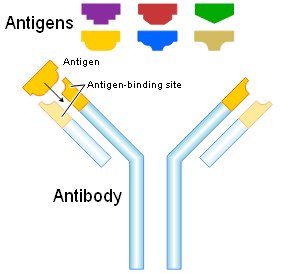

An antigen [ann-tuh-jen] is a protein expressed by a bacteria or virus that is recognized by an immune system as foreign which can stimulate the production of antibodies and combine specifically with them. Usually an antibody is a molecule, perhaps on the cell surface of a bacterium or virus. Antibodies are always ‘foreign’; except in rare cases the system is tolerant of its own molecules. Autoimmune diseases are caused when this safeguard fails. When an antigen is introduced into the body it causes the production of antibodies. Antigens include bacteria, cells of transplanted organs, plant pollen and toxins.
The first time that a new antigen comes into contact with the body the response of the immune system will be a complete immune response. During this first response, the antigen will cause antibodies to be made. The next time the same antigen contacts the body, a full scale immune response is not needed as the body already has a specific antibody available instantly for that antigen. This means that the body can begin fighting an infection much sooner for illnesses it has encountered before, and takes more time to begin to fight an infection in new illnesses.

Beer head is the frothy foam on top of beer after it is poured in a glass. It is produced by bubbles of carbon dioxide rising to the surface. The density and longevity of the head will be determined by the type of malt and adjunct from which the beer was fermented. In general, wheat tends to produce larger and longer lasting heads than barley.
The carbon dioxide may be produced naturally through the activity of brewer’s yeast, or artificially by dissolving carbon dioxide under pressure into the liquid. The beer head is created by the carbon dioxide produced as a byproduct of the metabolism of brewer’s yeast acting upon starches and sugars found in the wort.
read more »
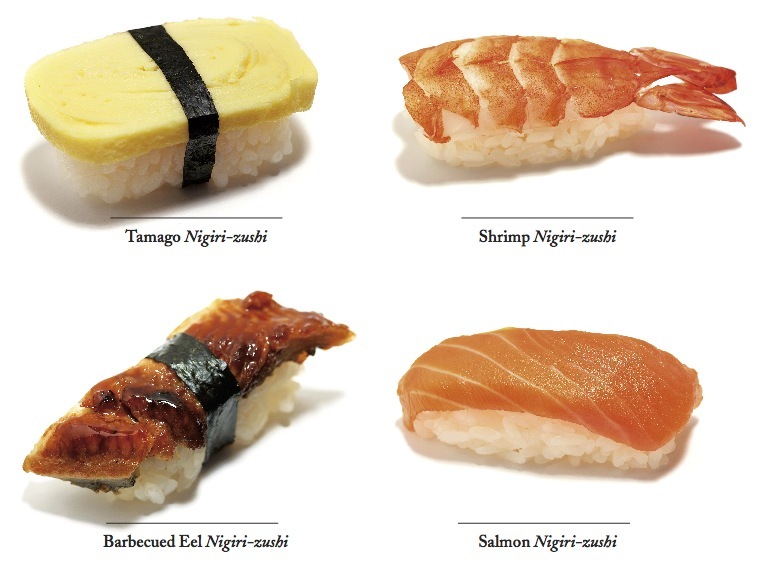
Nigirizushi [ni-geer-ee-zoo-shee] (‘hand-formed sushi’) is an oblong mound of sushi rice that the chef presses into a small rectangular box between the palms of the hands, usually with a bit of wasabi, and a topping draped over it (typically seafood). Certain toppings are bound to the rice with a thin strip of nori (seaweed), most commonly octopus (tako), freshwater eel (unagi), sea eel (anago), squid (ika), and sweet egg (tamago). When ordered separately, nigiri is generally served in pairs. A sushi set (a sampler dish) may contain only one piece of each topping.
Gunkanmaki (‘warship roll’) is a special type of nigirizushi: an oval, hand-formed clump of sushi rice that has a strip of nori wrapped around its perimeter to form a vessel that is filled with some soft, loose or fine-chopped ingredient that requires the confinement of nori such as roe, natto, oysters, sea urchin, corn with mayonnaise, and quail eggs. Temarizushi (‘ball sushi’) is a ball-shaped sushi made by pressing rice and fish into a ball-shaped form by hand using a plastic wrap.

A hopper crystal is a form of crystal, defined by its ‘hoppered’ shape: the edges are fully developed, but the interior spaces are not filled in due to rapid growth. This results in what appears to be a hollowed out step lattice formation; the interior edges still show the crystal form characteristic to the specific mineral, and so appear to be a series of smaller and smaller stepped down miniature versions of the original crystal.
Hoppering occurs when electrical attraction is higher along the edges of the crystal, causing faster growth at edges than near face centers. This attraction draws the mineral molecules more strongly than the interior sections of the crystal, thus the edges develop more quickly. Hoppering is common in many minerals, including lab-grown bismuth, galena, quartz (called skeletal or fenster crystals), gold, calcite, halite (salt), and water (ice).

The Jyllands-Posten Muhammad cartoons controversy began after 12 editorial cartoons, most of which depicted the Islamic prophet Muhammad, were published in the Danish newspaper ‘Jyllands-Posten’ in 2005. The newspaper announced that this publication was an attempt to contribute to the debate regarding criticism of Islam and self-censorship. Danish Muslim organizations responded by holding public protests. The cartoons were reprinted in newspapers in more than 50 other countries, expanding the controversy.
Critics of the cartoons described them as Islamophobic or racist, and argued that they are blasphemous to people of the Muslim faith, are intended to humiliate a Danish minority, or are a manifestation of ignorance about the history of Western imperialism. Supporters have said that the cartoons illustrated an important issue in a period of Islamic terrorism and that their publication is a legitimate exercise of the right of free speech, explicitly tied to the issue of self-censorship.


 The Daily Omnivore