March 29, 2011

Sheeple (a portmanteau of ‘sheep’ and ‘people’) is a term of disparagement, in which people are likened to sheep. It is often used to denote persons who voluntarily acquiesce to a perceived authority or suggestion without sufficient research to understand fully the ramifications involved in that decision, and thus undermine their own human individuality or in other cases give up certain rights.
The implication of sheeple is that as a collective, people believe or do whatever they are told, especially if told so by a perceived authority figure believed to be trustworthy, without critically thinking about it or doing adequate research to be sure that it is an accurate representation of the real world around them. The term is generally used in a political, social, and mostly in a spiritual sense.
Posted in Humor, Language, Politics |
Leave a Comment »
March 29, 2011

The Bradley effect is a theory proposed to explain observed discrepancies between voter opinion polls and election outcomes in some US government elections where a white candidate and a non-white candidate run against each other. The theory proposes that some voters will tell pollsters they are undecided or likely to vote for a black candidate, while on election day they vote for the white candidate. It was named after Los Angeles Mayor Tom Bradley, an African-American who lost the 1982 California governor’s race despite being ahead in voter polls going into the elections.
The effect theorizes that the inaccurate polls were skewed by the phenomenon of social desirability bias. Specifically, some white voters give inaccurate polling responses for fear that, by stating their true preference, they will open themselves to criticism of racial motivation. Some analysts have dismissed that theory, or argued that it may have existed in past elections, but not in more recent ones. Others believe that it is a persistent phenomenon. Similar effects have been posited in other contexts, notably the Shy Tory Factor and spiral of silence.
Posted in Politics |
Leave a Comment »
March 29, 2011

Groupthink is a type of thought within a deeply cohesive group whose members try to minimize conflict and reach consensus without critically testing, analyzing, and evaluating ideas. Research psychologist, Irving Janis studied a number of ‘disasters’ in American foreign policy, such as failure to anticipate the Japanese attack on Pearl Harbor (1941), the Bay of Pigs fiasco (1961), and the prosecution of the Vietnam War (1964–67) by President Lyndon Johnson. He concluded that in each of these cases, the decisions were made largely due to the cohesive nature of the committees which made them. Moreover, that cohesiveness prevented contradictory views from being expressed and subsequently evaluated.
Individual creativity, uniqueness, and independent thinking are lost in the pursuit of group cohesiveness, as are the advantages of reasonable balance in choice and thought that might normally be obtained by making decisions as a group. Members of the group avoid promoting viewpoints outside the comfort zone of consensus thinking to avoid being seen as foolish, or to avoid embarrassing or angering other members of the group. Groupthink may cause groups to make hasty, irrational decisions, where individual doubts are set aside, for fear of upsetting the group’s balance. The term is frequently used pejoratively, in hindsight, and was coined by journalist William H. Whyte in a 1952 ‘Fortune’ magazine article.
Posted in Money, Politics, Science |
Leave a Comment »
March 29, 2011

The Abilene paradox is a paradox in which a group of people collectively decide on a course of action that is counter to the preferences of any of the individuals in the group. It involves a common breakdown of group communication in which each member mistakenly believes that their own preferences are counter to the group’s and, therefore, does not raise objections. A common phrase relating to the Abilene paradox is a desire to not ‘rock the boat.’
read more »
Posted in Money, Science |
Leave a Comment »
March 29, 2011

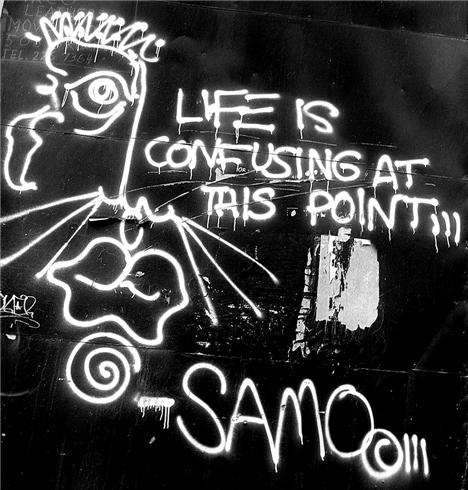
SAMO© graffiti appeared in NYC from 1977 to early 1980. They were short phrases, in turns poetic and sarcastic, mainly painted in downtown Manhattan. The tag has been primarily associated with the artist Jean-Michel Basquiat, but was developed in collaboration with his high school friend Al Diaz, and a few others. Diaz had previously been part of the New York graffiti scene, using the tag ‘Bomb I.’ Later Basquiat took on the tag himself, creating some non-graffiti work on paper and canvas with it, just before and after killing off the SAMO graffiti by painting ‘SAMO IS DEAD’ around the streets of downtown in early 1980.
Basquiat claims the name was first developed in a stoned conversation with Diaz, calling the marijuana they smoked ‘the same old shit.’ The character of SAMO was first developed by Basquiat, Diaz, and Shannon Dawson while they were students at City As School high school. Basquiat took the lead in the project, selling a false religion, in comics made in high school. The concept was further developed in a theatre-as-therapy course in upper Manhattan (called ‘Family Life’).
Posted in Art |
Leave a Comment »
March 29, 2011

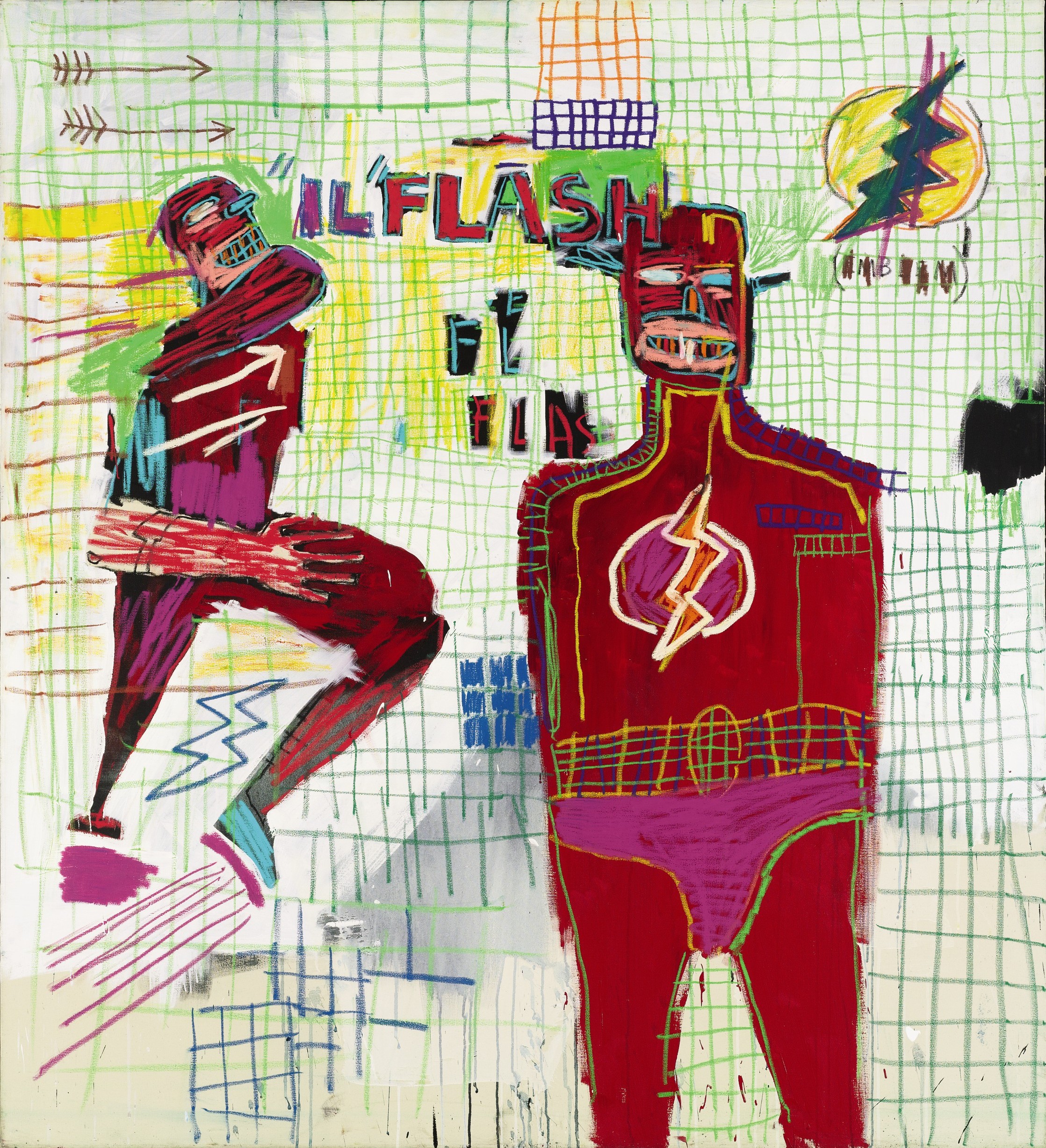
Jean-Michel Basquiat [bah-skee-ott] (1960 – 1988) was a Neo-expressionist painter who got his start as a graffiti artist in NYC in the late 1970s. He died of a heroin overdose at the age of 27. In 1976, Basquiat and friend Al Diaz began spray-painting political-poetical graffiti on buildings in Lower Manhattan, working under the pseudonym SAMO. In 1979, he formed the noise rock band Gray with Vincent Gallo. In 1983-84 he was a frequent collaborator with Andy Warhol. The record price for a Basquiat painting is $14.6 million, paid in 2007 for an untitled 1981 piece. In keeping with his street art roots, Basquiat often incorporated words into his paintings.
He would often draw on random objects and surfaces. A major reference source throughout his career was ‘Gray’s Anatomy,’ which his mother gave to him while in the hospital at age seven. It remained influential in his depictions of internal human anatomy, and in its mixture of image and text. Other reference sources were Henry Dreyfuss’ ‘Symbol Sourcebook,’ Da Vinci’s notebooks, and Brentjes’ ‘African Rock Art.’ Basquiat doodled often, and some of his later pieces, done mostly with colored pencils on paper, exhibit this, often with a loose, spontaneous, and dirty style much like his paintings.
Posted in Art, Money |
Leave a Comment »
March 29, 2011
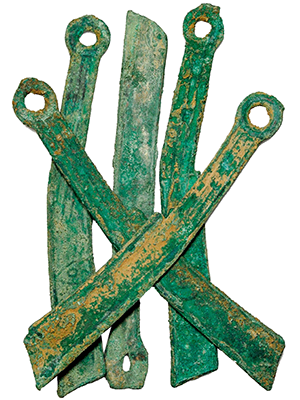
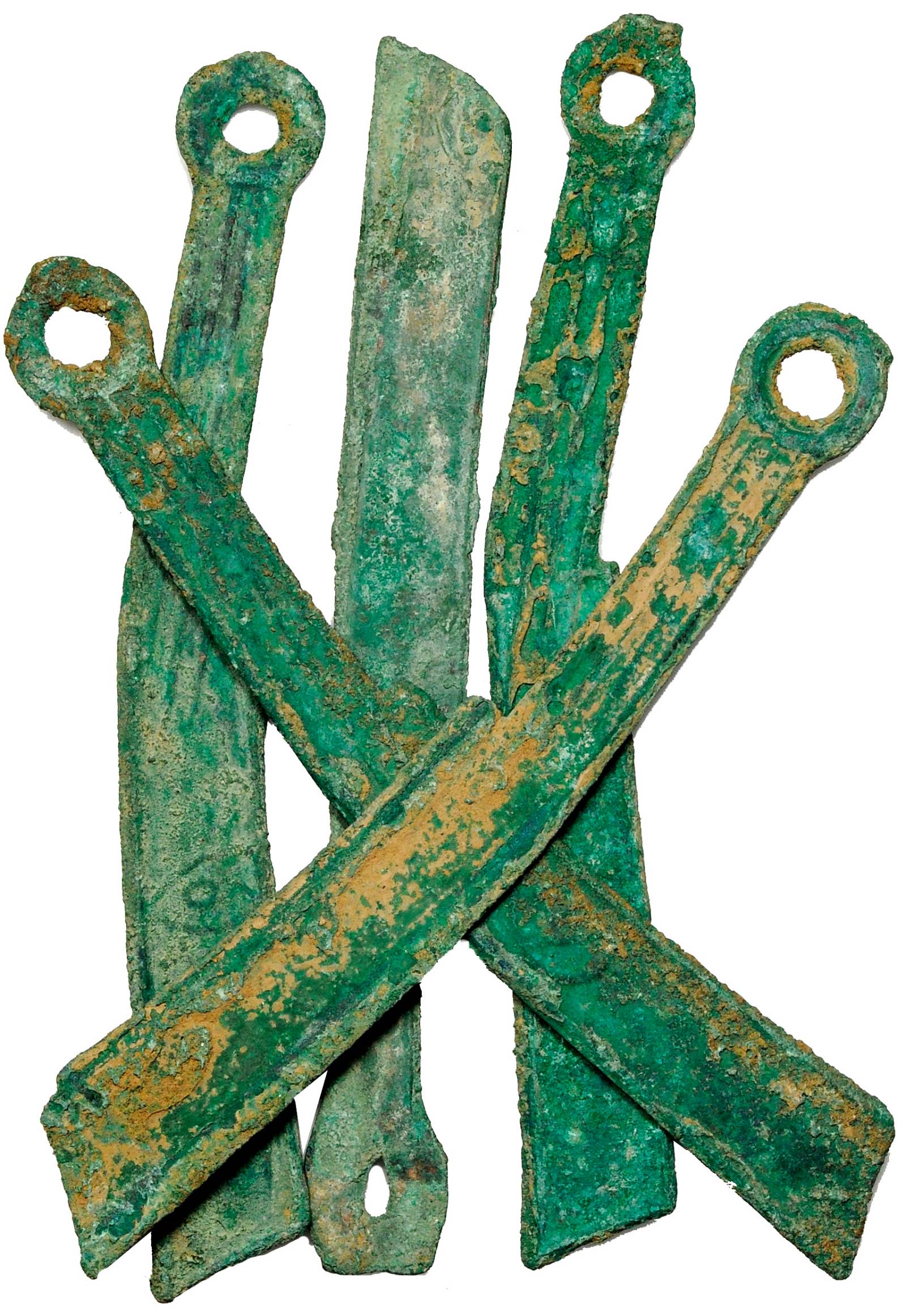
Knife money refers to large, cast, bronze, knife-shaped coins produced by Ancient Chinese governments and kingdoms approximately 2500 years ago. They had holes on the end to be easily strapped onto belts or rings. Known as ‘jin cuo dao’ in Chinese, knife money circulated in China between 600 to 200 BCE during the Zhou dynasty. There are several stories that attempt to explain how knife money was introduced but it is not certain if any or all are true.
In one story a prince who was running low on money to pay his troops allowed them to use their knives as a form of currency to barter with villagers and the medium became so popular that it became generally accepted. In another story, the same prince began accepting knives as payment for small fines in the place of the current legal ring currency. Knife money may also have been brought in by sea traders from the Indian Ocean. Over time, the currency slowly shrank until only the ring of the handle was produced as a symbol of the knife that it represented.
Posted in Money, World |
Leave a Comment »
March 29, 2011
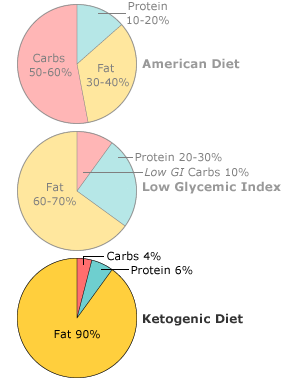
The ketogenic [kee-toh-jen-ik] diet is a high-fat, adequate-protein, low-carbohydrate diet that in medicine is used primarily to treat difficult-to-control epilepsy in children. The diet mimics aspects of starvation by forcing the body to burn fats rather than carbohydrates.
Normally, the carbohydrates contained in food are converted into glucose, which is then transported around the body and is particularly important in fuelling brain function. However, if there is very little carbohydrate in the diet, the liver converts fat into fatty acids and ketone bodies. The ketone bodies pass into the brain and replace glucose as an energy source. An elevated level of ketone bodies in the blood, a state known as ketosis, leads to a reduction in the frequency of epileptic seizures.
read more »
Posted in Food, Health, Science |
Leave a Comment »
March 28, 2011

Red Hot Organization (RHO) is an international not-for-profit organization dedicated to fighting AIDS through pop culture. Since its inception in 1989, over 400 artists, producers and directors have contributed to over 15 compilation albums, related television programs and media events to raise donations totaling more than 10 million dollars for HIV / AIDS relief and awareness around the world.
First founded as King Cole, Inc. by Leigh Blake and John Carlin, Red Hot was established in response to the devastation wrought by AIDS on a generation of New York artists and intellectuals. Carlin had an ‘improbable dream: to create an AIDS charity album with pop stars singing Cole Porter songs.’ In 1990 the dream was realized when ‘Red Hot + Blue’ was released, featuring David Byrne, Annie Lennox, Tom Waits, U2, and Erasure.
read more »
Posted in Art, Health, Money |
Leave a Comment »
March 28, 2011

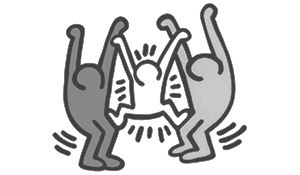
Keith Haring [hah-ring] (1958 – 1990) was an artist and social activist whose work responded to the New York City street culture of the 1980s. Born in Reading, Pennsylvania, at age 19 he moved to NYC, where he was inspired by graffiti art, and studied at the School of Visual Arts. Haring achieved his first public attention with chalk drawings in the subways. The exhibitions were filmed by the photographer Tseng Kwong Chi. Around this time, ‘The Radiant baby’ became his symbol. His bold lines, vivid colors, and active figures carry strong messages of life and unity. Starting in 1980, he organized exhibitions in Club 57, a performance venue.
He participated in the Times Square Exhibition and drew, for the first time, animals and human faces. In 1981 he sketched his first chalk drawings on black paper and painted plastic, metal and found objects. Haring died of AIDS-related complications. By expressing concepts of birth, death, love, sex and war, his imagery has become a widely recognized visual language of the 20th century. His work was featured in several of the Red Hot Organization’s efforts to raise money for AIDS and AIDS awareness. Specifically, its first two albums, ‘Red Hot + Blue’ and ‘Red Hot + Dance’ — the latter of which used Haring’s work on its cover.
Posted in Art, Politics |
Leave a Comment »
March 28, 2011

Nadia Plesner is a Danish/Dutch painter who works and lives in the Netherlands. Plesner is working on issues that lie between the editorial and advertising and often with political undertones. She trained at the Graphic Arts Institute, Copenhagen and at the Gerrit Rietveld Academie, Amsterdam. In 2010 Plesner was sued by Louis Vuitton for showing her controversial painting ‘Darfurnica.’ The painting shows a little hungry boy holding a handbag resembling one made by Louis Vuitton. The little boy is standing in the conflict-ridden region of Darfur in Sudan. The fashion giant thought that the legal rules about logo products were broken and the case was taken to court.
A Dutch court imposed daily fines for approximately 6000 US dollars. The trial attracted much international attention and several artists and celebrities supported Plesner as they believed that the case also referred to artistic expression and the right to make the world aware of international issues in an artistic way. Plesner and Louis Vuitton were also involved in a prior dispute about an artistic campaign called Simple Living in 2008. In 2011 the Dutch court reversed its decision and acquitted Nadia Plesner. ‘Darfurnica’ was sold in 2011 for approximately 45.000 US dollars.
Posted in Art, Money, Politics |
Leave a Comment »
March 28, 2011

The deadlift is a weight training exercise where one lifts a loaded barbell off the ground from a stabilized bent-over position. It is one of the three gauges of powerlifting, and is an exercise for overall body development. The deadlift is a compound movement that works grip strength with the erector spinae, gluteus maximus, adductor magnus, hamstrings, and quadriceps serving as the primary muscles. The remaining muscles are involved in stability control. It is, in a sense, the purest test of strength because it is one of the few lifts of dead weight (weight lying on the ground).
In most other lifts there is an eccentric phase (lowering) followed by the concentric phase (lifting). The eccentric phase essentially stores some amount of energy in the stretched muscles and tendons, making the concentric phase somewhat easier. the deadlift, however, is solely a concentric movement. The lift begins at its most difficult point, with no inertia or stored energy. The record for a raw deadlift (a deadlift performed without the aid of a deadlift suit where only a belt is allowed) is 1015 lbs by Benedikt Magnússon of Iceland.
Posted in Games, Health |
Leave a Comment »


 The Daily Omnivore