March 24, 2011
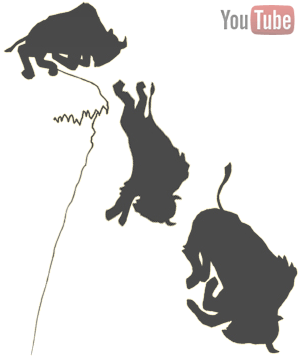
A buffalo jump is a cliff formation which North American Indians historically used in mass killings of plains bison. Hunters herded the bison and drove them over the cliff, breaking their legs and rendering them immobile. Tribe members waiting below closed in with spears and bows to finish the kills. The Blackfeet Indians called the buffalo jumps ‘pishkun,’ which loosely translates as ‘deep blood kettle.’
This type of hunting was a communal event which occurred as early as 12,000 years ago and lasted until at least 1500 CE, around the time of the introduction of horses. Buffalo jump sites are often identified by rock cairns, which were markers designating ‘drive lanes,’ by which bison would be funneled over the cliff. These drive lanes would often stretch for several miles.
Posted in Death, Food, Technology |
Leave a Comment »
March 24, 2011
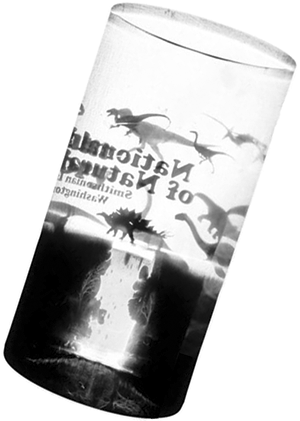
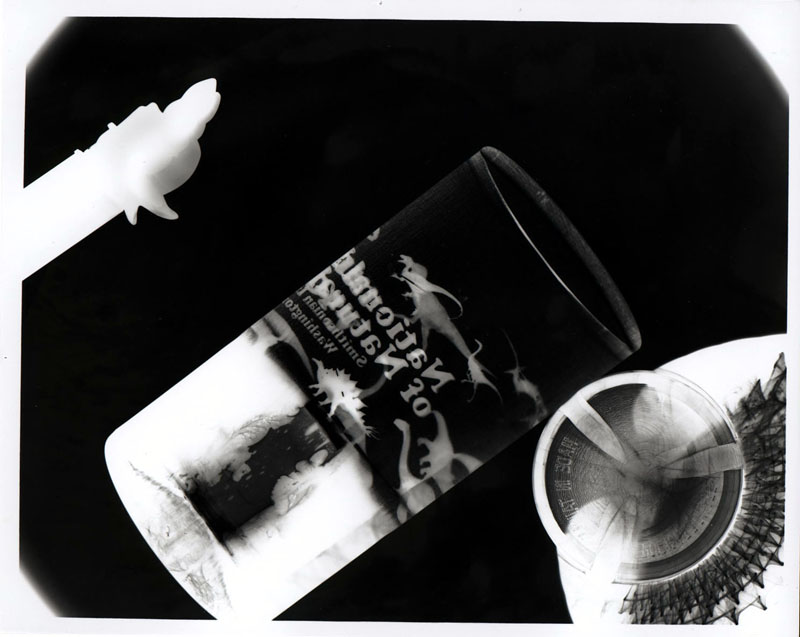
A photogram is a photographic image made without a camera by placing objects directly onto the surface of a photo-sensitive material such as photographic paper and then exposing it to light. The result is a negative shadow image varying in tone, depending on the transparency of the objects used. Areas of the paper that have received no light appear white; those exposed through transparent or semi-transparent objects appear grey.
Artistic cameraless photography, as the technique producing photograms is usually known, is perhaps most prominently associated with Man Ray and his exploration of ‘rayographs.’ Others who have experimented with the technique include László Moholy-Nagy, Christian Schad (who called them ‘Schadographs’), Imogen Cunningham and even Pablo Picasso.
Posted in Art, Technology |
Leave a Comment »
March 24, 2011
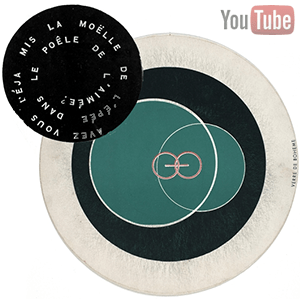
Kinetic art is art that contains moving parts or depends on motion for its effect. The moving parts are generally powered by wind, a motor or the observer. ‘Bicycle Wheel’ (1913) by Marcel Duchamp, is said to be the first kinetic sculpture. Besides being an example of kinetic art it is also an example of a readymade, a type of art of which Duchamp made a number of varieties throughout his life.
read more »
Posted in Art, Language, Money |
Leave a Comment »
March 24, 2011
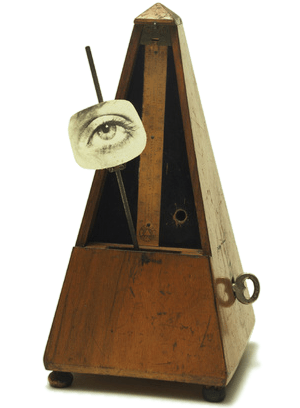
Man Ray (1890 – 1976), born Emmanuel Radnitzky, was an American artist who spent most of his career in Paris, France. Perhaps best described simply as a modernist, he was a significant contributor to both the Dada and Surrealist movements, although his ties to each were informal.
Best known in the art world for his avant-garde photography, Man Ray produced major works in a variety of media and considered himself a painter above all. He was also a renowned fashion and portrait photographer. He is noted for his photograms (images made without a camera by placing objects directly onto photographic paper, which he renamed ‘rayographs’ after himself.
read more »
Posted in Art, Money |
Leave a Comment »
March 24, 2011
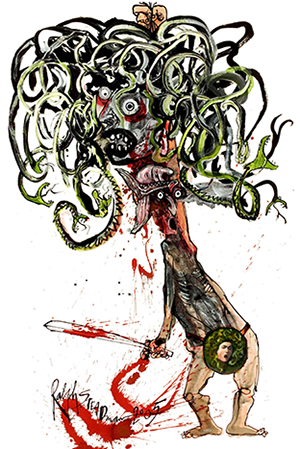
Ralph Steadman (b. 1936) is a British cartoonist and caricaturist who is perhaps best known for his work with American author Hunter S., drawing pictures for several of his articles and books. He accompanied Thompson to the Kentucky Derby for an article for ‘Scanlan’s,’ to the Honolulu Marathon for the ‘Running,’ and illustrated both ‘Fear and Loathing in Las Vegas’ and ‘Fear and Loathing on the Campaign Trail ’72.’
read more »
Posted in Art, Money |
1 Comment »
March 24, 2011
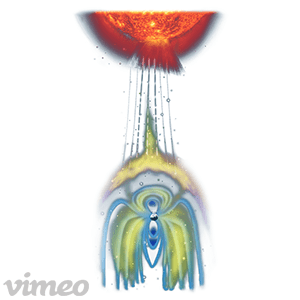
An aurora [uh-rawr-uh] is a flickering light caused by the sun’s radiation interacting with an atmosphere, usually found near the poles (Aurora borealis – Dawn of the North, or Aurora australis – Dawn of the South). They come in red, green and occasionally blue, and can sometimes resemble fire, and can be seen for a long way, many hundreds of kilometers or miles. Auroras can occur during the daytime, but are not visible to the naked eye.
The Sun emits a flow of charged particles into space called ‘solar wind.’ The Earth is shielded from these particles by its magnetosphere, a protective electromagnetic bubble created by the planet’s molten iron, outer core. The magnetic field is weakest at the cold areas, so at the poles some particles hit the atmosphere. They discharge their energy on impact, giving off light. An aurora can also happen in a coronal mass ejection, when charged particles are expelled so forcefully they that can penetrate electromagnetic fields.
Posted in Science, World |
Leave a Comment »
March 24, 2011
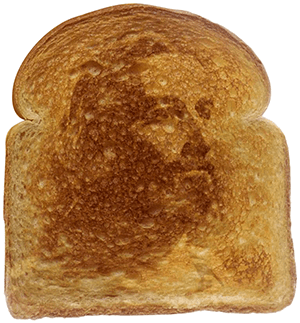
Pareidolia [pare-eye-doh-lee-uh] is a psychological phenomenon involving a vague and random stimulus (often an image or sound) being perceived as significant. Common examples include seeing images of animals or faces in clouds, the man in the moon or the Moon rabbit, and hearing hidden messages on records played in reverse. Pareidolia is a type of apophenia (seeing meaningful patterns in random data).
Carl Sagan hypothesized that as a survival technique, human beings are ‘hard-wired’ from birth to identify the human face. This allows people to use only minimal details to recognize faces from a distance and in poor visibility but can also lead them to interpret random images or patterns of light and shade as being faces.
Posted in Science |
Leave a Comment »
March 24, 2011
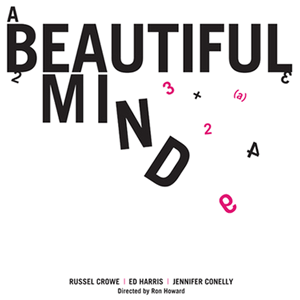
Apophenia [ap-uh-fee-nee-uh] is the experience of seeing meaningful patterns or connections in random or meaningless data. The term was coined in 1958 by German neurologist and psychiatrist Klaus Conrad, who defined it as the ‘unmotivated seeing of connections’ accompanied by a ‘specific experience of an abnormal meaningfulness.’
Conrad originally described this phenomenon in relation to the distortion of reality present in psychosis, but it has become more widely used to describe this tendency in healthy individuals without necessarily implying the presence of neurological differences or mental illness.
Posted in Health, Science |
Leave a Comment »
March 24, 2011

Synchronicity [sin-kro-nis-uh-tee] is the experience of two or more events, that are apparently causally unrelated or unlikely to occur together by chance, that are observed to occur together in a meaningful manner. The concept of synchronicity was first described by Swiss psychologist Carl Jung in the 1920s. The concept does not question, or compete with, the notion of causality. Instead, it maintains that just as events may be grouped by cause, they may also be grouped by their meaning.
read more »
Posted in Philosophy, Science |
Leave a Comment »
March 23, 2011

The lottery of birth is a philosophical argument that states: since no one chooses where they are born, they should not be held responsible for something that is beyond their control (e.g. being rich, being poor, etc.). The lottery of birth argument was sometimes used by philosophers such as John Locke, Thomas Hobbes, and Jean-Jacques Rousseau. More modern day uses have been prompted by political theorists such as John Rawls, who explores the subject more in depth in his book ‘A Theory of Justice.’
Posted in Money, Philosophy |
Leave a Comment »
March 23, 2011
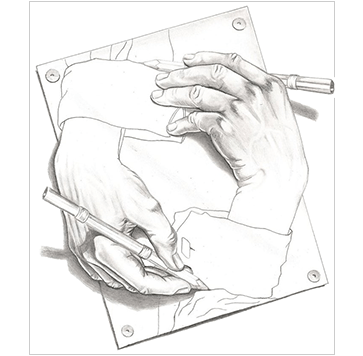

A strange loop arises when, by moving up or down through a hierarchical system, one finds oneself back where one started. Strange loops may involve self-reference and paradox.
The concept of a strange loop was proposed and extensively discussed by Douglas Hofstadter in ‘Gödel, Escher, Bach,’ and is further elaborated in Hofstadter’s book ‘I Am a Strange Loop,’ published in 2007. A tangled hierarchy is a hierarchical system in which a strange loop appears.
Posted in Language, Science |
Leave a Comment »
March 23, 2011

Tetra Pak is a multinational food processing and packaging company of Swedish origin. It was founded in 1951 in Lund, Sweden, by Ruben Rausing and Erik Åkerlund. Erik Wallenberg invented the original tetrahedral package in 1952, today known as ‘Tetra Classic.’ Ruben Rausing’s sons Hans and Gad Rausing ran Tetra Pak from 1954 until 1985, taking the company from a seven-person concern to one of Sweden’s largest corporations. At his death in 1983, Ruben Rausing was Sweden’s richest person.
Tetra Pak’s innovation is in the area of aseptic processing liquid food packaging which, when combined with ultra-high-temperature processing, allows liquid food to be packaged and stored under room temperature conditions for up to a year. In 1963 the company introduced ‘Tetra Brik,’ a rectangular cuboid carton. Later, it launched other formats such as ‘Tetra Wedge’ (wedge-shaped), ‘Tetra Prisma’ (round octagonal), and ‘Tetra Fino’ (pouch-shaped). Recent innovations have seen the introduction of laminated paper boxes for vegetables as an alternative to canned goods (‘Tetra Recart’).
Posted in Food, Money, Technology |
Leave a Comment »



 The Daily Omnivore