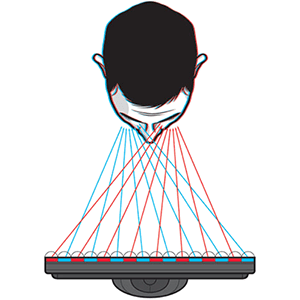
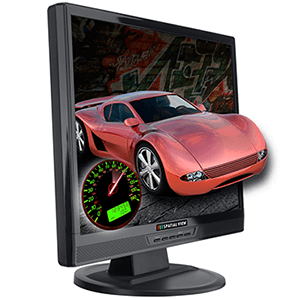
Autostereoscopy [aw-toh-ster-ee-os-kuh-pee] is any method of adding the perception of 3D depth without the use of special glasses on the part of the viewer. Because headgear is not required, it is also called ‘glasses-free 3D.’
The technology also includes two broad approaches used in some of them to accommodate motion parallax (the perceived change in location of an object seen from two different places) and wider viewing angles: those that use eye-tracking, and those that display multiple views so that the display does not need to sense where the viewers’ eyes are located. Examples of autostereoscopic displays include parallax barrier, lenticular, volumetric, electro-holographic, and light field displays.
Movement parallax refers to the fact that the view of a scene changes with movement of the head. Thus, different images of the scene are seen as the head is moved from left to right, and from up to down. Many autostereoscopic displays are single-view displays and are thus not capable of reproducing the sense of movement parallax, except for a single viewer, in systems capable of eye tracking.
Some autostereoscopic displays, however, are multi-view displays, and are thus capable of providing the perception of left-right movement parallax. Eight and sixteen views are typical for such displays. While it is theoretically possible to simulate the perception of up-down movement parallax, no current display systems are known to do so, and the up-down effect is widely seen as less important than left-right movement parallax.
Many organizations have developed autostereoscopic 3D displays, ranging from experimental displays in university departments to commercial products, and using a range of different technologies. Auto-stereoscopic 3D using lenses was first developed at the HHI institute in Berlin in 1985. The HHI Free2C is a display with very high-resolution and very good comfort achieved by an eye tracking system and a seamless mechanical adjustment of the lenses. Eye tracking has been used in a variety of systems in order to limit the number of displayed views to just two, or to enlarge the stereoscopic sweet spot. However, as this limits the display to a single viewer, it is not favored for consumer products.
Currently, most flat-panel solutions employ lenticular lenses or parallax barriers that redirect incoming imagery to several viewing regions at a lower resolution. When the viewer’s head is in a certain position, a different image is seen with each eye, giving a convincing illusion of 3D. Such displays can have multiple viewing zones allowing multiple users to view the image at the same time, though they may also exhibit dead zones where only a monoscopic, crosseyed, or no image at all can be seen.
The principle of the parallax barrier was invented by French inventor, Auguste Berthier, but was later popularized by the independent invention by American inventor, Frederick E. Ives. Sharp developed the technology to commercialization, briefly selling two laptops with the world’s only 3D LCD screens. Hitachi released the first 3D mobile phone for the Japanese market. In 2009, Fujifilm released the Fujifilm FinePix Real 3D W1 digital camera which featured a built-in autostereoscopic LCD display measuring 2.8″ diagonal. Nintendo has also implemented this technology on their latest portable gaming console, the Nintendo 3DS.
The principle of lenticular display is usually attributed to French physicist, Gabriel Lippmann. Philips produced its WOWvx line, based on lenticular technology until 2009, running at 3840×2160 pixels with 46 viewing angles. A hardware overlay for iPhone named 3DeeSlide also adopts this technology to convert the standard screen into an auto 3D display.
There are a variety of other autostereo systems as well, such as volumetric display, in which the reconstructed light field occupies a true volume of space, and integral imaging which uses a fly’s-eye lens array.
Sunny Ocean Studios, located in Singapore, has been credited with developing an automultiscopic screen that can display autostereo 3D images from 64 different reference points. Tridelity AG, located in Germany, has been credited with developing a auto-stereoscopic display in portrait format specially designed for the signage market.


 The Daily Omnivore
Leave a comment