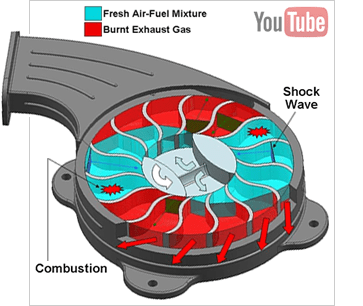
A wave-disk engine is an innovative internal combustion engine design being worked on by teams at Michigan State University and Warsaw Institute of Technology led by Norbert Müller. The first prototype was demonstrated in March 2011. The wave-disk engine has no valves, pistons or gear trains but utilizes a rotating disk to produce shock waves that compress an air fuel mixture. As the burning mixture expands it pushes against curved blades set into the rotor disk causing it to spin. The turning of the disk itself opens and closes inlet and outlet ports at appropriate times to introduce the air/fuel mixture and exhaust the combustion products.
It potentially shows savings in weight and better energy efficincy compared to normal internal combustion engine designs. Combustion engines are not very efficient, turning only 15% to 20% of the gasoline into propulsion. The rest of the energy in the gasoline is lost as waste heat. Wave disk engines promises to be 3.5x more efficient, 20% lighter, 30% cheaper to manufacture, and reduce emissions by 90 percent.


 The Daily Omnivore
Leave a comment