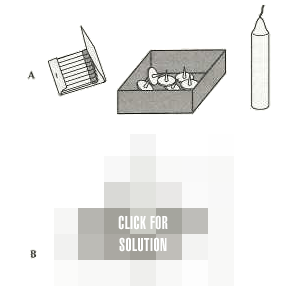
The Candle Problem is a cognitive performance test, measuring the influence of functional fixedness on a participant’s problem solving capabilities. The test was created by Gestalt psychologist Karl Duncker and published posthumously in 1945. The test presents the participant with the following task: how to fix a lit candle on a wall (a cork board) in a way so the candle wax won’t drip onto the table below. To do so, one may only use the following along with the candle: a book of matches and a box of thumbtacks.
The solution is to empty the box of thumbtacks, put the candle into the box, use the thumbtacks to nail the box (with the candle in it) to the wall, and light the candle with the match. The concept of functional fixedness predicts that the participant will only see the box as a device to hold the thumbtacks and not immediately perceive it as a separate and functional component available to be used in solving the task. However, if the task is presented with the tacks piled next to the box (rather than inside it), virtually all of the participants were shown to achieve the optimal solution.


 The Daily Omnivore
Leave a comment