June 14, 2011


Vaporware is a term in the computer industry that describes a product, typically computer hardware or software, that is announced to the general public but is never actually released nor officially canceled. The term also generally applies to a product that is announced months or years before its release, and for which public development details are lacking.
The word has been applied to a growing range of products including consumer electronics, automobiles, and some stock trading practices. At times, vendors are criticized for intentionally producing vaporware in order to keep customers from switching to competitive products that offer more features.
read more »
Posted in Money, Technology |
Leave a Comment »
June 14, 2011

Utility fog (coined by Dr. John Storrs Hall) is a hypothetical collection of tiny robots that can replicate a physical structure. As such, it is a form of self-reconfiguring modular robotics. Hall thought of it as a nanotechnological replacement for car seatbelts. The robots would be microscopic, with extending arms reaching in several different directions, and could perform three-dimensional lattice reconfiguration.
Grabbers at the ends of the arms would allow the robots (or foglets) to mechanically link to one another and share both information and energy, enabling them to act as a continuous substance with mechanical and optical properties that could be varied over a wide range. Each foglet would have substantial computing power, and would be able to communicate with its neighbors.
read more »
Posted in Technology |
Leave a Comment »
June 14, 2011
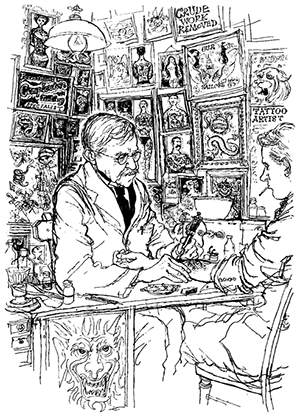
George Burchett (1872 – 1953), known as ‘Professor Burchett’ and the ‘King of Tattooists,’ is a renown English tattoo artist. Having been expelled from school at 12 for tattooing his classmates, he joined the Royal Navy at 13, developing his skills while travelling overseas as a deckhand on the HMS Vincent. After absconding from the Navy, he returned to England, where he was trained in tattoo artistry in London by the legendary English tattooist Tom Riley (who invented the modern tattoo machine).
With a studio on Mile End Road, London, Burchett became the first star tattooist and a favourite among the wealthy upper class and European royalty. Among his customers were King Alfonso XIII of Spain, King Frederick IX of Denmark and the ‘Sailor King’ George V of the United Kingdom. He also tattooed sideshow performer, Horace Ridler (‘The Great Omi’). He constantly designed new tattoos from his worldwide travel, incorporating African, Japanese and Southeast Asian motifs into his work. In the 1930s, he developed cosmetic tattooing with such techniques as permanently darkening eyebrows.
Posted in Art |
Leave a Comment »
June 14, 2011

Permanent makeup is a cosmetic technique which employs tattoos (permanent pigmentation of the dermis) as a means of producing designs that resemble makeup, such as eyelining and other permanent enhancing colors to the skin of the face, lips, and eyelids.
It is also used to produce artificial eyebrows, particularly in people who have lost them as a consequence of old age, disease, such as alopecia, chemotherapy, or a genetic disturbance, and to disguise scars and white spots in the skin such as in vitiligo. It is also used to restore or enhance the breast’s areola, such as after breast surgery.
read more »
Posted in Art, Health |
Leave a Comment »
June 14, 2011

Scratch and sniff technology generally refers to things that have been treated with a microfragrance coating. When scratched, the coating releases an odor that is normally related to an image being displayed under the coating. The technology has been used on a variety of surfaces from stickers to compact discs. Stickers became common in the late 1970s, and grew into big business for several companies throughout the early and mid-1980s. As the technology evolved to an ‘acid-free’ design the sticker craze seemed to come to a close.
Utility companies have sometimes enclosed scratch and sniff cards in their bills to educate the public on recognizing the smell of a methane gas leak. However, this sometimes would lead to a rash of false alarms as the scent emanating from a discarded scratch and sniff is later mistaken for a real gas leak. Scratch and sniff is created through the process of micro-encapsulation. The desired smell is surrounded by micro-capsules that break easily upon scratching. Because of the micro-encapsulation, the aroma can be preserved for extremely long periods of time.
Posted in Humor, Technology |
Leave a Comment »
June 14, 2011
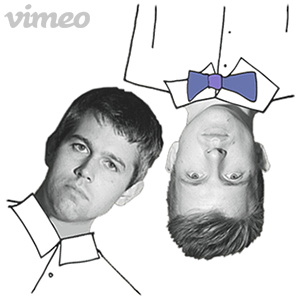
Bompas & Parr is a company specializing in food art using gelatin desserts. Named after the defunct food company of the same name, the company uses food molds to make edible decorations shaped like buildings and other architectural structures. The work of Bompas & Parr have been noted for their detail and have competed in culinary artwork competitions, an example being the Architectural Jelly Design Competition organized for the London Festival of Architecture.
The company claims their projects explore how the taste of food is altered through synaesthesia (a condition where the brain mixes up the senses), performance and setting. Currently the focus of their projects is gelatin based because they feel it is a perfect medium for an examination of food and architecture due to its plastic form and the historic role it has played in exploring notions of taste.
Posted in Art, Food, Humor |
Leave a Comment »
June 14, 2011


Recovery International (often referred to simply as Recovery) is a mental health, self-help organization founded in 1937 by neuropsychiatrist Abraham Low in Chicago. Recovery’s program is based on self-control, self-confidence, and increasing one’s determination to act.
Recovery deals with a range of people, all of whom have difficulty coping with everyday problems, whether or not they have a history of psychiatric hospitalization. It is non-profit, secular, and although it uses methods devised by Low, most groups are currently led by experienced non-professionals.
read more »
Posted in Health |
Leave a Comment »
June 13, 2011
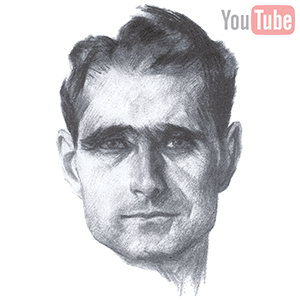
Rudolf Hess (1894 – 1987) was a prominent Nazi politician and official acting as Adolf Hitler’s Deputy in the Nazi Party during the 1930s and early 1940s. On the eve of war with the Soviet Union, he flew solo to Scotland in an attempt to negotiate peace with the United Kingdom, but instead was arrested and held in captivity for the rest of the war. Hess was tried at Nuremberg and sentenced to life in prison at Spandau Prison, Berlin, where he died in 1987.
Hess’ 1941 attempt to negotiate peace and subsequent lifelong imprisonment have given rise to many theories about his motivation for flying to Scotland, and conspiracy theories about why he remained imprisoned alone at Spandau, long after all other convicts had been released. Precise and detailed information on many aspects of Hess’ situation either has been withheld in confidential archives in several nations, or has disappeared outright; this has made accurate historical conclusions very problematic.
read more »
Posted in Politics, War, World |
Leave a Comment »
June 13, 2011

‘Born secret‘ refers to a policy of information being classified from the moment of its inception, usually regardless of where it was being created, usually in reference to specific laws in the United States that are related to information that describes the operation of nuclear weapons. It has been extensively used in reference to a clause in the Atomic Energy Act of 1946, which specified that all information about nuclear weapons and nuclear energy was to be considered ‘Restricted Data’ (RD) until it had been officially declassified. The ‘born secret’ policy was created under the assumption that nuclear information could be so important to national security that it would need classification before it could be formally evaluated.
Whether or not it is constitutional to declare entire categories of information preemptively classified has not been definitively tested in the courts. When it was directly challenged in a freedom of the press case in 1979 (United States v. The Progressive) where a magazine attempted to publish an account of the so-called ‘secret of the hydrogen bomb’ (the Teller-Ulam design) which was apparently created without recourse to classified information, many analysts predicted that the Supreme Court would, if it heard the case, reject the ‘born secret’ clause as being an unconstitutional restriction of speech. The government, however, dropped the case as moot before it was resolved.
Posted in Politics, War |
Leave a Comment »
June 13, 2011
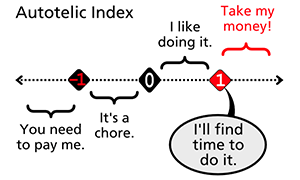

‘Art for art’s sake‘ is the usual English rendering of a French slogan, from the early 19th century, ‘l’art pour l’art,’ and expresses a philosophy that the intrinsic value of art, and the only ‘true’ art, is divorced from any didactic (educational), moral or utilitarian function.
Such works are sometimes described as ‘autotelic,’ from the Greek ‘autoteles,’ ‘complete in itself,’ a concept that has been expanded to embrace ‘inner-directed’ or ‘self-motivated’ human beings. A Latin version of this phrase, ‘Ars gratia artis,’ is used as a slogan by Metro-Goldwyn-Mayer and appears in its logo.
read more »
Posted in Art, Language, Philosophy |
1 Comment »
June 13, 2011

Autodidacticism [aw-toh-dahy-dak-tuh-siz-uhm] is self-education or self-directed learning. In a sense, autodidacticism is ‘learning on your own’ or ‘by yourself,’ and an autodidact is a person who teaches him or herself something. Self-teaching and self-directed learning are contemplative, absorptive processes. A person may become an autodidact at nearly any point in his or her life. While some may have been educated in a conventional manner in a particular field, they may choose to educate themselves in other, often unrelated areas.
In the field of mathematics, Srinivasa Ramanujan (1887 – 1920) was an Indian autodidact who, with almost no formal training, made substantial contributions to number theory.
read more »
Posted in Education, Science |
Leave a Comment »
June 13, 2011

Didacticism [dahy-dak-tuh-siz-uhm] is an artistic philosophy that emphasizes instructional and informative qualities in literature and other types of art. The primary intention of didactic art is not to entertain, but to teach. Didactic plays, for instance, teach the audience through the use of a moral or a theme. An example of didactic writing is Alexander Pope’s ‘An Essay on Criticism’ (1711), which offers a range of advice about critics and criticism. An example of didactism in music is the chant ‘Ut queant laxis,’ which was used by Guido of Arezzo to teach solfege syllables.
The term ‘didactic’ is also used as a criticism for work that appears to be overly burdened with instructive, factual, or otherwise educational information, to the detriment of the enjoyment of the reader. Edgar Allan Poe called didacticism the worst of ‘heresies’ in his essay ‘The Poetic Principle.’
Posted in Art, Games, Language |
Leave a Comment »




 The Daily Omnivore