June 1, 2011


Toots and the Maytals are a Jamaican ska and reggae vocal group. The Maytals were key figures in reggae music. Formed in the early 1960s when ska was hot, the Maytals had a reputation for having strong, well-blended voices and a seldom-rivaled passion for their music. Frederick ‘Toots’ Hibbert (b. 1945) is the group’s frontman.
He met Henry ‘Raleigh’ Gordon and Nathaniel ‘Jerry’ Mathias, forming in 1961 a group whose early recordings were incorrectly attributed to ‘The Flames’ and ‘The Vikings’ in the UK by Island Records. The Maytals first had chart success recording for producer Clement ‘Coxsone’ Dodd at Studio One. With musical backing from Dodd’s house band, The Skatalites, the Maytals’ close-harmony gospel singing overshadowed Dodd’s other up-and-coming vocal group, The Wailers.
read more »
Posted in Art, World |
Leave a Comment »
June 1, 2011

‘54-46 (That’s My Number)‘ is a song by Fred ‘Toots’ Hibbert, recorded by Toots & the Maytals and originally released on the Beverly’s label in Jamaica and the Pyramid label in the UK. It was one of the first ska songs to receive widespread popularity outside Jamaica and is seen as being one of the defining songs of the reggae genre. It has been anthologized repeatedly and the titles of several reggae anthologies include ’54-46′ in their title.
The lyrics describe Toots’ time in prison for an arrest for possession of marijuana. The song features the same riddim (instrumental accompaniment) to a song as ‘Train to Skaville’ by Toots & the Maytals’ contemporaries The Ethiopians. Hibbert later admitted that 54-46 was not his actual jail number, and that he was not arrested for a crime related to marijuana.
Posted in Art, Drugs, Politics |
Leave a Comment »
June 1, 2011
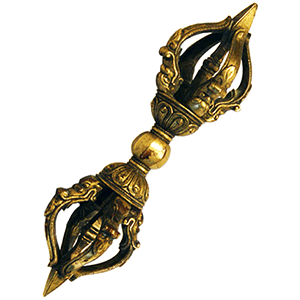
Vajra [vuhj-ruh] is a Sanskrit word meaning both thunderbolt and diamond. It is a short metal weapon – originally a kind of fist-iron like Japanese yawara – that has the symbolic nature of a diamond (it can cut any substance but not be cut itself) and that of the thunderbolt (irresistible force). The vajra is believed to represent firmness of spirit and spiritual power. It is a ritual tool or spiritual implement which is symbolically used by Buddhism, Jainism and Hinduism, all of which are traditions of Dharma. In Buddhism the vajra is the symbol of Vajrayana, one of the three major branches of Buddhism. Vajrayana is translated as ‘Thunderbolt Way’ or ‘Diamond Way’ and can imply the thunderbolt experience of Buddhist enlightenment or bodhi. It also implies indestructibility, just as diamonds are harder than other gemstones.
The vajra is made up of several parts. In the center is a sphere which represents Sunyata, the primordial nature of the universe, the underlying unity of all things. Emerging from the sphere are two eight petaled lotus flowers. One represents the phenomenal world (or in Buddhist terms Samsara), the other represents the noumenal world (or Nirvana). This is one of the fundamental dichotomies which are perceived by the unenlightened. Arranged equally around the mouth of the lotus are two, four, or eight mythical creatures which are called makaras. These are mythological half-fish, half-crocodile creatures made up of two or more animals, often representing the union of opposites, (or a harmonisation of qualities that transcend our usual experience). From the mouths of the makaras come tongues which come together in a point.
Posted in Philosophy, War |
Leave a Comment »
June 1, 2011

New Belgium Brewing Company is a regional brewery located in Fort Collins, Colorado. The brewery was founded by husband-and-wife team Jeff Lebesch and Kim Jordan in 1991 and emphasizes eco-friendly practices and employee ownership in its marketing materials. Fat Tire, an amber ale, is the company’s flagship beer. Its recipe originates from a co-founder’s bicycle trip through Belgium from brewery to brewery. The company promotes its Fat Tire ale locally by the public placement of colorful vintage bicycles outside its brewery, which is located adjacent to the public bike path along the Cache La Poudre River. New Belgium beer labels are designed by Anne Fitch, a watercolorist. Kim Jordan, the President of New Belgium Brewery, credits the success of New Belgium Brewery in part on Anne’s artwork, ‘Our beers were good, our labels were interesting to people, and we pretty quickly had a fairly robust following.’ In 2006, her artwork appeared on each of the over 125 million bottles sold by New Belgium.
Tour de Fat is a bicycle parade and festival sponsored by New Belgium. The events, which take place annually in various large- and medium-sized cities around the West, include music, New Belgium beer, circus- and -vaudeville type acts, bicycle dance troupes, and the main activist spectacle, a giant group bike ride/parade wherein the participants, many of whom are in fanciful costume, ride through town. The actual activist climax of the tour, however, is the bike trade, in which a local participant transfers the keys and title of their motor vehicle to New Belgium in exchange for a new commuter bike and trailer in order to promote bike riding and sustainability. The ‘Fat Tire’ bike is so strongly associated with New Belgium Breweries that employees of the brewery are given a ‘cruiser bike’ ‘like the one pictured on its Fat Tire Amber Ale label’ on their one -year anniversary with the company.
Posted in Art, Food, Money |
Leave a Comment »


 The Daily Omnivore