June 28, 2011

Barry Cooper (b. 1969) is an anti-drug-war lecturer known for his DVD series, ‘Never Get Busted’ and his reality show, KopBusters. Cooper formerly served as a law enforcement officer. Before his career in law enforcement, he trained dogs in obedience, hunting, and working with livestock. He was later hired by the Big Sandy Police Department as an interdiction officer in East Texas and trained his own narcotic detection dog.
As a law enforcement officer, Cooper confiscated large amounts of illegal narcotics and drug money. Cooper cited that he began to notice that people who were arrested for possession of marijuana were nonviolent and cooperative in contrast to the people that were arrested for violations while intoxicated on alcohol who ‘[…] would fight and scream and act crazy.’ He also noted being deeply affected by the emotional trauma he witnessed while participating in home narcotic raids with other officers attired in raid gear and ‘more guns than we would ever need.’ Cooper also stated, ‘We’re sending the kids to the department of human services, we’re sending the parents to jail over marijuana. Well, I knew some of these people and I knew they weren’t gangsters. I knew they were nonviolent people.’ He quit law enforcement soon after.
Posted in Drugs, Politics |
1 Comment »
June 28, 2011

Stop Snitchin’ refers to a controversial 2004 campaign launched in Baltimore, United States to persuade criminal informants to stop ‘snitching,’ or informing, to law enforcement. Public officials, activists and media outlets say that it is a campaign used by criminals to frighten people with information from reporting their activities to the police.
Some Stop Snitching activists say they are not opposed to concerned citizens going to the police with accurate information and don’t consider them snitches. They say that snitches are people who give the government favorable testimony in exchange for a plea bargain, money, or some other kind of reward.
read more »
Posted in Politics |
Leave a Comment »
June 28, 2011

Technogaianism [tek-noh-guy-uh-niz-uhm] is a ‘bright green’ environmentalist stance of active support for the research, development and use of emerging and future technologies to help restore Earth’s environment. Technogaians argue that developing safe, clean, alternative technology should be an important goal of environmentalists.
This point of view is different from the default position of radical environmentalists and a common opinion that all technology necessarily degrades the environment, and that environmental restoration can therefore occur only with reduced reliance on technology. Technogaians argue that technology gets cleaner and more efficient with time.
read more »
Posted in Science, Technology, World |
Leave a Comment »
June 28, 2011
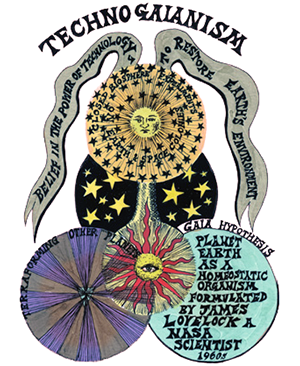

Bright green environmentalism is an ideology based on the belief that the convergence of technological change and social innovation provides the most successful path to sustainable development.
The term, first coined in 2003 by writer Alex Steffen, refers to the fast-growing new wing of environmentalism, distinct from traditional forms. Bright green environmentalism aims to provide prosperity in an ecologically sustainable way through the use of new technologies and improved design.
read more »
Posted in Science, Technology, World |
1 Comment »
June 27, 2011

Neophile [nee-uh-fahyl] is a term used by counterculture cult writer Robert Anton Wilson to describe a particular type of personality. A neophile or neophiliac can be defined as a personality type characterized by a strong affinity for novelty.
Neophiles/Neophiliacs have the following basic characteristics: The ability to adapt rapidly to extreme change. A distaste or downright loathing of tradition, repetition, and routine. A tendency to become bored quickly with old things. A desire, bordering on obsession in some cases, to experience novelty. A corresponding and related desire to create novelty by creating or achieving something and/or by stirring social or other forms of unrest.
read more »
Posted in Language, Philosophy, Technology |
Leave a Comment »
June 27, 2011

Zombie Nation is a German techno and electro project of the Munich based DJ and producer Florian Senfter (also known as John Starlight). The first Zombie Nation five track EP was released in the spring of 1999 on DJ Hell’s label, International DeeJay Gigolo Records.
A remix of the song ‘Kernkraft 400’ on this debut release landed in high chart-positions all over the world, including number 2 in the U.K. ‘Kernkraft 400’ was a 1:1 melody copy from the Commodore C64 computer game ‘Lazy Jones.’
read more »
Posted in Art, Money, Technology |
Leave a Comment »
June 27, 2011

Inside Job is a 2010 documentary film about the financial crisis of 2007–2010 directed by Charles H. Ferguson, who has described the film as being about ‘the systemic corruption of the United States by the financial services industry and the consequences of that systemic corruption.’ In five parts the film explores how changes in the policy environment and banking practices helped create the 2008 financial crisis.
The film focuses on changes in the financial industry in the decade leading up to the crisis, the political movement toward deregulation, and how the development of complex trading such as the derivatives market allowed for large increases in risk taking that circumvented older regulations that were intended to control systemic risk.
read more »
Posted in Money, Politics |
Leave a Comment »
June 27, 2011

‘The Third Chimpanzee: The Evolution and Future of the Human Animal’ (1991) is a wide-ranging book by Jared Diamond, professor of geography and physiology at UCLA, which applies insights from biology, anthropology, and linguistics to questions such as why one species of big mammal (humans) came to dominate its closest relatives, such as chimpanzees, and why one group of humans (eurasians) came to dominate others (Indigenous peoples of the Americas).
It also examines how asymmetry in male and female mating behavior is resolved through differing social structures across cultures, and how first contact between unequal civilizations almost always results in genocide. The book ends by noting that technological progress may cause environmental degradation on a scale leading to extinction. Diamond expanded on these themes in subsequent books: ‘Guns, Germs and Steel’ (1997), ‘Why Is Sex Fun? (1997), and ‘Collapse’ (2005).
read more »
Posted in Science, Sex, War |
Leave a Comment »
June 27, 2011

Loompanics Unlimited was an American book seller and publisher specializing in nonfiction on generally unconventional or controversial topics, with a philosophy arguably tending to a mixture of libertarian and left wing ideals, although Loompanics carried books expressing other political viewpoints (including far right) as well as outspokenly apolitical ones. The topics in their title list included drugs, weapons, anarchism, sex, and conspiracy theory, among others. Many of their titles describe some illicit or extralegal actions, such as ‘Counterfeit I.D. Made Easy,’ while others are purely informative, like ‘Opium for the Masses.’
Mike Hoy started Loompanics Unlimited in East Lansing, Michigan, in 1975. He later moved the business to Port Townsend, Washington, where his friend and fellow publisher R.W. Bradford had earlier located. The company’s name is a play on words inspired by Hoy’s fondness for National Lampoon.
read more »
Posted in Money, Philosophy, Politics |
Leave a Comment »
June 27, 2011


CrimethInc. is a decentralized anarchist collective of autonomous cells. It emerged in the mid-1990s, initially as the hardcore zine ‘Inside Front,’ and began operating as a collective in 1996. It has since published widely read articles and zines for the anarchist movement and distributed posters and books of its own publication.
In their own words, ‘Crimethought is not any ideology or value system or lifestyle, but rather a way of challenging all ideologies and value systems and lifestyles—and, for the advanced agent, a way of making all ideologies, value systems, and lifestyles challenging.’
read more »
Posted in Money, Politics |
Leave a Comment »
June 27, 2011

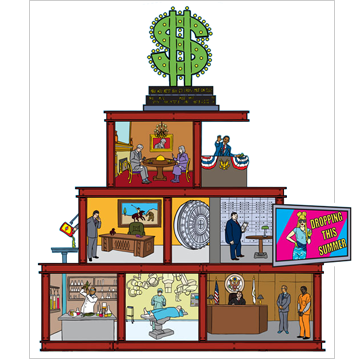
Work is a book published by Crimethinc Far East, a decentralized anarchist publishing collective. It covers a wide range of economic, political, and philosophical issues, mostly relating to the ethical and utilitarian implications of Capitalism. Central to the book’s theme is that Capitalism is inherently immoral and inevitably causes massive wealth inequality and degradation of general human experience.
The book focuses specifically on the causes and effects crises suffered by capitalist economies, such as the 2008 financial crisis, and how the people can subvert global Capitalism to create a better future. The book features an ‘updated’ version of the Pyramid of the Capitalist System, designed by American artist, Packard Jennings, on the inside flap.
Posted in Money, Philosophy, Politics |
Leave a Comment »
June 27, 2011

‘He who does not work, neither shall he eat‘ is a Biblical aphorism derived from Paul’s letter to the Thessalonians, which became a slogan for new colonies and socialist societies. The slogan was used by Captain John Smith in setting up the English colony of Jamestown, Virginia after his experiment with the common store system, or socialism, was abandoned. According to Soviet leader Vladimir Lenin, it is the first principle of socialism. The phrase is mentioned in his 1917 work, ‘State and Revolution.’ Through this slogan Lenin explains that in socialist states only productive individuals would be allowed access to the articles of consumption.
This is not really directed at lazy or unproductive workers, but rather the bourgeoisie. Marxist theory holds that the bourgeoisie buy the commodity labor-power of workers and enlists them in the process of production. Profits are then made by the expropriation of surplus value. Accordingly, in a communist society, with the abolition of property and the law of value, there would be no class of individuals that lives off the labor of others. The principle would not apply to those who could not work, such as the elderly or the lame. These groups would have a right to society’s products because they were not at fault for their condition. The elderly, furthermore had worked during their youth, and so could not be denied life’s basic necessities.
Posted in Money, Politics, World |
Leave a Comment »



 The Daily Omnivore