June 27, 2011
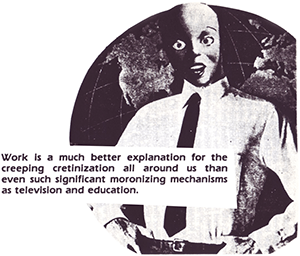
‘The Abolition of Work‘ is an essay written by American anarchist, Bob Black in 1985. The essay was part of an anthology of essays entitled ‘The Abolition of Work and Other Essays’ published by Loompanics (a publisher specializing in nonfiction on generally unconventional or controversial topics).
It is an exposition of Black’s ‘type 3 anarchism’ – a blend of post-Situationist theory and individualist anarchism – focusing on a critique of the work ethic. He adopted Situationist tropes that had recently been re-popularized (or recuperated) by pop bands of the time (Bow Wow Wow in particular having earlier featured ‘demolition of the work ethic’ and ‘there’s no need to work ever’ among similar lines in their lyrics).
read more »
Posted in Money, Philosophy, Politics |
Leave a Comment »
June 27, 2011


A flat tax is a tax system with a constant tax rate. A flat tax may also be called a tax in rem (‘against the thing’), such as an excise tax on gasoline of three cents per gallon. Usually the term flat tax refers to household income (and sometimes corporate profits) being taxed at one marginal rate, in contrast with progressive or regressive taxes that vary according to parameters such as income or usage levels. Flat taxes offer simplicity in the tax code, which has been reported to increase compliance and decrease administration costs. Proposals differ in how they define and measure what is subject to tax. A ‘true flat rate tax’ is a system of taxation where one tax rate is applied to all income with no exceptions.
Critics of the flat tax argue that the marginal dollar to low income individuals is vastly more vital than that of the high income earner, especially around the poverty level. In their view this justifies a progressive taxation system as the added income gained from a flat tax rate to the rich would not be spent on vital goods and services for survival as they might at the poverty level with reduced taxation. However, true Flat tax proponents necessarily contest the concept of the diminishing marginal utility of money and that a marginal dollar should be taxed differently.
read more »
Posted in Money, Politics, World |
Leave a Comment »
June 27, 2011
A consumption tax is a tax on spending on goods and services. Consumption taxes are usually indirect, such as a sales tax or a value added tax. However, a consumption tax can also be structured as a form of direct, personal taxation, such as an expenditure tax (a tax levied on the total consumption expenditure of an individual).
Consumption taxes do not tax savings, which allows invested assets to grow more quickly. Although personal and corporate income taxes provide the bulk of revenue to the federal government, consumption taxes continue to be a primary source of income for state and local governments.
read more »
Posted in Money, Politics |
Leave a Comment »
June 24, 2011
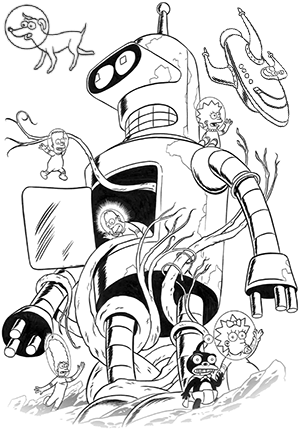
A fictional crossover is the placement of two or more otherwise discrete fictional characters, settings, or universes into the context of a single story. They can arise from legal agreements between the relevant copyright holders, or because of unauthorized efforts by fans, or even amid common corporate ownership.
Crossovers generally occur between properties owned by a single holder, but they can more rarely involve properties from different holders, provided that the inherent legal obstacles can be overcome. They may also involve using characters that have passed into the public domain with those that currently enjoy copyright protection.
read more »
Posted in Art, Language |
Leave a Comment »
June 24, 2011

The Repository for Germinal Choice was a sperm bank that existed in Escondido, California from 1980 to 1999. The repository is commonly believed to have accepted only donations from Nobel Prize laureates, although in fact it accepted donations from non-Nobelists, also. Founded by Robert Klark Graham, the repository was dubbed the ‘Nobel prize sperm bank’ by media reports at the time.
The only contributor who became known publicly was William Shockley, Nobel laureate in physics. Other donors were recruited from among the ranks of scientists and academics Graham and his assistant, Paul Smith, considered to be ‘the future Nobel laureates.’
read more »
Posted in Health, Science, Sex |
Leave a Comment »
June 24, 2011
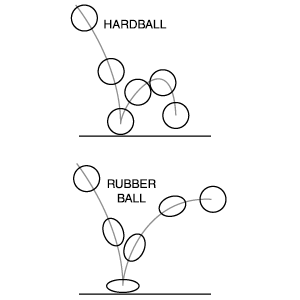
Squash and stretch is a common animation technique applied to characters or objects in motion. The technique makes their actions more fluid, and it is generally exaggerated for a cartoonish effect. When utilized with more subtlety, it works just as well for realistic movements. Squash and stretch was used to great effect in early 1920s American cartoons such as ‘Felix the Cat’ and ‘Betty Boop.’ It can also be used in comics or still cartoon art.
When done in accordance with the principles of animation, squash and stretch keeps the volume of the character constant. When squash and stretch is applied, it creates the illusion that a drawing has dimension and volume. Squash and stretch does not always have to be cartoonlike – when we crouch down in anticipation for a large leap, we squash. When we spring into the air, we stretch. A half-filled flour sack is an example of a more cartoonlike squash and stretch – when dropped the sack squashes a lot; when picked up it stretches a lot – but throughout the entire action, the volume never changes.
Posted in Art, Humor |
Leave a Comment »
June 24, 2011
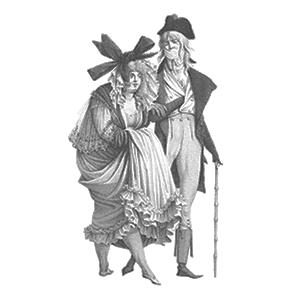
The Incroyables (Incredibles) and their female counterparts, the Merveilleuses (Marvelous), were a name for the fashionable subcultures living in France in the Directoire era (late 18th century). The exhibition of products of national industry, organized in 1798, testified to their infatuation with luxury.
The names are sometimes spelled and were pronounced ‘incoyables’ and ‘meveilleuses’ without the letter R, in reaction against the Revolution, which begins with an R, in which so many had suffered and lost relatives, the letter R was banished. Divorce became legal under the Directoire and morals tended to be looser than in the past. Many Incroyables were ‘nouveaux riches,’ gaining their wealth from selling arms and lending money (usury). When the Directoire period ended, society took a more sober and modest turn.
read more »
Posted in Art, Money, World |
Leave a Comment »
June 24, 2011

The candy desk is a tradition of the United States Senate established in 1968. The desk, located on the Republican side of the Senate chamber, was first stocked with candy and treats by Senator George Murphy. Those entrusted with the candy desk have included John McCain, Slade Gorton, Bob Bennett, and Rick Santorum. Most senators take advantage of the desk, even though eating is not allowed on the Senate floor. The desk is currently occupied by Senator Mark Kirk of Illinois.
The tenant of the candy desk is charged with stocking it with candy from his or her home state, but funding has been an issue. Originally senators would ask for a specific candy and leave a few dollars to keep the desk stocked with their favorites, but as time continued, and the candy desk became a more solid tradition of the Senate, lobby groups and organizations, specifically the National Confectioners Association, and the Chocolate Manufacturers Association, organized donations.
read more »
Posted in Food, Humor, Politics |
Leave a Comment »
June 24, 2011


This Is Your Life is an American television documentary series broadcast on NBC, originally hosted by its producer, Ralph Edwards from 1952 to 1961. In the show, the host surprises a guest, and proceeds to take them through their life in front of an audience including friends and family. The format originated as a radio show on NBC Radio airing from 1948 to 1952.
The idea for ‘This Is Your Life’ arose while Edwards was working on ‘Truth or Consequences.’ He had been asked by the U.S. Army to ‘do something’ for paraplegic soldiers at a California Army rehabilitation hospital. Edwards chose a ‘particularly despondent young soldier and hit on the idea of presenting his life on the air, in order to integrate the wreckage of the present with his happier past and the promise of a hopeful future.’
read more »
Posted in Art, Money |
1 Comment »
June 24, 2011

In the culture of American adolescents, the game of baseball is often used as a euphemistic metaphor for the degree of sexual intimacy achieved in intimate encounters or relationships. In the metaphor, prevalent in the post-World War II period, sexual activities are described as if they are actions in a game of baseball.
Although details vary, a broadly accepted description of what each base represents, first base is commonly understood to be any form of mouth to mouth kissing, especially open mouth (‘French’) kissing involving the tongue. Thus, if a person complains that s/he ‘can’t get to first base,’ it means that the partner spurned advances or is not interested, although this is not necessarily a specific reference to a spurned attempt to engage in kissing. Second base is manual stimulation of the genitalia. Third base is oral stimulation of the genitalia. Finally, a home run (Fourth base) is the act of penetrative intercourse.
read more »
Posted in Games, Humor, Sex |
Leave a Comment »
June 23, 2011

Net cafe refugees (also known as cyber-homeless) is a term for a growing class of homeless people in Japan who do not own or rent a residence and thus have no permanent address and sleep in 24 hour Internet cafés or manga cafés. Some internet cafes offer free showers and sell underwear and other personal items, enabling net cafe refugees to use the internet cafes like a hotel or hostel.
A Japanese government study estimated that over 5,400 people are spending at least half of their week staying in net cafes. It has been alleged that this phenomenon is part of an increasing wealth gap in Japan, which has historically been a very economically equal society. Another word for Net cafe refugees is Cyber-homeless, a Japanese word based on English. Typically, the cyber-homeless are unemployed or underemployed and cannot afford to rent even the cheapest apartment, which is more than the cost per month to rent an internet booth daily. The cyber-homeless may use the address of the internet cafe on resumes.
Posted in Money, Technology, World |
Leave a Comment »
June 23, 2011

The dolly zoom effect is an unsettling in-camera special effect that appears to undermine normal visual perception in film. In its classic form, the camera is pulled away from a subject while the lens zooms in, or vice-versa.
Thus, during the zoom, there is a continuous perspective distortion, the most directly noticeable feature being that the background appears to change size relative to the subject.
read more »
Posted in Art, Language, Technology |
Leave a Comment »



 The Daily Omnivore