July 24, 2011

Knismesis [niz-muh-sis] and gargalesis [gar-gal-uh-sis] are the scientific terms, coined in 1897 by psychologists G. Stanley Hall and Arthur Allin, used to describe the two types of tickling. Knismesis refers to light, feather-like type of tickling, which generally does not induce laughter and is often accompanied by an itching sensation. Knismesis can also be triggered by crawling insects or parasites, prompting scratching or rubbing at the ticklish spot, thereby removing the pest. It is possible that this function explains why knismesis produces a similar response in many different kinds of animals. In a notable example, it is possible to tickle the area just under the snout of a great white shark, putting it into a near-hypnotic trance.
Gargalesis refers to harder, laughter-inducing tickling, and involves the repeated application of high pressure to sensitive areas. This ‘heavy tickle’ is often associated with play and laughter. The gargalesis type of tickle works on humans and primates, and possibly on other species. Because the nerves involved in transmitting ‘light’ touch and itch differ from those nerves that transmit ‘heavy’ touch, pressure and vibration, it is possible that the difference in sensations produced by the two types of tickle are due to the relative proportion of itch sensation versus touch sensation. While it is possible to trigger a knismesis response in oneself, it is usually impossible to produce gargalesthesia, the gargalesis tickle response, in oneself.
Posted in Health, Language, Science |
Leave a Comment »
July 24, 2011

The Selfish Gene is a book on evolution by Richard Dawkins, published in 1976. It builds upon the principal theory of George C. Williams’s first book ‘Adaptation and Natural Selection.’ Dawkins coined the term ‘selfish gene’ as a way of expressing the gene-centred view of evolution as opposed to the views focused on the organism and the group. From the gene-centred view follows that the more two individuals are genetically related, the more sense (at the level of the genes) it makes for them to behave selflessly with each other. Therefore the concept is especially good at explaining many forms of altruism, regardless of a common misuse of the term along the lines of a selfishness gene.
An organism is expected to evolve to maximize its inclusive fitness — the number of copies of its genes passed on globally (rather than by a particular individual). As a result, populations will tend towards an evolutionarily stable strategy. The book also coins the term ‘meme’ for a unit of human cultural evolution analogous to the gene, suggesting that such ‘selfish’ replication may also model human culture, in a different sense. Memetics has become the subject of many studies since the publication of the book.
read more »
Posted in Language, Science, Sex |
Leave a Comment »
July 24, 2011

God Helmet refers to an experimental apparatus used in neuroscience, primarily in the field of neurotheology (the study of correlations of neural phenomena with subjective experiences of spirituality). Originally called the ‘Koren helmet’ after its inventor Stanley Koren, it was conceived to study creativity and the effects of subtle stimulation of the temporal lobes. Reports by participants of a ‘sensed presence’ brought public attention to the device. The apparatus, placed on the head of an experimental subject, generates weak fluctuating (i.e. ‘complex’) magnetic fields. These fields are approximately as strong as those generated by a land line telephone handset or an ordinary hair dryer, but far weaker than that of an ordinary fridge magnet.
Michael Persinger, a Canadian neuroscientist, has published extensively about the effects on the human brain of the ‘complex’ magnetic fields generated by the God helmet and similar devices. Many subjects have reported ‘mystical experiences and altered states’ while wearing the God Helmet.
read more »
Posted in Health, Philosophy, Technology |
1 Comment »
July 24, 2011

Circuit bending is the creative customization of the circuits within electronic devices such as low voltage, battery-powered guitar effects, children’s toys, and small digital synthesizers to create new musical or visual instruments and sound generators.
Emphasizing spontaneity and randomness, the techniques of circuit bending have been commonly associated with noise music, though many more conventional contemporary musicians and musical groups have been known to experiment with ‘bent’ instruments. Circuit bending usually involves dismantling the machine and adding components such as switches and potentiometers (control knobs) that alter the circuit.
read more »
Posted in Art, Games, Technology |
Leave a Comment »
July 24, 2011
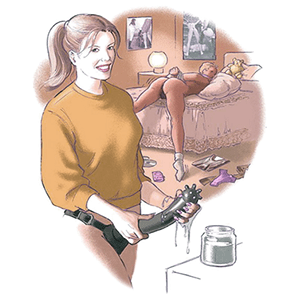
Orgasm control, also known as ‘edging,’ ‘peaking,’ ‘surfing,’ and by other terms, is a sexual technique which involves the maintenance of a high level of sexual arousal for an extended period of time before reaching orgasm. If orgasm is not reached after the extended period of arousal, it is referred to as ‘erotic sexual denial.’
If the partner whose orgasm is being controlled, sometimes referred to as the submissive partner, is put into physical restraints, the better to control the orgasm, the activity is sometimes called ‘tie and tease,’ and if orgasm is denied it is ‘tease and denial.’ Additional possibilities include the dominant partner subjecting the submissive partner to a forced orgasm(s). Orgasm control can involve either one sex partner being in control of the other partner’s orgasm, or a person delaying their own orgasm during sexual intercourse or masturbation.
read more »
Posted in Sex |
1 Comment »
July 24, 2011

Promession is an ecologically-conscious method for disposing of human remains by freeze drying. It was invented and patented in 1999 by Swedish biologist Susanne Wiigh-Mäsak. The method begins by reducing the body of the deceased to a fine powder, thereby allowing subsequent decomposition to be aerobic. This is achieved by submerging the body in liquid nitrogen, making the remains so brittle that they shatter into a powder as the result of slight vibrations. The powder is then dried, reducing the deceased remains to around 30% of their original body weight. Next, an electromagnet pulls out metals within the powdered remains (including mercury, which is only magnetic at cryogenic temperature, which are recycled. Finally, the powder is buried shallowly in a biodegradable cornstarch box. Seeds planted in the soil draw nutrients from the remains. Below two feet, at the depth which coffins are traditionally buried, there is no oxygen, which is one of the prerequisites for composting or aerobic decomposition to take place. But despite this, the dead are buried at a depth where the oxygen is missing; therefore the deceased are exposed to a negative putrefaction process or anaerobic decomposition.
It is the lack of oxygen combined with the amount of remains that causes the body to not decompose, but effectively putrify in an ordinary burial, With such large bodies, humans always start to rot if not first broken down into smaller parts so that oxygen can reach all body parts. In the past this would have been done by wild animals. It is important to remember that even the powder produced by Promession would not compost at 2 meters below ground, due to the lack of oxygen. The same applies to a body that is above ground or in the upper soil layers with high availability of oxygen. Despite the high oxygen content, the body still putrefies because the body is intact and whole and anaerobic conditions are already present in the gut . It is not enough for one or the other. Proper composting or aerobic decomposition of a corpse requires a combination of fragmentation of the body, oxygen-rich soil and micro-and macro-organisms. Therefore Promession is a modern and ethical manner to transform the body into smaller parts to get it to compost correctly and return to soil without the negative side effects associated with putrefaction.
Posted in Death, Technology |
Leave a Comment »
July 24, 2011


Security theater is a term that describes security countermeasures intended to provide the feeling of improved security while doing little or nothing to actually improve security. The term was coined by computer security specialist and writer Bruce Schneier, but has gained currency in security circles, particularly for describing airport security measures.
Security theater typically involves restricting certain aspects of people’s behavior in very visible ways, that could involve potential restrictions of personal liberty and privacy, ranging from negligible (where bottled water can be purchased) to significant (prolonged screening of individuals to the point of harassment).
read more »
Posted in Politics, War |
Leave a Comment »
July 23, 2011

Kid Carpet, real name Ed Patrick, is a musician from Bristol, England. His music has been described as ‘kiddy disco punk’ and ‘shit-hop,’ as it is recorded in his home studio using instruments such as samplers, Casio keyboards, and various children’s toys including plastic Fisher-Price guitars and Tamagotchi innards.
Posted in Art, Humor, Technology |
Leave a Comment »
July 23, 2011

Retrotronics is the making of electric circuits or appliances using older electric components, such as vacuum tubes, Nixie displays, relays, uniselectors, analog meters, etc. These are usually chosen for their aesthetic qualities, rather than their utility. Retrotronics is a popular strand within the steampunk movement. At the Oxford exhibition of Steampunk art, many of the works had a strong retrotronic influence, from light fittings of period components to computer keyboards and webcams of burnished copper and brass. Outside steampunk, similar influences are found amongst the retro-futurist scene.
A recent musical trend has sought to recapture early 1980s 8-bit game and synthesizer sounds, often referred to as Chiptune. Artists such as Kid Carpet perform entire sets on children’s toys or pocket synths of the period. Other artists, such as Nullsleep, perform using only period video game hardware. DJs offer dance music events built from samples of period games or gadgets.
read more »
Posted in Art, Money, Technology |
Leave a Comment »
July 23, 2011

A death pool (or dead pool) is a game of prediction which involves guessing when someone will die. A typical pool might have players pick out celebrities who they think will die within the year. There are also several scoring variants. For example, a player might be rewarded few, if any, points for predicting the death of someone who is over 80 years old or is known to be suffering from a terminal disease. Another common method to calculate score is subtracting the celebrity’s age from 100. Other pools require participants to form a list ranked on how sure they are that a person on the list will die, with points given based on how high a person on their list is ranked, and others award points based on how many other contestants selected the deceased celebrity. Another variant on the game has a single point awarded for each correct prediction, regardless of the celebrity’s age or medical condition. The advantage of this scoring method is that there is more scoring, and it rewards research (learning which celebrities are experiencing failing health) rather than luck.
Definitions of celebrity vary from contest to contest. Smaller pools may rely on consensus of the players as to who is famous. Others require an obituary to appear in a recognized newswire such as the Associated Press or Reuters. The Lee Atwater Invitational Dead Pool employs a Fame Committee consisting of non-contestants who assess ahead of time the name-recognition of each celebrity. The Rotten.com Dead Pool, the largest in the world, uses the Notable Names Database (NNDB) as its source of qualified celebrities, and as arbiter of their life status.
Posted in Death, Games, Money |
Leave a Comment »
July 23, 2011

Dieselpunk is a sub-genre of the pop surrealist art movement, as well as a budding subculture, that combines the aesthetics of the interbellum period through the early 1950s with postmodern technology and sensibilities. First coined in 2001 as a marketing term by game designer Lewis Pollak to describe his role-playing game ‘Children of the Sun,’ dieselpunk has grown to describe a distinct style.
The name ‘dieselpunk’ is a derivative of the 1980s science fiction genre cyberpunk, and is used to represent the time period – or ‘era’- when diesel-based locomotion was the main technological focus of Western culture. The ‘-punk’ suffix attached to the name is representative of the counterculture nature of the genre with regards to its opposition of contemporary aesthetics. The term also refers to the tongue-in-cheek name given to a similar cyberpunk derivative, ‘steampunk,’ which focuses on science fiction set within the Victorian era.
read more »
Posted in Art, Language, Technology |
2 Comments »
July 22, 2011

Steampunk is a sub-genre of science fiction, alternate history, and speculative fiction that came into prominence during the 1980s and early 1990s. It involves a setting where steam power is still widely used—usually the Victorian era Britain—that incorporates elements of either science fiction or fantasy.
Works of steampunk often feature anachronistic technology or futuristic innovations as Victorians may have envisioned them; based on a Victorian perspective on fashion, culture, architectural style, art, etc. This technology may include such fictional machines as those found in the works of H. G. Wells and Jules Verne.
read more »
Posted in Art, Language, Technology |
Leave a Comment »



 The Daily Omnivore